 Environment

Lotte, Phát Đạt combine strengths in Thu Thiem project
1.
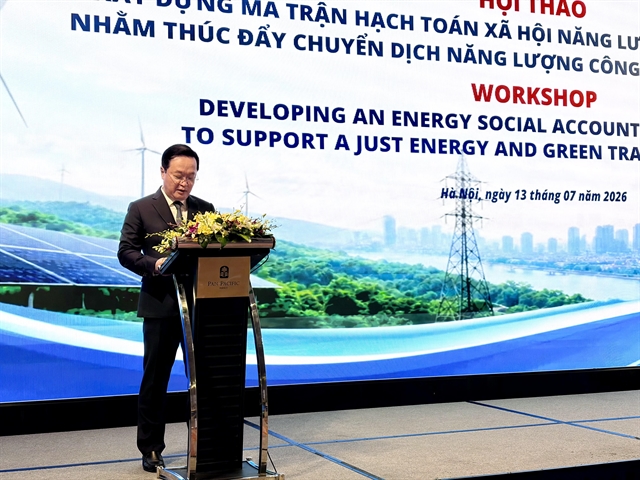 |
| Nguyễn Đức Trung, Deputy Head of the Central Policy and Strategy Commission speaks at the workshop on Monday in Hà Nội. — VNS Photo Nguyễn Hằng |
HÀ NỘI — Improving energy efficiency by 10 per cent could lift Việt Nam’s gross domestic product (GDP) by about 1 per cent, while reducing energy consumption and greenhouse gas emissions and increasing disposable incomes across all household groups.
These findings are drawn from a research announced at a workshop on Monday by the Institute for Policy and Strategy Studies under the Central Policy and Strategy Commission and the United Nations Development Programme (UNDP).
It found that well-designed energy transition policies can deliver economic, environmental and social benefits simultaneously.
The conclusions are based on a series of policy scenarios tested using a new suite of analytical tools designed to support evidence-based policymaking.
The tools enable policymakers to assess how different energy transition measures could affect economic growth, emissions and household incomes, including those of the most vulnerable groups.
At the core of the analytical framework is a new Energy-focused Social Accounting Matrix (ESAM), a comprehensive dataset that maps the relationships between production, energy use, household income and emissions within a single analytical framework.
The ESAM was developed by the institute in collaboration with the University of Copenhagen, the National Statistics Office under the Ministry of Finance and UNDP Việt Nam.
The model also examined the effects of higher electricity prices, which can quickly ripple through the economy given electricity's central role in production.
It found that a 10 per cent increase in electricity prices would have the greatest effect on manufacturing and processing industries, along with other energy-intensive sectors, leading to higher production costs across supply chains.
The study also reveals significant differences in household impacts.
Urban non-farm households are among the most affected, while rural farm households are the least affected, reflecting differences in consumption patterns and exposure to energy-intensive goods and services.
The findings underscore the need for support measures to protect vulnerable groups while preserving economic competitiveness during the energy transition.
Researchers also assessed policy options involving more complex economic and social trade-offs.
The model suggests that a tax of US$15 per tonne of carbon dioxide equivalent could reduce emissions by approximately 2.9 per cent by increasing the relative cost of carbon-intensive activities.
However, GDP could decline by around 0.8 per cent and, in the absence of compensatory measures, household incomes could fall across income groups.
The findings highlight the importance of carefully designing carbon pricing policies that reduce emissions while protecting vulnerable households and ensuring a just transition.
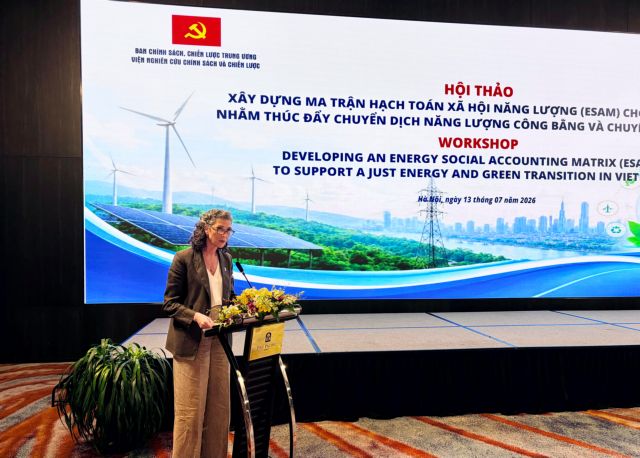 |
| UNDP Resident Representative Ramla Khalidi delivers addresses the workshop. — VNS Photo Nguyễn Hằng |
High appreciation
Nguyễn Đức Trung, Deputy Head of the Central Policy and Strategy Commission, praised the research, saying the new dataset and analytical tools would strengthen policy research, forecasting and advisory work.
He also said he highly appreciates the close collaboration between the institute, UNDP Việt Nam, the National Statistics Office, and the Development Economics Research Group at the University of Copenhagen in developing this dataset and analytical toolkit to support policymaking.
"I am confident that these research outcomes will be effectively utilised to enhance the quality of policy research, forecasting and advisory work as Việt Nam implements the Resolution of the 14th National Party Congress and Politburo Resolution No 70-NQ/TW on safeguarding national energy security,” Trung said.
To ensure the workshop delivered practical outcomes, Trung urged experts and delegates to focus discussions on five key priorities.
First, he called for greater attention to the role of data, analytical tools and forecasting capacity in policymaking, including how these resources can be regularly updated and effectively integrated into policy formulation and implementation.
Second, he emphasised the need for solutions to promote energy efficiency and accelerate renewable energy development, while addressing bottlenecks in power transmission, energy storage, system operation, investment mechanisms and electricity market reforms.
Third, he stressed the importance of policies that ensure a just energy transition for rural communities, the agricultural sector and vulnerable groups through improved access to clean energy, support for livelihood transformation and compliance with increasingly stringent international green standards.
Fourth, he highlighted the need to align the energy transition with employment and workforce development by investing in worker reskilling, forecasting labour demand, strengthening job matching and improving the social security system.
Finally, he called for financial policies, carbon pricing mechanisms and resource mobilisation strategies that encourage the green transition while maintaining macroeconomic stability and enhancing the competitiveness of the economy.
"A just energy transition is a long-term undertaking that requires strategic thinking, a cross-sectoral approach and strong implementation capacity," he added.
He said he believes the research findings, together with the discussions at the workshop, will provide valuable scientific evidence and practical insights to support further policy refinement, promote a just and green energy transition, safeguard national energy security and contribute to the country's rapid and sustainable development in the new era.
In her remarks at the workshop, UNDP Resident Representative Ramla Khalidi highlighted the ESAM as a valuable tool for helping policymakers assess the economic, social and distributional impacts of energy-transition policies.
"What this research allows us to do, drawing on Việt Nam's own data, is to see clearly who stands to gain and who stands to lose as the transition unfolds," Khalidi said.
The value of a tool like the ESAM lies in helping policymakers understand these trade-offs and design policies that advance energy security, environmental sustainability and, crucially, equity. Importantly, the ESAM can continue to be applied and updated by Vietnamese institutions as new policy questions arise, she said. — VNS
Environment
 Environment
 Environment
 Environment
 Environment
 Environment
 Environment
 Environment
 Environment
 Environment
 Environment
 Environment
 Environment
 Environment
 Environment