 Inner Sanctum
Việt Nam, Timor-Leste explore cooperation in agriculture and fisheries
1.
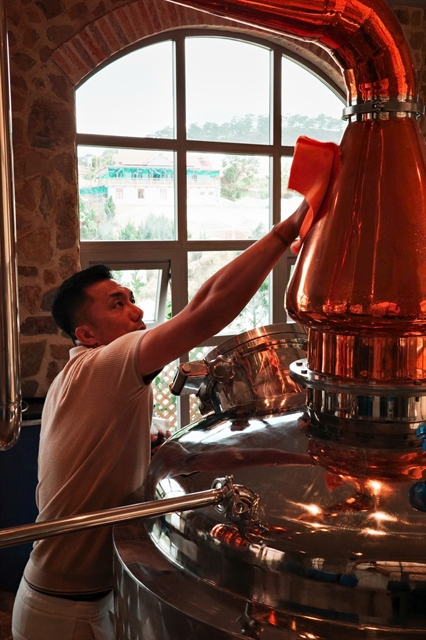 |
| Đoàn Minh Châu checks equipment at a Vietnamese whiskey factory in Đà Lạt. Photo courtesy of Minh Châu |
Đoàn Minh Châu, an overseas Vietnamese information expert, came up with the idea of creating a Vietnamese whiskey brand using local ingredients while spending time in Việt Nam during the pandemic. Châu talks to Việt Nam News reporter Công Thành about the development of his new brand.
How did the idea of creating a Vietnamese whiskey begin?
The idea for Mangline Hills started during the pandemic, when I was spending more time in Việt Nam. One evening, I ordered whiskey at a bar and was disappointed by the quality. It made me wonder why Việt Nam, with such rich agricultural resources, culture and local flavours, did not yet have a whiskey brand that could confidently tell a Vietnamese story.
That question stayed with me. I did not want to simply import an existing style or create a copy of Scotch whisky. I wanted to explore whether we could make a whiskey with its own identity, using Vietnamese ingredients, the local climate, water and flavours that people here could recognise and connect with.
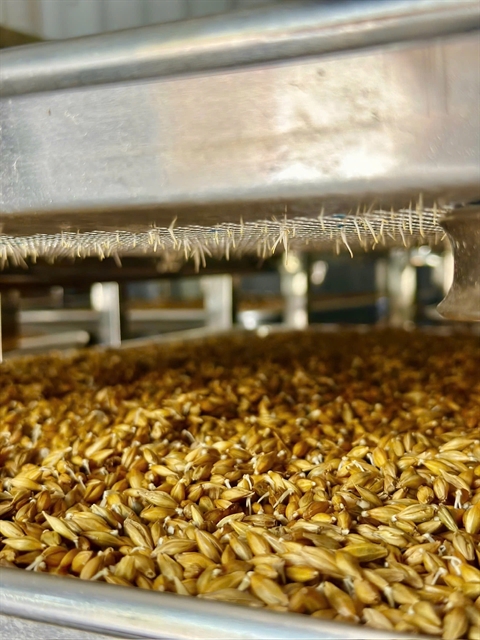
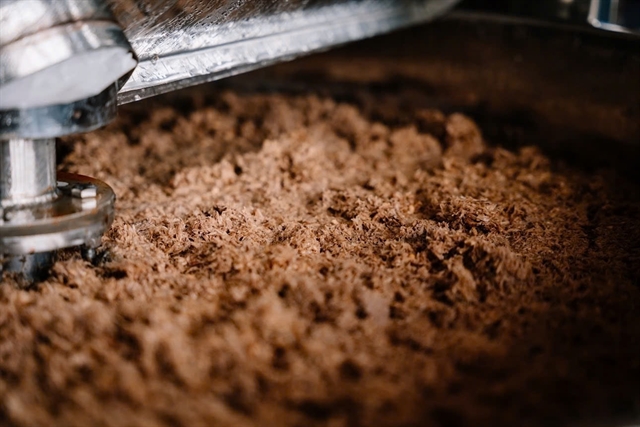
That eventually became Mangline Hills, developed in the Central Highlands city of Đà Lạt with the idea of creating a Vietnamese highland whiskey. Our base recipe combines 50 per cent malted barley and 50 per cent Vietnamese rice, together with highland water. From there, we developed expressions and flavour profiles inspired by familiar Vietnamese ingredients and tastes such as cinnamon, roasted coffee, ginger, honey, citrus and herbs.
Coffee is particularly meaningful because it is deeply connected to Việt Nam and to the Central Highlands. For us, incorporating those familiar aromas is another way of allowing the whiskey to reflect the place where it is created. For me, it was never only about making an alcoholic beverage. The bigger question was always: if Việt Nam had its own whiskey, what story should it tell?
 |
| Ingredients such as Vietnamese rice, cinnamon, coffee, ginger, honey and local herbs provide a vocabulary through which Mangline Hills seeks to tell a distinctly Vietnamese story through whiskey. — Photo courtesy of Đoàn Minh Châu |
How is Mangline Hills being developed in Đà Lạt today?
Đà Lạt felt like a very natural home for the brand. The cool climate, pine forests, misty hills, highland water and strong agricultural identity of the region all create an environment that connects naturally with whiskey. The Central Highlands are also closely associated with Vietnamese coffee culture, which gives us another important source of inspiration.
We also use highland water and incorporate Vietnamese ingredients and flavour influences throughout the range. For example, our Classic expression carries notes of cinnamon, roasted coffee and dried fruit, while Cinnamon draws inspiration from Vietnamese cinnamon. Honey Ginger reflects familiar flavours such as honey, ginger and citrus, while Cool Mint brings a fresher herbal character.
When we develop new products, we always ask whether there is a meaningful connection to Việt Nam rather than simply adding flavours for marketing purposes. For us, ingredients such as Vietnamese rice, cinnamon, coffee, ginger, honey and local herbs provide a vocabulary through which we can tell a distinctly Vietnamese story in whiskey.
The Single Cask project is particularly important to us. We currently have a limited number of 100-litre barrels ageing, and we are allowing them more time rather than rushing them to market. The flavour direction we are developing includes smoky, spicy and citrus characteristics.
Commercially, we are focusing on hospitality channels such as restaurants, cocktail bars, hotels, tastings and selected retail partners. I believe whiskey is a product people should experience first, not simply see on a shelf.
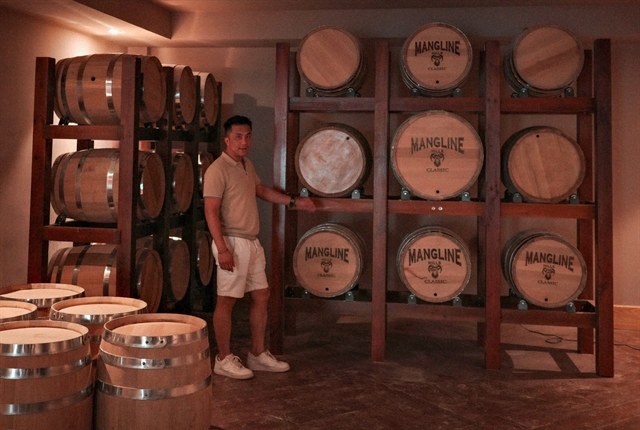 |
| The Single Cask whiskey range is ageing in barrels at the Mangline Hills Whiskey distillery in Đà Lạt. — Photo courtesy of Minh Châu |
How is progress going so far in terms of growth?
Production capacity and the sourcing of ingredients for Mangline Hills have been developed in Đà Lạt as a long-term investment rather than simply as a product launch.
To date, we have invested approximately US$880,000 in the project, including production infrastructure, R&D, distillation, barrel ageing, bottling and product development. Our production facility in Đà Lạt covers approximately 2,000sq.m, with a current production capacity of around 12,000 litres per year.
We do not currently operate our own agricultural growing area. Instead, we procure our raw materials directly through a network of suppliers. In total, the distillery currently uses around 12 tonnes of agricultural ingredients per year.
We hope to build longer-term relationships with suppliers and gradually increase the value created around Vietnamese agricultural products.
For me, the goal is to create a premium product in which more of the economic value, from ingredients and production to packaging, hospitality and tourism, can remain within Việt Nam.
 |
| The Vietnamese highland whiskey is made from a base recipe of 50 per cent malted barley and 50 per cent Vietnamese rice, together with highland water. — Photo courtesy of Minh Châu |
How does Mangline Hills contribute to a Vietnamese-made value chain?
Our approach at this stage is to work with selected suppliers and procure the ingredients required for each production cycle. As the business expands, one of our ambitions is to create more stable demand for Vietnamese agricultural products.
Việt Nam is already known internationally for products such as rice, coffee, cinnamon, ginger and many other agricultural ingredients. The opportunity, in my view, is to take some of these familiar ingredients and incorporate them into premium finished products with stronger branding and greater added value.
Mangline Hills is currently developing its market primarily through restaurants, hotels, cocktail bars, tastings and selected retail partners in Việt Nam. We also work with hospitality partners on staff training, cocktails, tasting experiences and food pairing because I believe whiskey needs to be experienced and explained, especially when introducing a new concept such as Vietnamese whiskey.
In the longer term, we are also exploring international opportunities. The value chain we hope to build can be described as Vietnamese agriculture, production and distillation, ageing, Vietnamese branding and packaging, hospitality and tourism and international markets.
If a bottle of Mangline Hills eventually reaches consumers abroad, I hope it represents more than just our company. I would like it to carry with it a small part of the story of Đà Lạt and Việt Nam.
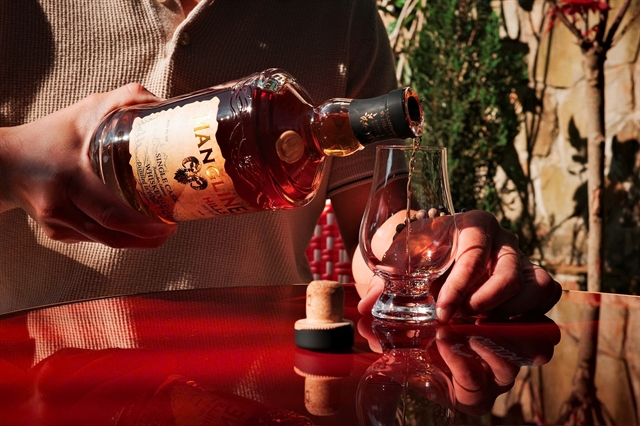 |
| If a bottle of Mangline Hills reaches consumers abroad, it represents more than just the company; it carries with it a small part of the story of Đà Lạt and Việt Nam. Photo courtesy of Mangline Hills Whiskey |
How has your past shaped this journey?
I was born in Hà Nội, although I left Việt Nam when I was still very young. Because of that, my connection with Hà Nội is strongly associated with family, relatives and the feeling of returning to the place where I was born.
I later spent an important part of my childhood growing up in Warsaw, Poland. Growing up outside Việt Nam while maintaining Vietnamese roots gave me an interesting perspective on identity. When you live between different cultures, you sometimes become even more conscious of where you come from.
Later, I moved to the United States and lived in California, where I studied IT and computer science. I began working in the US in 2005, primarily in the technology sector. Working in technology gave me a mindset that has influenced the way I approach Mangline Hills today: experimentation, problem-solving and continuous improvement.
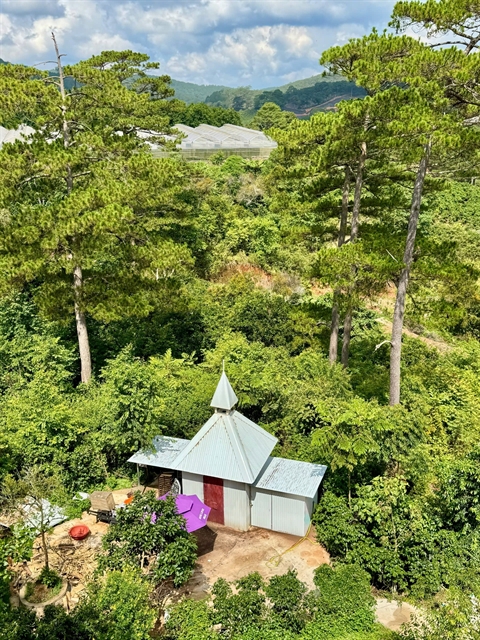 |
| Đà Lạt felt like a natural home for Mangline Hills. The cool climate, pine forests, misty hills, highland water and strong agricultural identity of the region create an environment that connects naturally with whiskey. Photo courtesy of Minh Châu |
Developing whiskey is obviously very different from working in technology, but there are similarities. You experiment, collect information, make adjustments and sometimes have to start again when something does not work. At the same time, my years abroad made me appreciate Vietnamese identity much more strongly.
When I eventually started developing Mangline Hills, I did not want to simply reproduce something that already existed elsewhere. I wanted to take the experience and perspective I had gained internationally and apply them to something genuinely connected to Việt Nam.
In that sense, the philosophy behind Mangline Hills can be summarised quite simply: international thinking, Vietnamese roots. — VNS
Inner Sanctum
 Inner Sanctum
 Inner Sanctum
 Inner Sanctum
 Inner Sanctum
 Inner Sanctum
 Inner Sanctum
 Inner Sanctum
 Inner Sanctum
 Inner Sanctum
 Inner Sanctum
 Inner Sanctum
 Inner Sanctum
 Inner Sanctum
 Inner Sanctum