 Inner Sanctum
Int’l cooperation helps address nuclear power workforce shortages
1.
Once again, a new edition of The Story of a Seagull and the Cat Who Taught Her to Fly by Chilean author Luis Sepúlveda (published in Vietnamese as Chuyện Con Mèo Dạy Hải Âu Bay) has captured the hearts of young readers. Translator Phương Huyên talks to Lâm Hạnh about the book's unexpected journey and her enduring passion for nurturing a love of reading.
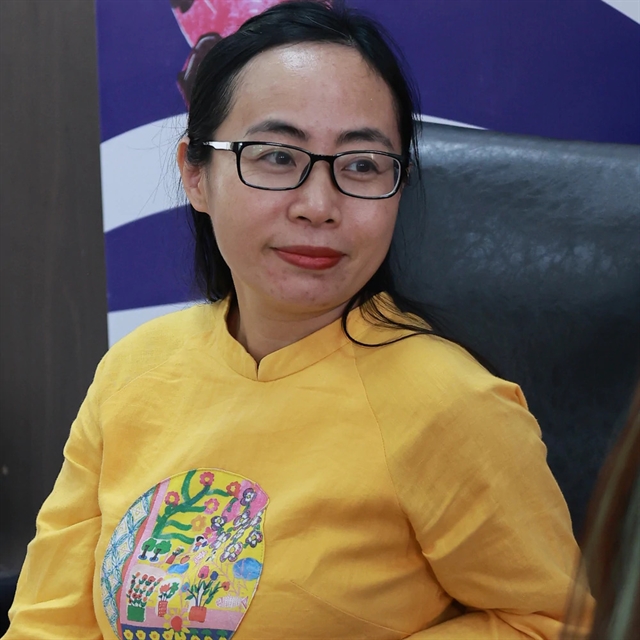 |
| Writer and translator Phương Huyên believes that translating children's literature is not simply about language, but about passing on kindness and hope from one generation of readers to the next. — Photo courtesy of thethaovanhoa.vn |
Inner Sanctum: How did you come to translate 'The Story of a Seagull and the Cat Who Taught Her to Fly'?
It happened almost entirely by chance. At the time, I was a very young copyright officer at a publishing company, responsible for acquiring the Vietnamese rights to the book. I had never imagined becoming its translator.
A colleague initially accepted the assignment, but after translating only a few pages, she became too busy to continue. To keep the publication on schedule, and because I had always loved children's books, I volunteered to finish the translation.
Looking back, I think the book simply found its way to me.
Inner Sanctum: The original was written in Spanish, but you translated it from the English edition. Did that present any difficulties?
Not really. Perhaps one reason was that I was young enough to be fearless. Sometimes youth gives you the confidence to take on challenges without overthinking them.
There's another reason, too. Luis Sepúlveda wrote the novel while living in Germany, and the story itself is set there. Although it comes from a Chilean writer, the emotions and values it conveys always felt universal to me. That universality made the journey into Vietnamese feel quite natural.
The author never questioned or requested changes to my translation, so I've always believed he trusted translators and embraced the idea that stories can travel freely across languages.
Inner Sanctum: How much of yourself did you invest in translating such a small book?
In terms of time, exactly two weeks. I translated it every evening after finishing work at the office.
Emotionally, though, it never felt like work. I love cats, harbours and fables written for children, so translating the book was as relaxing as watching a wonderful film at the end of a long day.
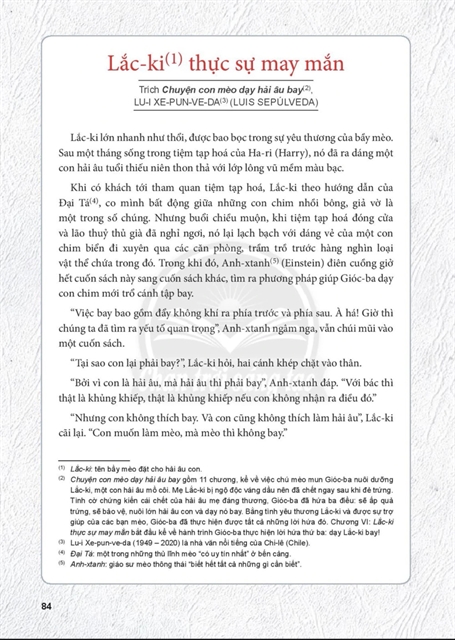 |
| This chapter was selected for the 'Grade 6 Vietnamese Language' textbook in the Knowledge Connects with Life series, introducing generations of Vietnamese students to Luis Sepúlveda's timeless story. — Photo courtesy of thethaovanhoa.vn |
Inner Sanctum: One chapter from your translation is now included in the 'Grade 6 Vietnamese Language' textbook. Did you ever imagine that would happen?
Never. As a translator, I could never have predicted that one day part of this book would appear in a school textbook. If I were teaching the class myself, I'd probably tell the students, "Now go and read the whole book".
That said, I think the textbook editors made an excellent choice. Even students who don't have time to read the complete novel can still discover something meaningful through this chapter. Its message of accepting and loving one another despite our differences comes across very clearly.
More importantly, I believe children can recognise themselves in Lucky's story – their fears, their self-doubt and the uncertainty they face as they grow up.
Through the story, they may begin to understand that identity is both simple and complex, and that kindness and compassion can become an anchor when life feels uncertain.
When I translated that chapter, I often felt as though someone was gently patting me on the back. Because whether we're children or adults, we all need to be reminded from time to time that kindness is real, and that love is something we can always choose.
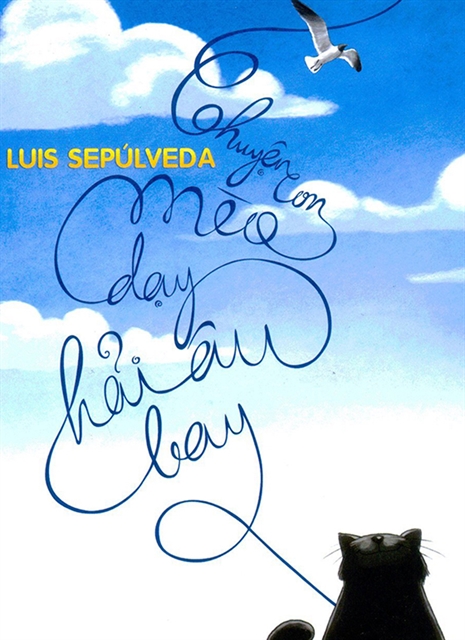 |
| 'The Story of a Seagull and the Cat Who Taught Her to Fly', written by Luis Sepúlveda and translated by Phương Huyên, has sold more than 100,000 copies in Việt Nam since its first release in 2011. — Photo courtesy of nghelatham.com |
Inner Sanctum: Luis Sepúlveda wrote several books for children. Why did you translate only this one?
(Laughs.) That's a question for the publisher rather than me. By the time the rights to his other books were acquired, my career had already taken a different direction. I had begun writing my own books and was becoming increasingly involved in professional communications, so my schedule became much busier.
To be honest, the publisher had already experienced what it was like waiting an entire year for me to submit a translation, so they probably weren't eager to ask me again. But if you think about it, I was only given Chuyện Con Mèo Dạy Hải Âu Bay because someone else had been too busy to finish it.
Perhaps every translation has its own destiny. Each one arrives for the right person at the right moment, and every project is also an opportunity for a younger translator, just as it once was for me.
Children's books have always carried an unspoken promise that things will somehow turn out well, that miracles remain possible. They remind us that hope is never entirely out of reach. That's why, to me, translating children's literature is a source of comfort.
Inner Sanctum: What guides your choice of books to translate?
I don't really have a fixed set of criteria. More often than not, I translate a book simply because it speaks to whatever I'm interested in at that particular stage of my life. At different times, I've translated children's books, books on cinema and, more recently, works of philosophy.
But regardless of the subject, I always ask myself one simple question: Can I do this book justice?
Inner Sanctum: You now teach at several universities and are actively involved in promoting reading in the community. Do these activities inspire you to continue translating?
My love for education, books, creativity and contributing to the community has always been there. Those have been the constants throughout my life. What changes is simply the form they take.
So I wouldn't say that teaching or community projects directly inspire me to translate. Rather, they complement one another and allow me to experience these values from different perspectives.
Interestingly, most of my students don't even know that I translate or write books. For me, translation has always remained something deeply personal – a quiet space where I can learn, reflect and simply enjoy the process.
Inner Sanctum: Your commitment to promoting reading in the community must have been shaped by the books you read as a child.
I grew up in a small rural town in the early 1990s, where books weren't something you could choose from – they were simply something to treasure whenever you found them.
My home was right next to the town library, so whenever I had a free afternoon, that was where you'd find me. I read everything I could get my hands on.
There were Russian and Vietnamese children's books, picture books from the Nordic countries and France that hadn't yet been translated into Vietnamese, and illustrated adaptations of Chinese classics.
Those books came from very different cultures, yet together they quietly shaped the way I saw the world. They gave me an awareness of how cultures can speak to one another, and inspired me to keep searching for beauty wherever it may be found. More importantly, they strengthened my belief that kindness is something shared across humanity.
That's why I believe children don't read only with words. They also read through their senses.
Since then, my own writing has tended to centre on the simple experiences of childhood and the quiet wonder found in everyday life, rather than adventure or fantasy. — VNS
Inner Sanctum
 Inner Sanctum
 Inner Sanctum
 Inner Sanctum
 Inner Sanctum
 Inner Sanctum
 Inner Sanctum
 Inner Sanctum
 Inner Sanctum
 Inner Sanctum
 Inner Sanctum
 Inner Sanctum
 Inner Sanctum
 Inner Sanctum
 Inner Sanctum