 Inner Sanctum
Dream of the visible 1300 years of history in the heart of Hà Nội starts to take shape
1.
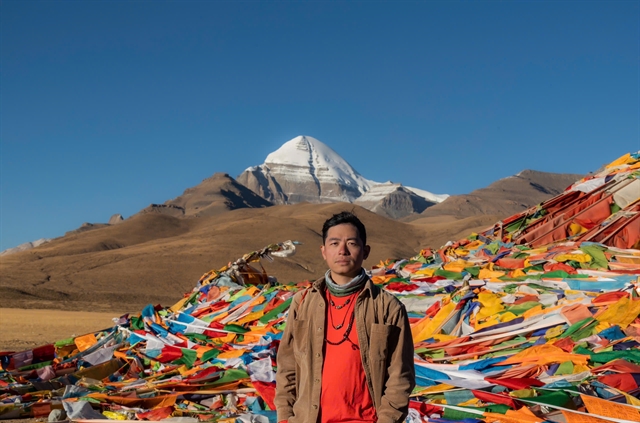 |
| Nguyễn Mạnh Duy during the kora pilgrimage around Mount Kailash in October 2023. The sacred Mount Kailash rises in the background, revered in Himalayan belief systems. — Photos courtesy of Nguyễn Mạnh Duy |
Nguyễn Mạnh Duy, who has conquered three Himalayan peaks above 8,000 metres, including Everest, has published a photo book titled Himalaya: Đất Nước Lửa Khí Không (Himalaya: Earth Water Fire Air Void), the first of its kind by a Vietnamese author. Việt Nam News and Law reporter Lê Hương speaks with him about the work.
What made you dedicate 12 years to the Himalayas and decide to tell that journey through this book?
The Himalayas drew me in and have kept me there, because with every journey I discover something new about the land’s energy. The Himalayas never grow old. They are in constant transformation.
I, too, have undergone profound change, learning lessons and maturing after each trip. And it won’t stop at 12 years; I believe my connection with the Himalayas will only deepen and grow stronger over time.
Why did you choose to combine photography, reportage and reflection instead of creating a purely photographic book?
A photo book satisfies the eye, but it is the story that opens up the imagination. Many readers of this book may have never set foot on the Himalayas. When images are combined with carefully distilled stories and reflections, I believe the book becomes a doorway, leading us into that sacred land.
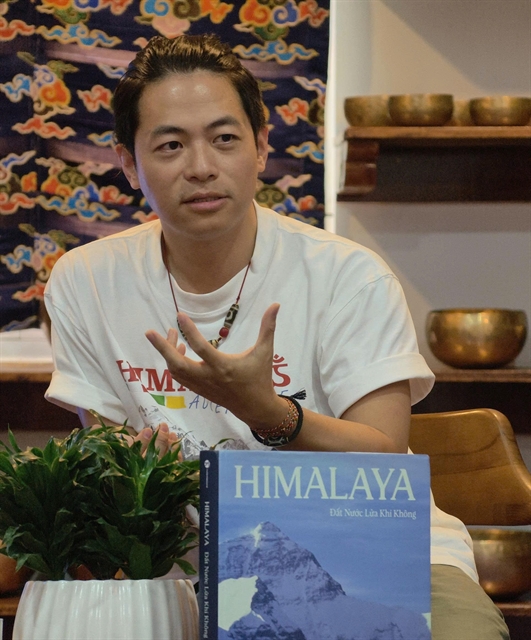 |
| The author at the book launch in Hà Nội. |
What does the title 'Himalaya: Earth Water Fire Air Void' mean, and what is the core message you want to convey?
Earth, water, fire, air and void are the five elements that constitute life. People in the Himalayas believe that all physical phenomena in the universe carry the energy of one of these elements, or a combination of them.
In this book, however, I look at five aspects of Himalayan life – nature, culture, people, lifestyle and belief – through the lens of energy, symbolising them as these five elements.
The book’s message may lie in a mandala, an energy circle that connects, circulates and contains the essence of the Himalayas.
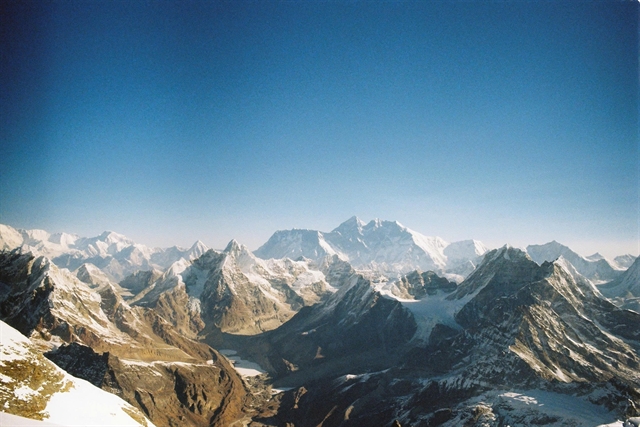 |
| The Himalayas, seen from the summit of Mera Peak (6,476m) in April 2023, stretch endlessly beneath shifting light — a landscape of grandeur and transformation. |
After conquering Everest, why do the Himalayas continue to hold your attention?
Climbing mountains, including Everest, is a journey toward the essence of nature. The peaks of the Himalayas hold treasures, among them the treasure of consciousness.
I do not climb to satisfy my ego; I climb to touch the mountains and feel this extraordinary energy. It is these peaks that have helped me recognise the energy present in nature, culture and people of the Himalayas.
Can you briefly explain the five-element mandala and why it is key to understanding this region?
A mandala is an energy circle where different elements converge and crystallise into a unified whole. The five Himalayan elements represent five pillars of life in this region: nature, culture, people, lifestyle and belief.
But beyond these five facets, I also perceive the natural energies of earth, water, fire, air and void, and even deeper still, the identity of this mysterious land. Looking at this mandala, I believe readers can find a gateway into this Himalayan energy space.
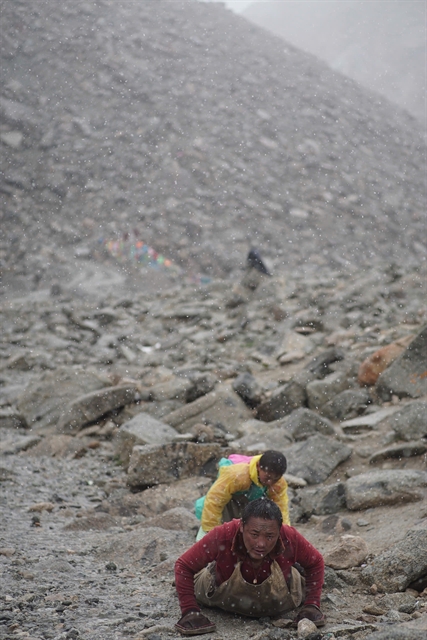 |
| A father and son perform full-body prostrations every three steps along the kora pilgrimage around Mount Kailash in May 2017, reflecting the profound faith of the Himalayan people. |
Among the thousands of moments you captured, which experience or image made you feel the Himalayas most vividly come alive?
Every image in this book is a condensed moment of connected energy. Over 12 years, I have lived through countless stories and encountered both extraordinary and ordinary people of this land.
Perhaps the most unforgettable image is of a Tibetan father and son prostrating in snow and rain at the foot of Mount Kailash. In that moment, I saw an unshakable faith and a human journey of constant transformation in the Land of Snow.
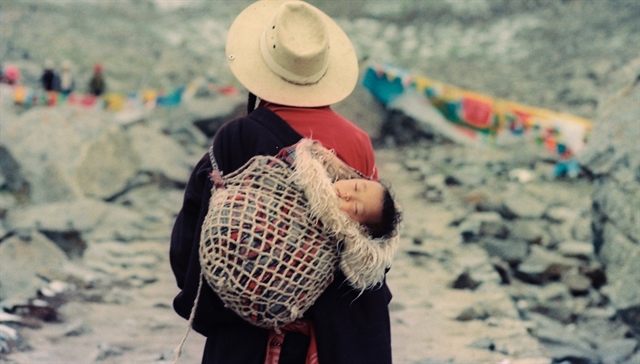 |
| A father carrying his young child on his back during the kora pilgrimage around Mount Kailash in August 2017. |
What change do you hope Vietnamese readers will experience in their perception of the Himalayas, and more broadly of spiritual life, after reading this book?
Many Vietnamese people also share a deep bond with the Himalayas. I believe that anyone who comes to the Himalayas undergoes a unique journey. I am always eager to listen to and learn from those who have such profound connections with this land.
Even those who have never been there may, in some way, connect with the Himalayas through its culture and beliefs and discover within themselves an inner Himalaya, filled with a quiet sense of longing and resonance.
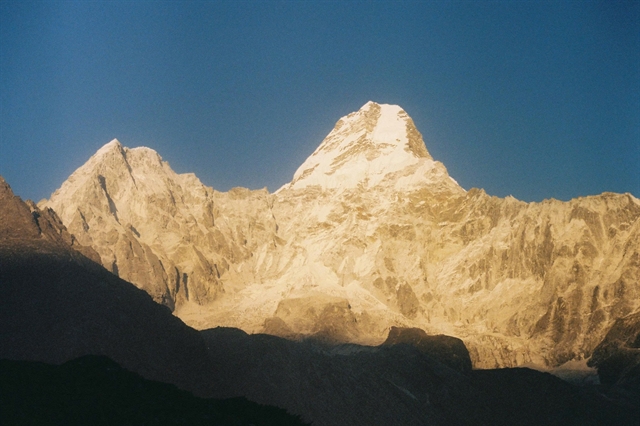 |
| Ama Dablam (6,812m), the iconic peak of Nepal’s Solukhumbu region. |
Do you have any further plans in the Himalayas?
My next journey with the Himalayas will continue to be one of learning and deep commitment. After 12 years, the Himalayas have given me so much, yet this culture still holds countless things to be explored. It is an endless reservoir of knowledge and spiritual energy.
This year, I hope to complete my second book, an adventure travelogue that follows a long journey ascending through the Himalayan peaks. The book will be titled The Road to Everest – A Journey Upward in the Himalayas. I began preparing for it in mid-2025, after fulfilling my dream of standing on the summit of Everest.
Beyond that, my path remains unchanged: to share a balanced way of living through Himalayan singing bowl therapy and inner journeys, alongside cultural spaces inspired by the Tibetan concept of home. VNS
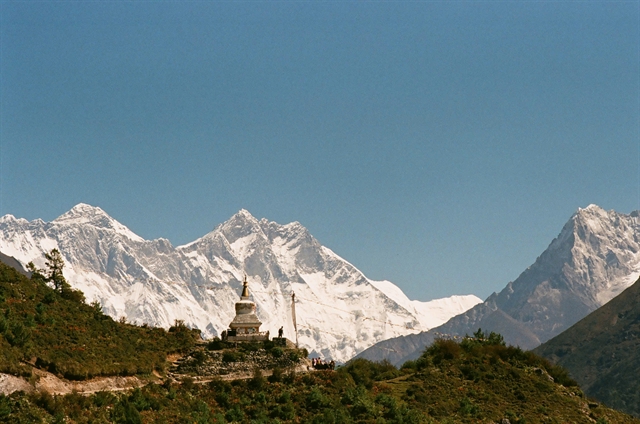 |
| Everest rises alongside the world’s highest peaks in the Himalayas, seen from Namche Bazaar in September 2015. |
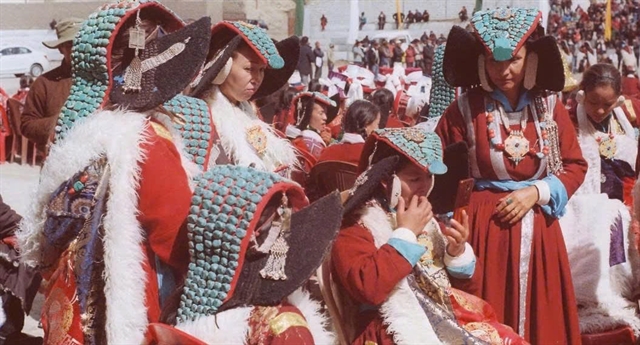 |
| Ladakhi women in traditional attire at an annual festival. |
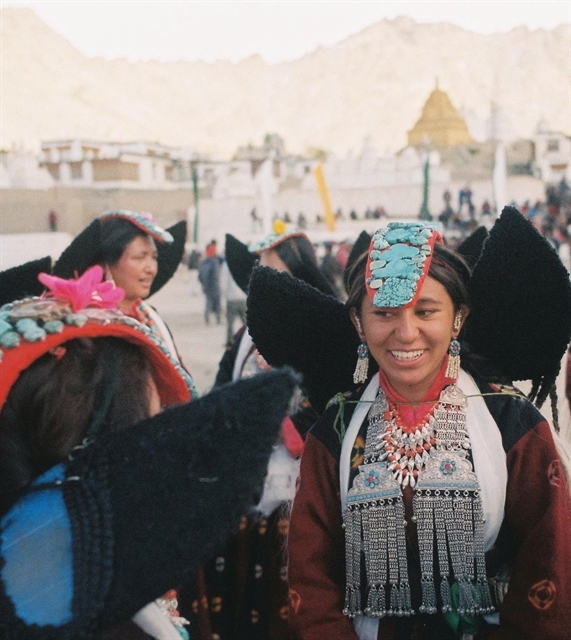 |
| Ladakhi women’s traditional attire is distinguished by the perak, a unique headdress adorned with rows of turquoise stones cascading from the forehead down the back, symbolising family status and wealth. |
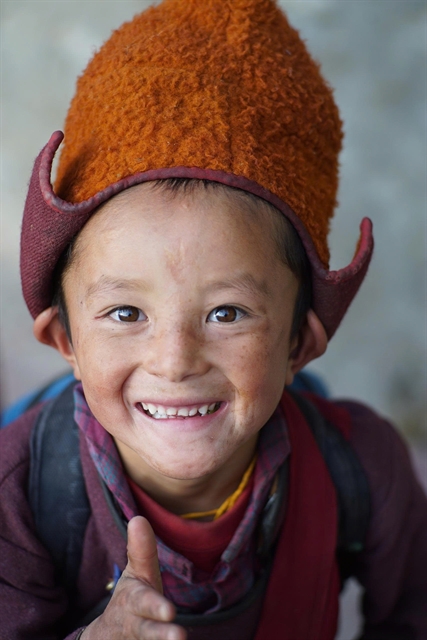 |
| A young Lama at Stongday Monastery after school in August 2017. |
Inner Sanctum
 Inner Sanctum
 Inner Sanctum
 Inner Sanctum
 Inner Sanctum
 Inner Sanctum
 Inner Sanctum
 Inner Sanctum
 Inner Sanctum
 Inner Sanctum
 Inner Sanctum
 Inner Sanctum
 Inner Sanctum
 Inner Sanctum
 Inner Sanctum