 Inner Sanctum
SBV to curb property price inflation, enforce lending rate rules
1.
Living in Finland yet rooted in the gardens of her Vietnamese childhood, writer Trương Huỳnh Như Trân continues to craft tender, lyrical stories for young readers. A screenwriter and member of the Vietnam Cinema Association, she has seen her essay Nếu Em Có Một Khu Vườn enter Grade 4 Vietnamese language textbooks. In this conversation with Lâm Hạnh, Trân reflects on memory, nature and the quiet joy of writing like a child running freely across a meadow.
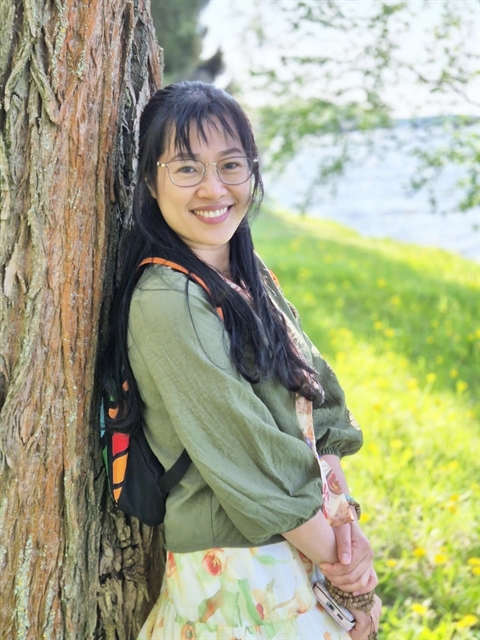 |
| Writer Trương Huỳnh Như Trân now lives in Finland but continues to nurture a literary garden rooted in her Vietnamese childhood. Photos thethaovanhoa.vn |
Inner Sanctum: 'Nếu Em Có Một Khu Vườn' has found its way into school textbooks. How did this essay come into being?
At the time, I was a regular contributor to Thời báo Kinh tế Sài Gòn (Sài Gòn Economic Times). The essay was first published there.
Back then, I lived in a small house in Gò Vấp on the outskirts of Hồ Chí Minh City with a spacious rooftop terrace where I grew vegetables and flowers. While tending to that hanging garden, I often found myself remembering the garden of my childhood in the countryside. After decades of living in the city, I had never stopped dreaming of one day returning to live in a small garden like the one I grew up in.
That dream, together with the deep imprint of childhood memories, became the emotional seed from which the essay later grew.
Inner Sanctum: Do you still remember your emotions while writing it and the memories that resurfaced after it reached readers?
Writing that essay felt like reliving my childhood.
There was the alley by Mrs Sen’s house, covered in bougainvillea blossoms, which I used as a landmark every afternoon on my way home from school. There were jackfruit trees lining the path, whose leaves we turned into spinning pinwheels to run with the wind. There were mango trees, tamarind trees and a backyard filled with wildflowers.
I have never stopped missing that garden. It no longer belongs to me but memory always does. At the time of writing, I recreated it first on paper.
When the collection was later published, I made sure this essay was included as it holds so much of my childhood tenderness.
A few years later, Đỗ Hồng Dương, a lecturer at the University of Social Sciences and Humanities in Hà Nội, happened to read the book while participating in the compilation of primary school textbooks. She contacted me to ask permission to use the text for the Grade 4 Vietnamese language textbook. For the textbook, the essay was slightly shortened to fit the format.
She told me that the editorial team loved its purity and poetic quality. I was deeply moved. It reassured me that there are still eyes that recognise and cherish what is tender and lyrical. I treasure sensitive souls who love nature.
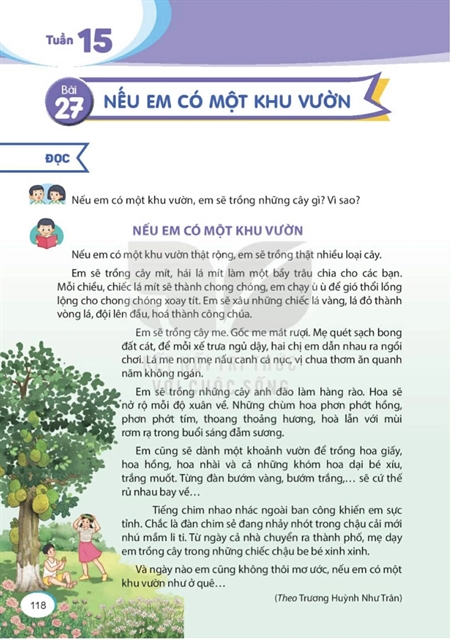 |
| The essay 'Nếu Em Có Một Khu Vườn' (If I Had a Garden) appears in the Grade 4 Vietnamese language textbook, 'Tiếng Việt 4, Volume 1', from the 'Kết nối Tri thức với Cuộc sống' (Connecting Knowledge with Life) series. |
Inner Sanctum: You have long been associated with writing for children and about nature. Is this your way of replenishing a world that seems to lack the breath and fragrance of trees and gardens?
Not exactly.
I began writing for children and about nature because it was my natural stream, not because I set out with a particular mission. No matter where I live, my mind is always filled with the breath of nature, the whispers of trees and the vivid stories of all living things.
I have realised that only when I write about nature do I feel completely immersed, as if the stream never runs dry.
My stories simply exist alongside other urban narratives. City children have many choices. They may choose my stories or they may not.
Only recently have I consciously thought about adding nature to the urban world. I find nature so wondrous and beautiful that I want to tell children about it, like a child who discovers something magical and eagerly shares it with others.
I became even more enthusiastic when I had a companion — when Nghé was born. I wanted to offer my child a world that is pure, fresh and luminous, the kind of world I have always loved.
Inner Sanctum: Your works for children are simple yet shimmering with dreams. The excerpts 'Thuyền Giấy' (Paper Boat) and 'Nếu Em Có Một Khu Vườn' (If I Had a Garden) are examples. Is this deliberate?
Perhaps it is simply because I carry such sparkling dreams within me.
For young souls, I want to bring beautiful stories and crystal-clear dreams, like colourful, glistening candies.
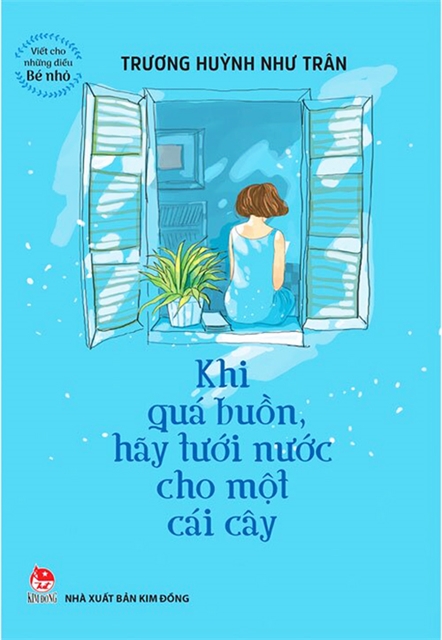 |
| The cover of the essay collection 'Khi Quá Buồn, Hãy Tưới Nước Cho Một Cái Cây' (When You Are Sad, Water a Plant), which won the 2018 Good Book Award, brings together some of the author’s most tender reflections on nature and memory. |
Inner Sanctum: Through writing, do you hope to show children how beautiful Vietnamese can be?
From my earliest pages, I have been very attentive to word choice. I seek words that evoke images, sounds and emotions accurately, yet remain pure and poetic, suitable for children.
It may sound like a strict standard, but if you are a dreamy child while writing, those beautiful words will come naturally.
I deeply admire the prose and sensibility of writer Trần Hoài Dương, who has greatly influenced my style in writing for children.
Inner Sanctum: What is writing to you?
It is the moment I feel like a calf frolicking freely in a meadow.
Inner Sanctum: Have you considered writing for adults, perhaps with wilder or more unconventional pages?
Since Nghé was born, I have been passionately telling children’s stories, introducing my child to my own childhood world and shaping a clear, bright one for them. But it is not only because of Nghé; I cannot blame everything on my child.
Even now that Nghé has grown, I still have not grown up. I remain fascinated by fields, forests and animals.
Writing for children allows me to breathe lightly, to live true to my own age within a space that feels entirely mine.
As for writing for adults, I channel that into film scripts, another part of my work.
Inner Sanctum: After running your own book company, how do you feel about that “spiritual child”?
I realised it was not yet the right time to pursue ambitions beyond writing. There were many things to manage, but my natural inclination is towards creation. So the Nghé Book Company is temporarily paused.
Inner Sanctum: Did working in publishing change your perspective on writing for children or on the children’s book market?
It was actually the other way around. My creative viewpoint has always remained the same. Precisely because of that, I wanted to make books, hoping to bring more meaningful values to young readers.
But when I realised my strength was not in running a company, I returned to the meadow of the little calf. -- VNS
Inner Sanctum
 Inner Sanctum
 Inner Sanctum
 Inner Sanctum
 Inner Sanctum
 Inner Sanctum
 Inner Sanctum
 Inner Sanctum
 Inner Sanctum
 Inner Sanctum
 Inner Sanctum
 Inner Sanctum
 Inner Sanctum
 Inner Sanctum
 Inner Sanctum