 Politics & Law
EVNNPT seeks over $224 mln in bank loans for grid expansion
1.
|
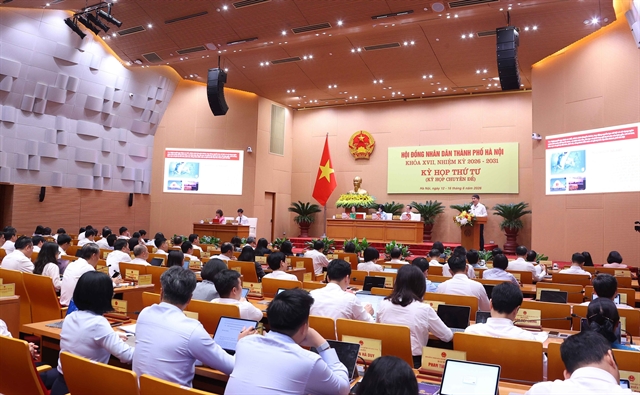
| Participants at the fourth session of the 17th Hà Nội People's Council on Friday in Hà Nội. — VNA/VNS Photo Văn Điệp |
HÀ NỘI — The Hà Nội People’s Council is not aiming to pass resolutions as quickly as possible but is instead placing the highest priority on the quality of every decision.
It aims to ensure that no proposal is rushed through due to time pressures before being thoroughly examined and fully clarified.
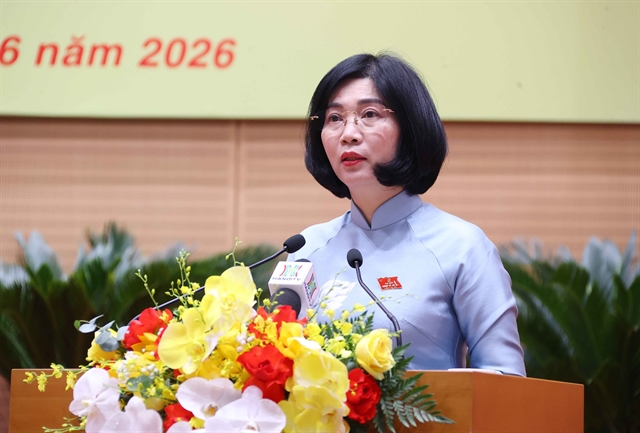
Chairwoman of the municipal People's Council Phùng Thị Hồng Hà made the remarks on Friday morning in Hà Nội as the council opened its fourth session to consider and decide on matters within its authority, most notably a series of resolutions implementing the 2026 Capital Law.
During the session, council members will hold group discussions on 55 draft resolutions covering five areas such as economy and budget, culture and society, legal affairs and urban development as well as science and technology.
The majority are intended to provide detailed guidance for implementing provisions of the 2026 Capital Law.
Hà said the 17th-term People’s Council convened the fourth session following the outcomes of its third sitting to consider and decide on matters prescribed by law.
The resolutions represent a substantial package of new policy mechanisms that will have a direct impact on governance and administration and therefore need to be issued comprehensively, consistently and in a timely manner so they can be implemented immediately once the Capital Law takes effect.
Under a report of the municipal People’s Committee, a total of 55 dossiers and draft resolutions have been submitted for consideration at the session - the largest number ever presented at a single sitting.
The volume reflects the intensive, serious and responsible preparation undertaken by agencies across the city’s political system, she said.
Many of the proposals have been carefully researched and subjected to consultations with experts, academics and central Government agencies, while also reflecting the city’s practical needs.
They have undergone multiple rounds of review by the People’s Council committees to ensure quality before being submitted for approval.
She also added that in response to increasingly demanding standards for legislative quality, the Standing Committee of the council had designed the session agenda to allow more time for debate, policy scrutiny and refinement.
Following presentations by the municipal People’s Committee, council members will devote an entire working day to discussions by sector, focusing on issues that remain subject to differing opinions, new challenges arising from practice, and matters directly affecting residents and businesses.
Based on the views raised during the discussions, the session will allocate a further one-and-a-half days for the People’s Committee to respond to comments, provide explanations and finalise the proposals submitted to the council.
Meanwhile, the council’s units will continue reviewing and consolidating opinions expressed during the session, compare them with the responses and clarifications of the People’s Committee, and identify issues that require further explanation or additional legal and practical justification before being brought back for consideration.
To ensure the session achieves the best possible outcome, Hà urged council members to uphold their responsibility to voters and the people of the capital, carefully study all documents and participate in frank and objective discussions grounded in practical realities and the city’s development needs.
She said that every resolution under consideration is linked to the requirement for immediate implementation once adopted.
Hà added: “The quality of each decision will ultimately be measured not only in the chamber but also through its practical application, its effectiveness in serving residents and businesses, and the tangible improvements it brings to governance and urban development.”
|
| Phùng Thị Hồng Hà, Vice Chairperson of the People's Council of Hà Nội delivers her speech at the fourth session of the 17th-term Hà Nội People’s Council on Friday. — VNA/VNS Photo Văn Điệp |
Special significance
Speaking at the opening session, Vũ Đại Thắng, a member of the Party Central Committee, Chairman of the municipal People’s Committee, said the fourth session of the 17th-term Hà Nội People’s Council carried particular significance.
The session is intended to complete the system of resolutions needed to implement the Capital Law before it comes into force on July 1.
Under the implementation roadmap, the city is required to fully translate all mechanisms and policies contained in the Capital Law into specific regulations.
The council has already adopted several important resolutions. At the current session, it will consider and approve a large number of the remaining measures to complete the legal framework for a new stage of the capital’s development.
“Regarding the breakthrough provisions contained in the resolutions implementing the Capital Law, both the People’s Council and the People’s Committee share the view that the mechanisms and policies will play a particularly important role in Hà Nội’s future development,” Thắng said.
He stressed that the resolutions submitted by the municipal administration are designed not only to address immediate challenges but also to lay the foundations for a modern, proactive and flexible urban governance model suited to the city’s next phase of development.
Thắng added: “Many of the policies have been designed for the first time to grant the city greater authority in implementation, resource allocation and decision-making on development issues specific to the capital.”
The 2026 Capital Law and the accompanying resolutions are expected to open up new development opportunities for Hà Nội.
The resolutions focus on strategic areas such as multi-layered, multi-centre urban development; the effective management and utilisation of land and development space, including underground space; and the establishment of high-tech parks and advanced industrial zones to pilot new economic development mechanisms.
In particular, a number of resolutions covering construction, transport, especially green transport, green energy transition, science and technology, innovation and digital transformation are expected to provide an important foundation for the city’s accelerated development in the years ahead. — VNS
Politics & Law
 Politics & Law
 Politics & Law
 Politics & Law
 Politics & Law
 Politics & Law
 Politics & Law
 Politics & Law
 Politics & Law
 Politics & Law
 Politics & Law
 Politics & Law
 Politics & Law
 Politics & Law
 Politics & Law