 Politics & Law
A bookstore truck on the road
1.
|
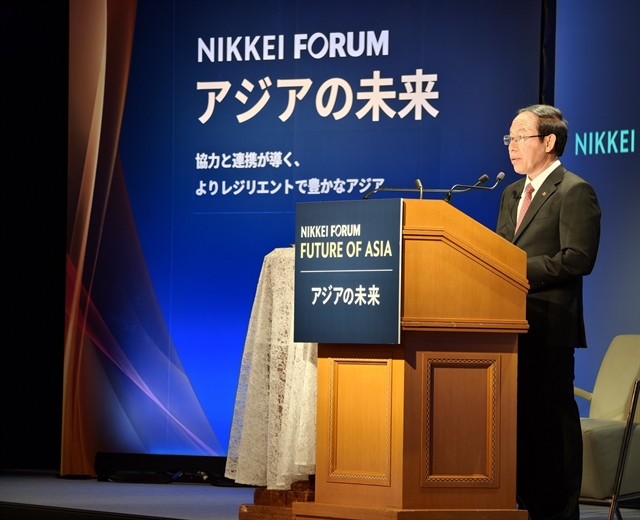
| Deputy Prime Minister Lê Tiến Châu addresses the 31st Future of Asia Conference in Tokyo, Japan on Thursday. — VNA/VNS Photo Bùi Hà |
TOKYO — Deputy Prime Minister Lê Tiến Châu delivered a speech at the 31st Future of Asia Conference in Tokyo on Thursday, highlighting Việt Nam’s vision for regional cooperation and sustainable development amid a rapidly changing global landscape.
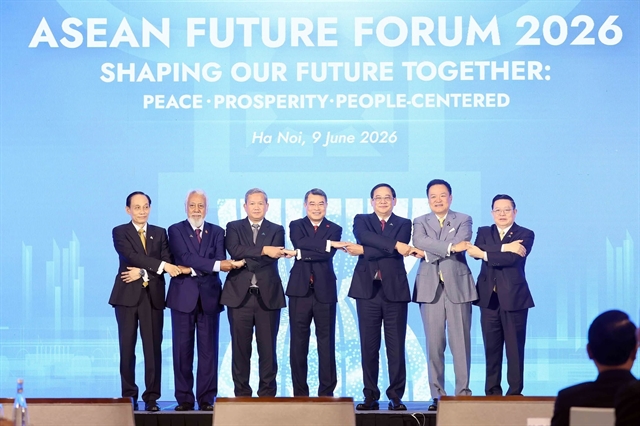
Châu flagged Việt Nam’s recent hosting of the third ASEAN Future Forum, pressing for deeper dialogue to build trust and solidarity so that nations can jointly pursue a better future for all.
Drawing on Asia’s development journey, he outlined three lessons. These include resilience as the bedrock of sustainable development, cooperation as the engine of a stable and open future, and reform and innovation as essential catalysts for economies adapting to a fast-changing era.
Asia has everything it takes to turn challenges into opportunities, Châu said. He pointed to three strategic advantages: its position as the world’s manufacturing and supply chain hub with a record of pioneering supply chain cooperation; powerful domestic growth drivers with a young population, a rapidly expanding middle class and accelerating urbanisation; and the potential to lead the twin shift to digital transformation and green transition.
Against this backdrop, Châu mapped out three cooperation priorities for the years ahead.
First, regional economies should deepen intra-regional integration mechanisms by exploring the early adoption of common supply chain standards covering environmental, social and governance criteria, data security and rules of origin in strategic sectors like semiconductors, batteries, pharmaceuticals and agriculture.
They should also fine-tune institutional frameworks, infrastructure and quality workforce training to support long-term development goals.
Priorities include establishing regional governance frameworks for critical sectors such as digital economy, cybersecurity and finance; pooling resources for cross-border transport, energy and data connectivity projects; and expanding cooperation in talent development.
Finally, Việt Nam called for tighter links among innovation ecosystems and broader access to technology know-how, urging investment in shared research infrastructure, common standards and regulations, and stronger intellectual property cooperation.
Việt Nam’s own development experience has reinforced its understanding of the importance of peace, stability, independence, self-reliance and international partnership, he said.
The deputy PM added that Việt Nam remains steadfast in pursuing a foreign policy of independence, self-reliance, resilience, peace, friendship, cooperation and development, as well as diversification and multilateralisation of external relations and positioning itself as a responsible member of the global community.
Châu said that in its new development phase, Việt Nam will maintain its pursuit of double-digit economic growth and strive to successfully achieve its two centennial goals. To realise these ambitions, the country is focusing on taking several key measures.
The country will work to maintain macroeconomic stability and ensure major economic balances while mobilising and maximising all resources to support its double-digit growth goal.
Việt Nam has also identified a new growth model driven by science and technology, digital transformation and the knowledge economy.
It will continue to improve its legal framework to facilitate and promote development, including significantly improving the investment and business environment, reforming national governance towards a leaner, more effective and efficient system, and accelerating the transition to data-driven governance.
In his remarks, the deputy PM also noted that Japan continues to play an important role in regional and global cooperation architecture.
Meanwhile, Việt Nam–Japan relations are developing rapidly, substantively and effectively across all areas. In particular, during Japanese Prime Minister Takaichi Sanae’s visit to Việt Nam in early May, the two sides agreed to establish new pillars of cooperation in economic security, energy security and food security.
Việt Nam stands ready to be a reliable, proactive and responsible partner in the journey to build a resilient and prosperous Asia where every country has its own place, every citizen has opportunities for development and no one is left behind, Châu concluded.
Following his address, the deputy PM joined a discussion session and answered questions regarding Việt Nam’s growth prospects, institutional and legal reforms, administrative streamlining and workforce development.
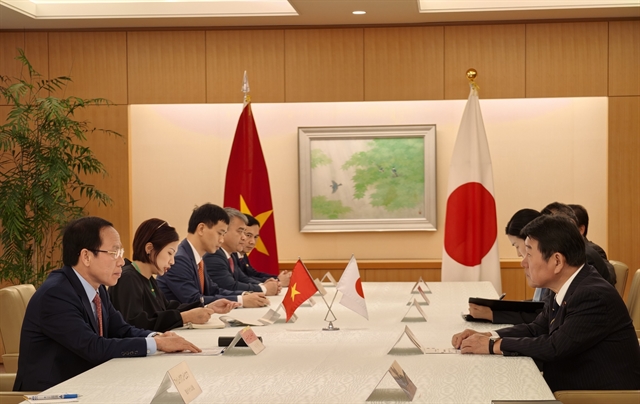
Earlier the same day, Châu held meetings with Lao PM Sonexay Siphandone and Cambodian Deputy PM Sun Chanthol.
|
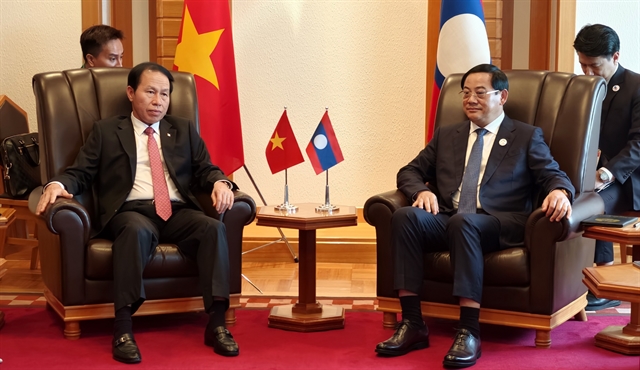
| Deputy Prime Minister Lê Tiến Châu meets with Lao Prime Minister Sonexay Siphandone (right) on the sidelines of the regional forum in Tokyo on Thursday. — VNA/VNS Photo Bùi Hà |
At the meeting with Sonexay, Châu congratulated the Lao PM on his reelection for the 2026-2031 term and, in particular, on the success of his recent official visit to Việt Nam and participation in the ASEAN Future Forum 2026.
The Vietnamese deputy PM welcomed the active and effective implementation of high-level agreements between the two nations and the outcomes of the 48th meeting of the Việt Nam–Laos Intergovernmental Committee in December 2025.
He suggested the two sides further strengthen comprehensive cooperation, particularly improving the quality of education and training collaboration, expediting the signing and implementation of the Laos–Việt Nam Friendship University project, and promoting projects related to high-quality workforce development.
Châu also urged the Lao side to continue creating favourable conditions for the Vietnamese community to live and work stably in the country.
For his part, Sonexay agreed with the proposals and suggested that the two sides coordinate closely in organising activities marking the 65th founding anniversary of Việt Nam–Laos relations.
He noted that education and justice are also among Laos’ current priorities and called for stronger cooperation to deliver tangible results.
The two officials agreed to direct relevant ministries and sectors to accelerate major transport and energy projects, including the Hà Nội–Vientiane Expressway, the Vientiane–Vũng Áng railway, an oil pipeline system and a 500kV power transmission line.
Sonexay confirmed that the Lao Party and Government will continue to create favourable conditions for the Vietnamese community to live and work stably in Laos, and for Vietnamese businesses to operate and expand their investment smoothly, contributing to Laos’s socio-economic development and further strengthening the special Việt Nam–Laos relationship.
|
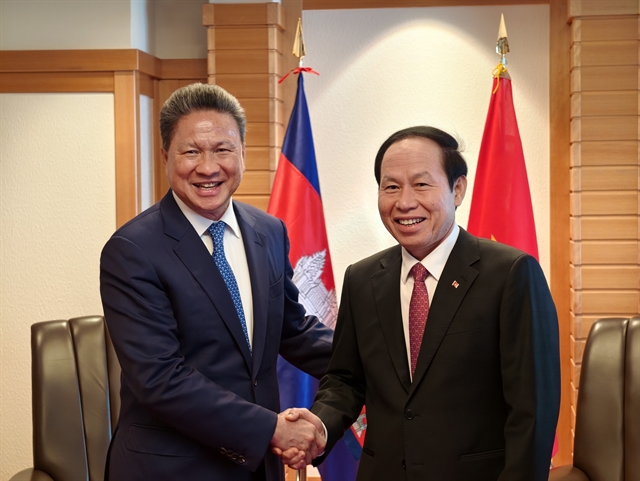
| Deputy Prime Minister Lê Tiến Châu meets with his Cambodian counterpart Sun Chanthol in Tokyo on Thursday. — VNA/VNS Photo Bùi Hà |
At a meeting with Cambodian Deputy PM Sun Chanthol, Châu commented on the significance of Cambodian PM Hun Manet’s recent official visit to Việt Nam and his attendance at the third ASEAN Future Forum, which helped strengthen political trust and deepen the traditional friendship between Việt Nam and Cambodia.
Châu confirmed Việt Nam’s consistent policy of giving high priority to the “good neighbourliness, traditional friendship, comprehensive cooperation and long-term sustainability” between the two countries.
He expressed confidence that under the sound leadership of the Cambodian People's Party, the decisive governance of the Cambodian government, and the unity of its people, Cambodia will continue to achieve strong development across all fields.
The Vietnamese deputy PM called on the two sides to effectively implement outcomes of recent high-level visits, including organising activities to commemorate the 60th anniversary of diplomatic relations between Việt Nam and Cambodia and accelerating the signing of cooperation agreements in education and justice.
He also proposed that the Cambodian government continue creating favourable conditions for Vietnamese citizens to live, study and work in the country.
For his part, Chanthol said Cambodia is stepping up efforts to attract foreign investment and encouraged Vietnamese enterprises to expand their investment in the country.
He also proposed strengthening infrastructure connectivity and promoting the link between the HCM City-Mộc Bài Expressway and the Bavet-Phnom Penh Expressway.
|
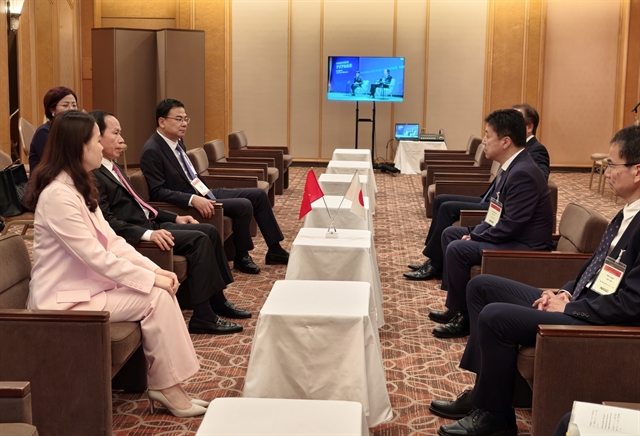
| Deputy Prime Minister Lê Tiến Châu meets with President and CEO of Nikkei Group Nobuhisa Iida in Tokyo on Thursday. — VNA/VNS Photo Bùi Hà |
On the same day, Châu received Nobuhisa Iida, president and CEO of Nikkei Group.
At the reception, Iida said Việt Nam and Japan have significant potential to expand cooperation with other countries in the region.
Given Việt Nam’s strong development prospects, particularly its abundant young workforce, he expressed confidence in the country’s continued economic growth and confirmed Nikkei’s desire to accompany Việt Nam in its socio-economic development process.
Châu stressed that Việt Nam continues to regard Japan as a trusted partner and an important companion that is always willing to share experience, development directions and valuable lessons.
He expressed hope that the Japanese government, localities, organisations and businesses will continue supporting and creating favourable conditions for the Vietnamese community in Japan. — VNA/VNS
Politics & Law
 Politics & Law
 Politics & Law
 Politics & Law
 Politics & Law
 Politics & Law
 Politics & Law
 Politics & Law
 Politics & Law
 Politics & Law
 Politics & Law
 Politics & Law
 Politics & Law
 Politics & Law
 Politics & Law