 Inner Sanctum

42 people hospitalised over suspected gas leak in Hà Nội
1.
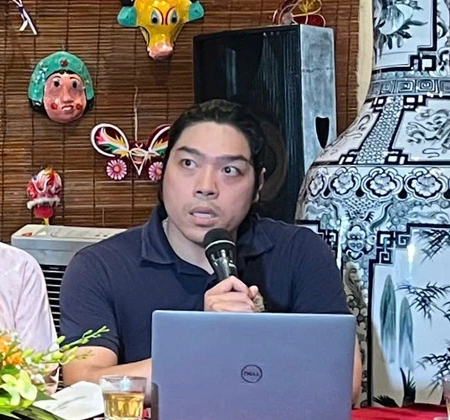 |
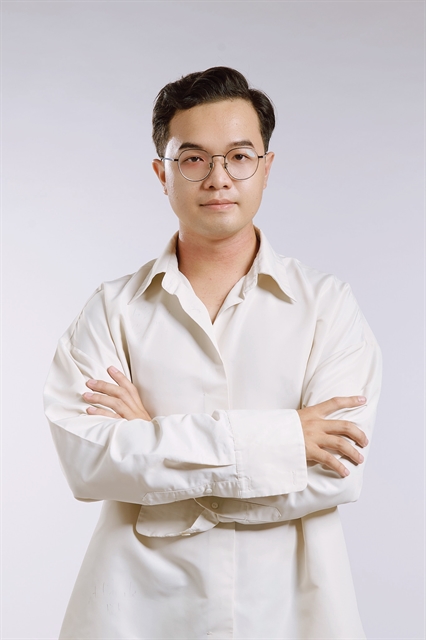
| Art researcher Kevin Vương is working to revive the heritage of Vietnamese traditional toys. VNA/VNS Photos |
Kevin Vương, an independent art researcher known for translating and publishing foreign literary works, has recently turned to reviving traditional Vietnamese toys after noticing that many childhood folk toys are being replaced by mass-produced products. He speaks with Inner Sanctum about restoring a historic lion head and his plans to revive traditional toy heritage.
Inner Sanctum: You have opportunities to access documents about the Vietnamese New Year during the Indochina era in French archives. What made you realise it was your mission to revive traditional toys of Việt Nam?
The Tết (Lunar New Year) and Mid-Autumn Festival are two of Việt Nam's largest celebrations. These are also topics of interest for which there is a fairly diverse collection of documents preserved in French archives.
Upon accessing, studying and analysing each detail in photographic documents and artefacts, I found that many cultural values and heritage sites have been eroded over time.
When traditional crafts with delicate shapes and harmonious colours began to be replaced by gaudy mass-produced items, I felt compelled to act.
This motivation led me to explore the rich treasure trove of folk knowledge and find ways to recreate the distinctive handicrafts of the Vietnamese people.
Inner Sanctum: How did you find the Vietnamese old lion head toy that was kept at the Quai Branly Museum in France? How did the artefact impress you?
When I was working in France, I visited the museum to research Vietnamese traditional lion heads.
That lion head was brought to France in 1931 when staff of the French School of Far Eastern Studies went to collect many Vietnamese Mid-Autumn Festival toys to bring back to France for display.
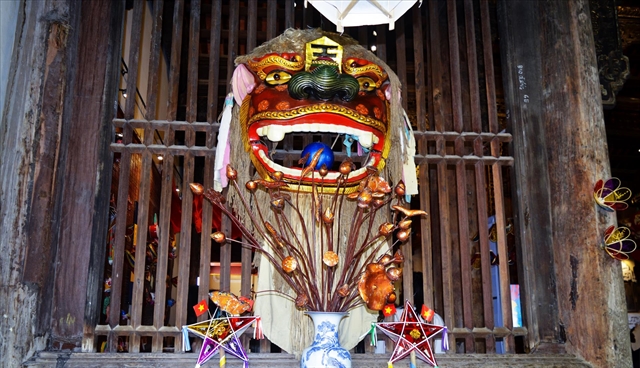 |
| A lion head restored by Kevin Vương is displayed at a recent exhibition at the Kim Ngân Communal House. |
Stored for decades in a museum warehouse alongside many other Asian artefacts, the lion’s head has never been displayed again.
I thought that at the time when the lion head was made Vietnamese folk handicrafts were in their golden age and although influenced by the West they still retained their Vietnamese character and style.
The nearly 100-year-old lion head is evidence of this. It is truly a work of art, not just a toy any more.
It is made of a rattan frame with woven joints reinforced with raw lacquer and the outer layer covered with gilded paper.
The lion head has many interesting details. I was surprised to realise it doesn’t have the eyes of an ordinary lion but rather eyes with carp-like eyebrows, a particularly rare feature on traditional lion heads from northern Việt Nam.
This feature isn’t found on lion heads from central or southern regions. Even the celestial dog heads in Hội An or the lion heads of the Fujian Chinese community don’t have carp-like eyebrows.
In my opinion the reason is that the carp is a symbol that has long been present in East Asian cultures. The carp symbolises good fortune, prosperity and also carries the meaning of wishing success in exams (carp transforming into a dragon), as well as family prosperity and many descendants.
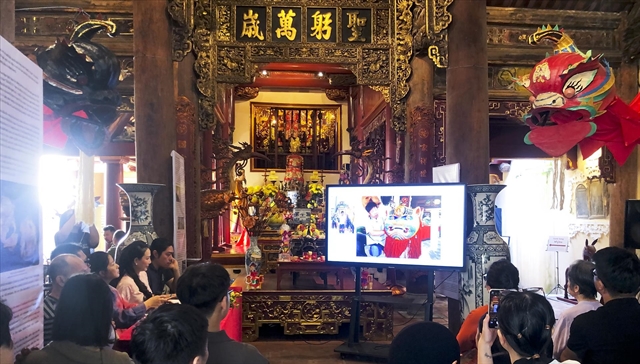 |
| Kevin Vương not only displays his restored lion head but also shares the story behind reviving the artwork with the public at the exhibition. |
The head is made of natural, lightweight yet durable materials typical of the style of Vietnamese craftsmanship. Its horns extend forward, slightly curved and rounded at the tip. Its ears are placed low on both sides and there is a red cloth band covering the nape which flutters during the dance.
Inner Sanctum: Do you face many challenges in restoring the lion head?
I travelled to different places in the Northern Delta region, including Hà Nội’s Old Quarter, particularly Hàng Mã Street, as well as outlying areas such as Hà Đông and localities like the former Sơn Tây and Nam Định provinces where villages once specialised in making papier-mâché lion heads.
Many veteran artisans had abandoned the traditional craft while others turned to producing colourful lion heads with plastic decorations and glitter. Finding a craftsman willing to recreate the traditional rattan or bamboo frame proved really difficult.
The working process was also not easy. It was not simple as paying someone to do the work; we had to sit down and talk with each other. It required collaboration, constant communication and timely adjustments.
The challenge was that only when the lion head was complete could I determine what needed improvement to achieve the desired shape. Therefore, multiple versions had to be tried and refined through trial and error before the best result was achieved.
Inner Sanctum: What message do you want to spread to the audience when introducing the lion head at the recent 'Trăng ta' (Vietnamese Moon) exhibition and a concert by singer Hoàng Thùy Linh?
The exhibition was organised at the Kim Ngân Communal House in Hàng Bạc Street. I wanted people to partly imagine how a traditional toy was associated with cultural beliefs and folk customs in that space.
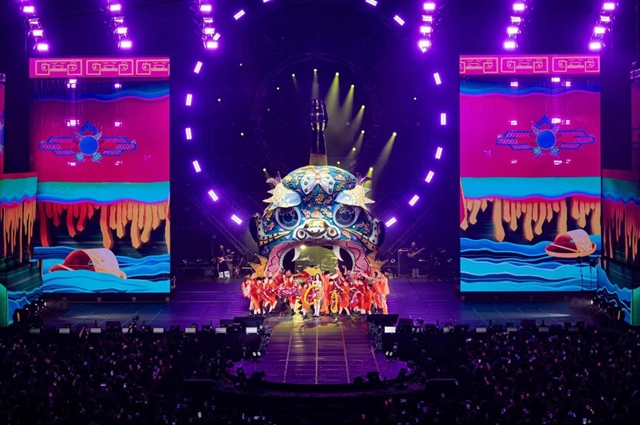 |
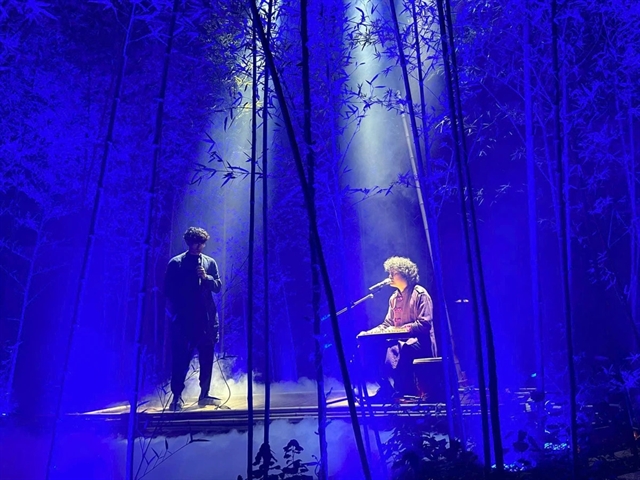
| The lion head also appears at a concert highlighting Vietnamese culture by singer Hoàng Thuỳ Linh. |
Colours on the lion head were made of raw lacquer which was also the main material covering the communal house.
In addition to the display of the lion head, a Mid-Autumn feast tray was prepared to offer to the patron saint of crafts as a reminder of the nation's origins.
The concert by Hoàng Thùy Linh took place on the night of the Mid-Autumn Festival and its theme celebrating Vietnamese culture was the main reason I decided to collaborate.
It was also the first time a traditional Northern Vietnamese lion head had been enlarged to more than six metres for a large stage. Working with such a meticulous and dedicated production team until the very last moment made me feel very happy and proud.
Inner Sanctum: Did you find any image or record related to Vietnamese horses while studying the French archives? Do you plan to restore a work of art related to horses in 2026?
Yes, many. They included tin toys, Hàng Trống and Đông Hồ folk paintings, altar paintings, wooden horses and horse carvings in temples and pagodas as well as stone horses in tombs.
Images of horses appear in many aspects of life and belief. In any context the horse is seen as a loyal and devoted animal, carrying out many arduous tasks with great responsibility. While it symbolises hard work, its majestic appearance also inspires respect and admiration. The horse is often associated with heroes and brave warriors.
I really love horses so I will create a piece specifically for this year. The image of a horse is not unfamiliar to anyone but to create a horse that embodies Vietnamese culture, being both traditional and unconventional, is a challenge.
Inner Sanctum: Do you think that recreating traditional folk toys is a way to bridge cultural gaps?
Recreating traditional toys is not simply an act of nostalgia but a way of healing cultural memories. When folk toys return to modern life they are no longer just museum exhibits. When the roots are well cared for the tree will grow new branches and bear fruit. Culture is a continuous flow and the heritage of one era can become a springboard for creativity and the development of national identity. — VNS
Inner Sanctum
 Inner Sanctum
 Inner Sanctum
 Inner Sanctum
 Inner Sanctum
 Inner Sanctum
 Inner Sanctum
 Inner Sanctum
 Inner Sanctum
 Inner Sanctum
 Inner Sanctum
 Inner Sanctum
 Inner Sanctum
 Inner Sanctum
 Inner Sanctum