 Opinion
Data centre market faces energy challenges
1.
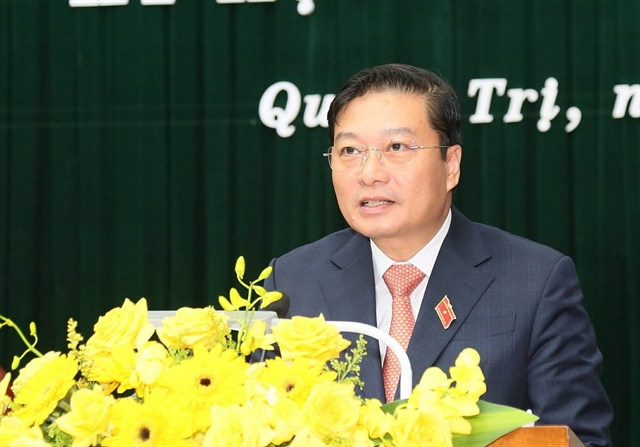 |
| PROVINCIAL PROMISE: Lê Hồng Vinh, deputy secretary of the Provincial Communist Party Committee and chairman of Quảng Trị People's Committee. |
With a development corridor stretching from its coastline westwards, Quảng Trị is strategically positioned to convert its core strengths into new economic drivers, supporting its ambition for marine-led growth. Lê Hồng Vinh, deputy secretary of the Provincial Communist Party Committee and chairman of the Quảng Trị People's Committee, talks about the province's vision to 2045.
Quảng Trị possesses the potential and conditions necessary to develop a strong maritime economy, including a range of marine-based industries. What are the priority areas that could drive breakthroughs and help transform the province into a strong coastal province?
Quảng Trị has entered a new phase of development with expanded space and greater growth potential.
The province has a coastline stretching over 200km, Cồn Cỏ Island Special Zone and abundant fishing grounds, natural resources, landscapes and marine ecosystems. It holds a unique geo-economic position, situated along the North-South axis and serving as the eastern gateway to the East Sea for Central Laos, Northeast Thailand, Myanmar and the Greater Mekong Subregion.
Furthermore, the network of national highways, the Hồ Chí Minh Road, coastal roads, the North-South railway, airports, seaports, coastal economic zones, industrial parks, urban areas and international border crossings has created a distinctive connectivity structure for Quảng Trị.
The most critical task now is to transform these advantages into genuine drivers of growth. First are the maritime economy, seaports and logistics. We aim to establish one or two modern, regionally competitive logistics centres by 2030 and develop one or two maritime fleets to handle import-export cargo and reduce logistics costs to below 12 per cent of GDP.
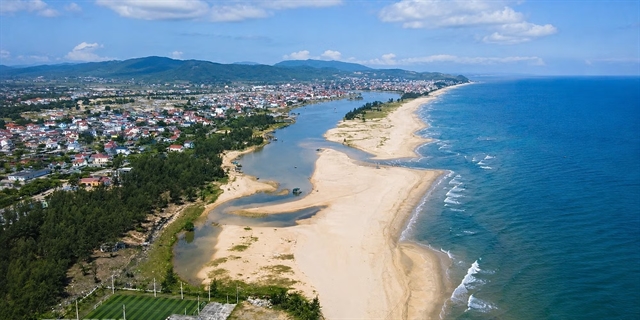 |
| The Lý Hòa estuary area in Đông Trạch Commune, Quảng Trị Province. VNA/VNS Photos |
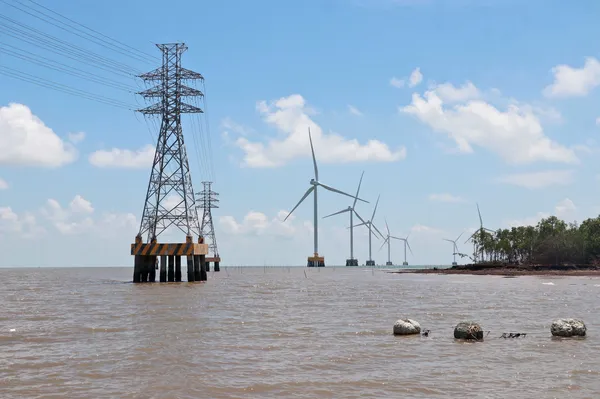
Second are energy and coastal industry, linked to the development of new economic sectors. We aim to develop offshore wind power projects with a total capacity of approximately 5,000MW by 2030; effectively harness oil and gas potential; bring gas from the Kèn Bầu field ashore and implement the Báo Vàng gas pipeline; and gradually establish liquefied natural gas (LNG) centres and energy storage facilities.
The next sectors include tourism, services and coastal urban systems. Within this framework, we aim to establish high-end tourism and resort areas, while developing fisheries, marine aquaculture and a modern marine ecological economy.
We will organise this development around four growth poles. The Hòn La Island to Quảng Trạch area in the north will focus on industry, energy, seaport operations and logistics; the Đồng Hới-Hoàn Lão area will drive the development of urban infrastructure, commerce, healthcare, education, tourism and marine services; the Đông Hà-Cam Lộ area will serve as the southern hub for urban and diversified economic activities linked to Cồn Cỏ Special Zone and the East-West Economic Corridor; and the Southeast Quảng Trị Economic Zone towards Vĩnh Định will develop industry, urban areas and services in conjunction with Mỹ Thủy deep-water seaport.
One of the breakthroughs in Quảng Trị’s marine development is a shift in mindset. Could you elaborate on this?
This is a fundamental matter. Potential alone does not guarantee growth. For Quảng Trị to achieve true marine-led prosperity, we must first reshape our perspective on the ocean, reform our approach to marine governance and reorganise our development space.
Moving forward, Quảng Trị’s guiding strategy will be "Reaching East and Radiating West".
The first part means shifting from a mindset of marine resource exploitation to the proactive creation and governance of marine development space. The ocean must be treated as a strategic development hub and growth driver, a focal point where economic, scientific, defence, security and diplomatic interests align.
Consequently, Quảng Trị will move decisively from fragmented, sector-by-sector management to integrated marine spatial governance. Resource utilisation will be anchored in spatial planning, digital data and technology, while maintaining a strict balance between development and conservation.
This also means step by step expanding the development footprint to the open ocean, deep waters and new maritime areas. It involves developing offshore wind power, high-tech marine aquaculture, oil and gas, maritime logistics, deep-sea technologies and new, high-value-added economic sectors.
But Quảng Trị cannot effectively "Reach East" without a sufficiently strong economic hinterland to the west.
"Radiating West" means that we have to maximise the advantages of the international border gates of Cha Lo, Lao Bảo and La Lay and the transport corridor system comprising National Highways 12A, 9 and 15D.
We need to connect production centres, economic zones and industrial parks within the province with Central Laos, Northeast Thailand and countries in the Greater Mekong Subregion.
A shift in mindset is also evident in the transition from isolated sectoral growth to a unified marine economic ecosystem. Seaports must link with logistics; logistics with economic and industrial zones; industry with clean energy; and coastal urban development and tourism with cultural and ecological preservation. Furthermore, these marine economic hubs must connect directly to international border gates and regional trade corridors.
Another important mindset change is that we must not sacrifice the environment for short-term growth. The marine economy that Quảng Trị aims to develop must be green, smart and resilient.
Science and technology, innovation, digital transformation, AI and big data will play an increasingly significant role in marine spatial management, environmental monitoring and the organisation of economic activities.
Our target for 2030 is to complete a provincial marine database system, ensuring that all data on marine resources, the environment, infrastructure and maritime activities under provincial jurisdiction is digitised, integrated and shared.
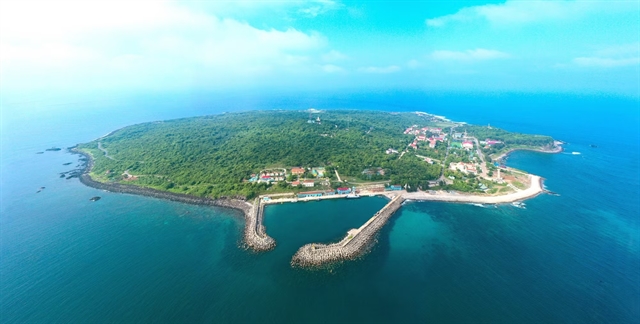 |
| Cồn Cỏ Island Special Zone is an important symbol of Việt Nam's national sovereignty at sea. VNA/VNS Photo |
This is not merely a matter of applying technology; it represents a fundamental shift in governance methods, ensuring that every marine resource is utilised more effectively and transparently.
What needs to be done to transform Quảng Trị into a strong maritime province that derives its wealth from the sea by 2045?
Our vision for 2045 is clear: Quảng Trị must become a strong maritime province that prospers and develops sustainably from the sea. It must establish a modern system of marine governance that applies advanced science and technology.
The living standards and spiritual wellbeing of people in coastal and island areas must be improved, and maritime culture preserved and promoted. National defence, security and sovereignty over the country's seas and islands must be firmly upheld.
Therefore, the action programme of the Provincial Party Standing Committee has set specific targets for 2030: achieving a gross regional domestic product (GRDP) of VNĐ238 trillion (US$9.15 billion) and an average annual economic growth rate exceeding 11 per cent, and achieving per capita income of more than VNĐ84.3 million per year in coastal localities.
To reach these goals in the coming period, we will focus on several tasks. Key priorities include transforming mindsets and strengthening marine governance; developing coordinated infrastructure across coastal growth poles; making environmental protection a prerequisite for development while stepping up efforts to combat illegal, unreported and unregulated fishing; fostering a maritime culture and improving living standards; and aligning marine economic growth with national defence, security and international cooperation. — VNS
Opinion
 Opinion
 Opinion
 Opinion
 Opinion
 Opinion
 Opinion
 Opinion
 Opinion
 Opinion
 Opinion
 Opinion
 Opinion
 Opinion