 Opinion
Hà Nội adorned in red ahead of Liberation Day
1.
|
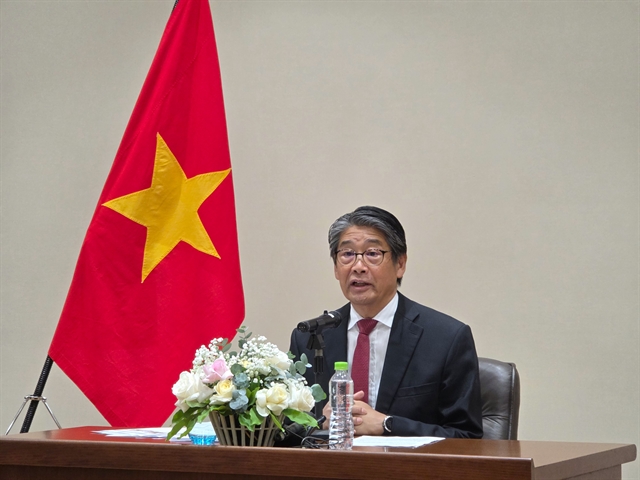
| Japanese Ambassador to Việt Nam Itō Naoki addressed Vietnamese media. — VNS Photo Trọng Kiên |
HÀ NỘI — Japan and Việt Nam are seeking to further deepen their Comprehensive Strategic Partnership, with cooperation in semiconductors, artificial intelligence, energy, critical minerals and food security emerging as key areas for the next stage of bilateral ties, Japanese Ambassador to Việt Nam Itō Naoki has said.
Speaking at a press briefing held on the occasion of the 53rd anniversary of the establishment of diplomatic relations between Japan and Việt Nam (September 21), Ambassador Itō highlighted the continued expansion of bilateral cooperation across a wide range of areas, saying the relationship was developing favourably within the framework of the Comprehensive Strategic Partnership for Peace and Prosperity in Asia and the World.
The Ambassador attributed the steady development of bilateral ties to the support and understanding of the peoples of both countries, as well as the sustained efforts of government agencies and officials on both sides.
New momentum in people-to-people and cultural ties
Ambassador Itō pointed to two symbolic events taking place this year.
The first was the staging of the musical Anio, which began performances in Yokohama, Kanagawa Prefecture, following its earlier presentation as an opera in both Japan and Việt Nam in 2023.
The work tells a symbolic story of the historical links and ties between the two countries and was well received by audiences. The musical adaptation is expected to be staged at the Hồ Gươm Opera House in Hà Nội next March.
The second was the inauguration of the Việt Nam–Japan Space at Hà Nội University of Science and Technology. Developed with support from Japanese companies, the facility is intended to strengthen cooperation between Japanese businesses and the university, particularly in human-resource development, while providing a venue for exchanges, research and discussion.
The Ambassador said Japan was placing particular emphasis on how public-private cooperation could help Việt Nam realise a new growth model as the country pursues reforms in a new era.
Japan, he said, had consistently supported Việt Nam’s reform orientation and stood ready to cooperate in helping realise its reform objectives.
“Together with improvements in administrative procedures and the investment environment, we also expect that business opportunities for Japanese companies in Việt Nam will continue to increase,” he said, stressing Japan’s desire to contribute to Việt Nam’s economic growth objectives and establish a sustainable framework for cooperation.
|
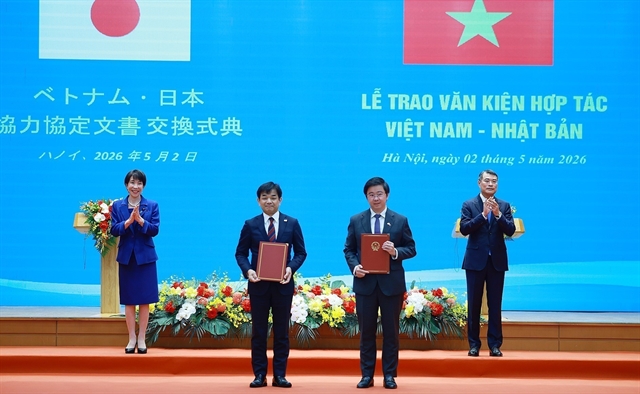
| Prime Minister Lê Minh Hưng (right) and Japanese counterpart Takaichi Sanae witnessed the signing of cooperation documents between the two countries and met with the press to brief of their talks on May 2, 2026. — VNA/VNS Photo Dương Giang |
Economic security becomes a key pillar
Ambassador Itō described Japanese Prime Minister Takaichi Sanae’s visit to Việt Nam from May 1 to 3 as the most prominent development in bilateral relations since the beginning of the year.
During the visit, the two countries shared an understanding of the importance of economic security and strengthening supply-chain resilience, while agreeing on a list of areas in which cooperation would be promoted.
These include science and technology, semiconductors, AI, energy, critical minerals and food security.
The two sides are now working to translate those broad areas of agreement into concrete programmes and activities, the Ambassador said.
Semiconductors have emerged as one of the areas where cooperation is becoming increasingly concrete.
Under the NEXUS programme, Japanese and Vietnamese universities agreed last year to undertake international research cooperation involving five pairs of universities. This year, the two sides are advancing cooperation on 10 new research topics, with preparations under way to announce the projects in the autumn.
The programme is also expected to expand into a third round, with the goal of receiving a total of 250 Vietnamese students in postgraduate doctoral programmes at Japanese universities.
At Việt Nam–Japan University, 106 students are currently enrolled in a semiconductor chip technology programme. Japan, the Vietnamese Government and Việt Nam National University, Hà Nội are expected to work closely together to provide the necessary support for their studies and research.
A Việt Nam–Japan Semiconductor Workshop, jointly organised by Việt Nam–Japan University and Hà Nội University of Science and Technology from September 20 to 23, is expected to bring together about 150 scholars, researchers and government representatives from both countries.
The workshop is intended to strengthen connections, expand joint research and promote university-business cooperation.
“Over the past year, with significant progress, semiconductors have increasingly become more concrete and emerged as one of the pillars of cooperation in innovation between Japan and Việt Nam,” Ambassador Itō said.
Energy cooperation under AZEC
Energy is another major area of cooperation.
To support Việt Nam in implementing its Power Development Plan VIII, the two countries plan to develop 15 pilot projects worth approximately US$20 billion under the Asia Zero Emission Community (AZEC) framework.
Japan is particularly focused on projects involving power plants using domestically produced natural gas and liquefied natural gas (LNG).
Ambassador Itō also highlighted the first dialogue between Prime Minister Lê Minh Hưng and the Japanese business community, held in Huế on September 6.
At the dialogue, the Prime Minister said Việt Nam would amend the Electricity Law and improve mechanisms to promote power-generation projects using domestic natural gas and LNG, with an amended draft law expected to be submitted to the National Assembly for consideration and approval at its October sitting.
Japanese investment reaches $81 billion
Two-way trade reached $38.6 billion in the first eight months of this year, up more than 15 per cent year on year. If the current growth rate is maintained, bilateral trade for the full year could approach $60 billion.
Japanese investment in Việt Nam reached $2.3 billion during the same period, an increase of 14.3 per cent year on year, bringing Japan’s accumulated investment in Việt Nam to $81 billion.
At the investment dialogue with PM Hưng, Japanese businesses placed particular emphasis on improving the predictability and stability of the investment environment.
Japan also proposed that restrictions should not be imposed on the export of products using EURO 3 technology covered by regulations guiding implementation of the Law on Technology Transfer in the motorcycle sector.
Toyota, meanwhile, proposed that hybrid vehicles, alongside electric vehicles, should be identified as important technologies in Việt Nam’s automotive-industry development strategy as the country works towards decarbonisation.
The Ambassador stressed the importance of public consultation and adequate engagement with stakeholders when new regulations are formulated and implemented.
Japan hopes Việt Nam will consider institutionalising mechanisms for dialogue and consultation with foreign-invested enterprises and other stakeholders before new regulations are issued, he said.
Defence and maritime law-enforcement cooperation
Also during PM Takaichi’s visit, she delivered a speech at Việt Nam National University, Hà Nội on an updated Free and Open Indo-Pacific (FOIP) initiative.
Ahead of the speech, the Japanese Prime Minister and Vietnamese leaders agreed to further strengthen security cooperation, including through concrete activities to enhance maritime law-enforcement capacity.
Against this backdrop, Japan attaches particular importance to implementing Official Security Assistance (OSA), Ambassador Itō said.
In July, Minister of National Defence General Phan Văn Giang visited Japan and held talks with Japanese Defence Minister Koizumi Shinjiro. It was the Vietnamese Defence Minister’s first visit to Japan in five years.
The two sides agreed to continue efforts to realise cooperation in defence equipment and technology, including co-development and co-production of high-speed landing craft.
Japan’s Ministry of Defence, relevant agencies and defence companies are also expected to actively participate in the Việt Nam Defence Expo scheduled for December, with Tokyo seeking to explore further opportunities for bilateral defence cooperation.
People-to-people links on the way to 2 million exchanges
In the first eight months of the year, 505,000 Vietnamese travelled to Japan, up 5.4 per cent from the same period last year, while 589,000 Japanese visited Việt Nam, an increase of 9.2 per cent.
At the current pace, Ambassador Itō said, two-way travel could reach a record high for the year.
If the trend continues, he said, the target of more than 2 million people travelling between the two countries annually before 2030 is becoming increasingly achievable.
Responding to concerns over recent visa fee hikes and its potential travel impacts, the Japanese diplomat noted previous Japan's visa fee had been set in 1978 and had not been changed at all over the past 48 years. During this long period, fluctuations in prices and exchange rates had created various constraints, leaving the relevant authorities without sufficient infrastructure, technological equipment and human resources to handle visa assessment and issuance.
“Therefore, increasing the fee is a necessary step to reinvest in resources, ensure that the visa review process is carried out effectively and meet growing demand,” the Japanese Ambassador said.
However, Ambassador Ito Naoki affirmed that demand among Vietnamese travellers to Japan had not declined as a result of visa costs, but had continued to maintain positive growth, adding that from January to August this year, the number of Vietnamese visitors to Japan reached 505,000, up 5.4 per cent, while the number of Japanese visitors to Việt Nam reached 589,000, up 9.2 per cent. At the current pace, two-way travel between the two countries is expected to reach its highest level ever for the full year.
Notably, according to figures shared by Ambassador Ito Naoki, Japan welcomed 92,000 Vietnamese visitors in March this year, a record high for a single month. Following Japan’s increase in visa fees, 56,600 Vietnamese visitors travelled to Japan in August, making Việt Nam the leading ASEAN country in terms of the number of tourists visiting Japan.
Regarding recent developments in culture sphere, in July, Japan’s Agency for Cultural Affairs and Việt Nam’s Ministry of Culture, Sports and Tourism jointly held a copyright workshop in Hà Nội, providing an opportunity for authorities, Japanese businesses and other stakeholders to exchange knowledge and experience on copyright protection and combating infringement.
Ambassador Itō also referred to the prosecution in August of three operators of the “Phim Nè” website, which had illegally streamed content including Japanese anime.
He noted, however, that no operators of copyright-infringing comic websites had so far been prosecuted, and expressed hope for further concrete progress in identifying and dealing with those operating such websites.
Looking towards a possible visit by Tô Lâm
Looking ahead, Ambassador Itō said Prime Minister Takaichi had invited Party General Secretary and State President Tô Lâm to visit Japan within the year, during her May visit to Việt Nam.
Against the backdrop of Tô Lâm’s active overseas engagements in recent time, Japan hopes the visit can take place soon, he said.
The Ambassador expressed his expectation that the visit would further consolidate and develop friendship and cooperation between the two countries under the Comprehensive Strategic Partnership. — VNS
Opinion
 Opinion
 Opinion
 Opinion
 Opinion
 Opinion
 Opinion
 Opinion
 Opinion
 Opinion
 Opinion
 Opinion
 Opinion
 Opinion