 Features

Oriental Residence Bangkok Awarded One MICHELIN Key for the Third Consecutive Year
1.
by Việt Dũng and Thu Ngân
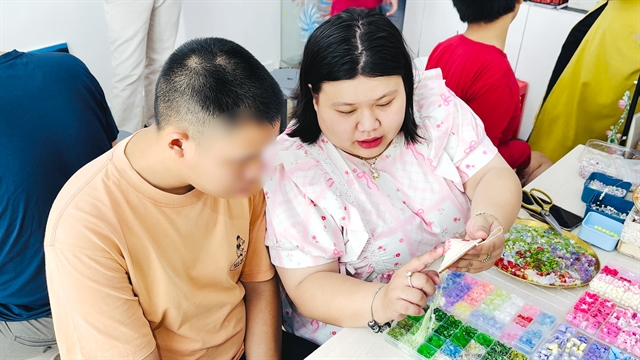 |
| The An Career Orientation Centre helps autistic children and young adults develop life skills and prepare for future employment. — VNS Photo Thu Ngân |
In a modest classroom in Hồ Chí Minh City’s Phú Thọ Ward, autistic children and young adults are learning more than arts and crafts. For the past two years, the An Career Orientation Centre has been helping them build life skills, confidence and pathways to future employment.
When we first arrived at the An Career Orientation Centre, we were introduced to a room of children and young adults diligently making decorative art items, while teachers showered them with kind words of encouragement.
Some of them greeted us with bright, cheerful smiles like any neurotypical young person.
Từ Mỹ Khánh, the centre’s founder, told Việt Nam News that she met several parents of autistic children during a charity activity.
“When I talked to them, at first I thought of creating a media project to help people better understand autism. But the more time I spent with these parents, the more I pondered: What will happen to these children when their parents are gone?" she said.
“That’s why I want to help them gain vocational skills and become more capable of taking care of themselves.”
While Việt Nam has facilities that work with autistic children, many do not accept those above the age of 10, according to Khánh. Her model therefore focuses on older age groups, providing them with future career opportunities.
Building independence
The centre currently has around 20 students aged seven to 26. They learn household chores and crafts such as decorating fabric handbags, making pictures with pinecones, decorating notebooks, and creating keychains, among others.
“Some students are more suited to certain skills than others, so we experimented with many different activities to find out which ones they are capable of doing and genuinely interested in,” Khánh said.
The arts and crafts products made by the students and teachers are sold through the centre’s social media page and occasionally at fairs, and are well received by customers.
Adult students can earn a percentage of sales based on their contributions, providing an additional source of motivation.
An excitable 23-year-old student named D. A. told us that he attends the centre five times a week and greatly enjoys learning how to cook, make keychains, and create paintings.
“The teachers here are very nice, I really love them,” he stressed repeatedly throughout our conversation, his face lighting up with a bright smile.
He also proudly showed us an intricate painting he had made together with the teachers, enthusiastically pointing out the parts he had worked on.
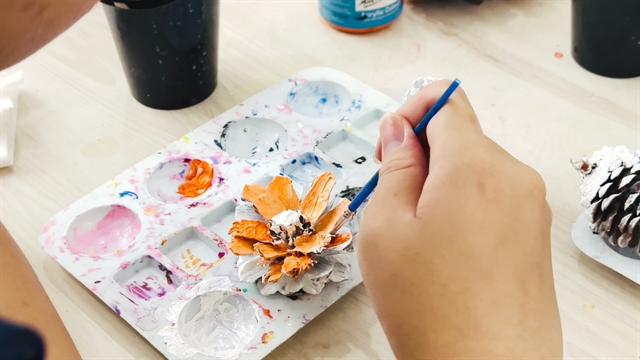 |
| The students are trained in arts-and-crafts activities to help them develop vocational skills for the future. — VNS Photo Thu Ngân |
Meanwhile, a younger student named Q. T. told us plainly: "I come here to learn social skills to be able to take care of myself in the future."
As lunchtime approached, one student volunteered to help prepare the meal. His hands slowly and carefully diced vegetables into small pieces while a teacher gently guided his every move.
Meanwhile, on the ground floor, two young children with attention deficit hyperactivity disorder engaged in physical exercise to expend energy and stimulate their minds.
The sight of a boy happily frolicking across the room and high-fiving a nearby teacher is particularly pleasing.
Learning through work
All of the teachers at the centre have qualifications and experience working with autistic children, each bringing expertise from different fields.
Hồ Thị Kim Thoa, an arts teacher, said she had worked at the centre from the very beginning and had taught many students with varying skill levels.
Students are gradually taught basic colouring skills before moving on to decorating items for sale. By that stage, they have a deeper understanding of what they are doing and are eager to pursue their craft.
Of course, things do not always go smoothly. The students can take much longer to acquire a skill than their neurotypical peers, and teachers need a great deal of patience as well as the ability to keep them focused on their activities.
Some are not always co-operative.
Nevertheless, the staff find their work meaningful and rewarding.
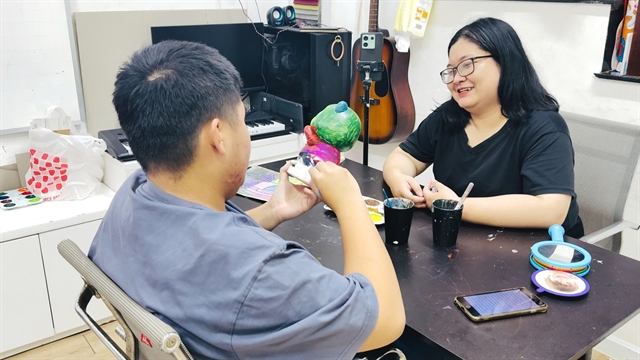 |
| The teachers at the centre find their work deeply fulfilling. — VNS Photo Thu Ngân |
A meaningful mission
“At first I wondered whether I had what it takes for the job. But after spending time with the students here, I found them to be so pure and lovely, living in a really honest way,” Thoa said.
“It motivates me to do my best to help them take care of themselves. Doing something meaningful makes me happy.”
Khánh said many parents wish they had known about the centre sooner, with some having searched long and hard for a place that could support their children.
Many students had shown significant improvement, becoming able to speak in full sentences, focus on tasks, and be less hyperactive.
“Many can now help clean the classrooms, prepare meals, look after themselves, and devote their full attention to art activities they enjoy.”
Khánh said the centre was looking into offering boarding services, which some parents had requested, and developing a café workshop model where students can prepare drinks for customers and sell art products.
As we took a final look around the centre before leaving, we spotted D. A. walking around wearing our camera bag. He showed great interest in our camera and the videos we had taken of him.
“So do you want to work for a newspaper in the future?” a teacher asked with a smile.
“Yes, I do!” he beamed.
For Khánh and her colleagues, moments like these are a reminder that building life skills is not only about helping students manage daily tasks, but also about giving them the confidence to imagine a future of their own.— VNS
Features
 Features
 Features
 Features
 Features
 Features
 Features
.jpg) Features
Features
 Features
 Features
 Features
 Features
 Features
 Features
 Features