 Features

Vietnamese students place confidence in Việt Nam-China cooperation
1.
Beneath the warm glow of early morning lights in Tri Lễ Village, artisans patiently stitch conical hats from palm leaves and bamboo, sustaining a craft that has long shaped both the identity and daily life of this rural community outside Hà Nội.
Shaped by the skilled hands of villagers and crafted from humble palm leaves and bamboo, Tri Lễ’s conical hats have crossed beyond village bamboo hedges to reach countries across Asia, including Japan and China.
Across generations, the hats have done more than shield people from sun and rain – they embody the diligence, skill and pride of an enduring craft community.
Though emerging later than nearby Chuông Village, Tri Lễ conical hats have carved out their own identity through adaptability and creativity. Alongside traditional designs, local artisans have also developed a distinctive product line known as the Lâm Xung hat, representing a fascinating blend of traditional craftsmanship and modern inspiration.
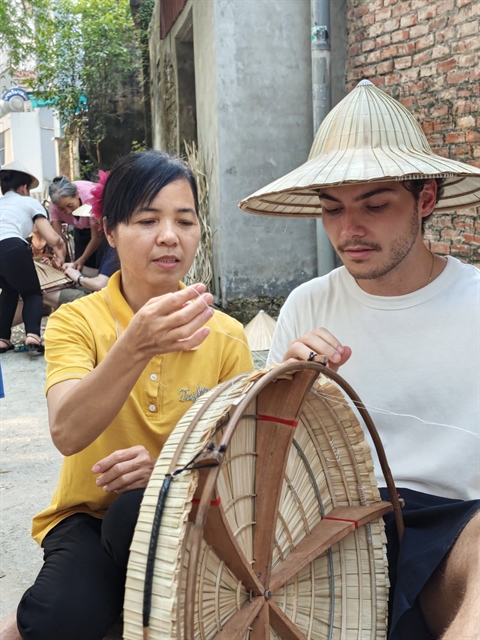 |
| A tourist wearing a Lâm Xung hat watches as a woman crafts a traditional palm-leaf hat in Tri Lễ Village. — Photo courtesy of TRILAF |
Village craft
The story of this distinctive conical hat traces back to the villagers’ fascination with cinema. Inspired by Lâm Xung, a chivalrous and magnanimous hero of the old society, master artisan Nghiêm Phú Đáo began experimenting with a new design, distinguished by a pointed crown, a cinched midsection and a broad brim.
Like traditional conical hats, the Lâm Xung type is crafted using a layered frame structure reinforced with 9 to 14 rings, depending on size, ensuring both durability and its characteristic refined silhouette.
Unexpectedly, the product was quickly embraced by the market and gradually became a signature craft of the village.
According to artisan Vũ Đình Thụy, crafting a completed conical hat involves multiple meticulous stages, from selecting and drying the palm leaves to splitting bamboo strips, forming the frame and stitching the hat.
"Every step requires great care and long-standing experience,” he said.
The products are crafted traditionally and manually. The palm leaves are sourced from Tuyên Quang and Phú Thọ provinces, carefully selected to ensure they are young, broad, white, and free from tears or damage.
Among all stages of production, drying the leaves is the most important and time-consuming, determining the durability and colour of the final product. In winter, it takes around 15 days on average to complete the drying process, while in summer, only about three sunny days are needed to prepare the materials for production.
In Tri Lễ Village in Dân Hòa Commune, more than 30 kilometres from central Hà Nội, from children to the elderly, almost everyone knows how to make conical hats. Young people can split bamboo strips and the elderly shape the rings, while women skillfully and rhythmically stitch the hats together. Every stage of production can be carried out flexibly, at any time and in any place.
“My family has been engaged in this craft for many generations and I am the fifth generation,” Thụy said.
Cultural tourism
According to Đinh Hữu Bình, chairman of the Dân Hòa Commune People’s Committee, preserving cultural identity not only helps safeguard traditional values but also creates sustainable livelihoods for local residents.
The commune has been implementing a range of coordinated measures, from communication and community engagement to wider outreach, in order to promote tourism development linked to traditional crafts, particularly the conical hat making.
One of the efforts to promote Tri Lễ's conical hats abroad is the launch of the TRILAF project, a collaboration between the People’s Committee of Dân Hòa Commune and the University of Languages and International Studies under Việt Nam National University in Hà Nội.
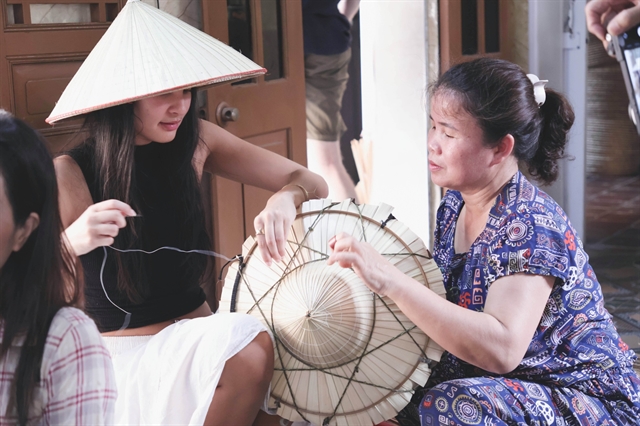 |
| A tourist tries making a Lâm Xung palm-leaf hat. — Photo courtesy of TRILAF |
TRILAF aims to develop experiential tourism products, a heritage introduction centre, cultural workshops, and community-based tourism activities, with the goal of making Tri Lễ a welcoming destination rich in identity.
The project has introduced students and tourists to a journey exploring the Tri Lễ conical hat craft, immersing them in Vietnamese rural culture, and engaging in language and cultural exchange in both Francophone and English-speaking environments.
“The craftsmen here are highly skilled. They are dedicated and willing to guide us through each step of the process," said French visitor Nicolas Teysseire.
"Being able to directly experience making conical hats in Việt Nam is something I have not seen anywhere else. I believe that crafts like these should be preserved and further promoted.”
Sustainable future
Beyond experiential activities, a series of training programmes on green production, community-based tourism development, and conical hat decoration workshops have been held for local residents. These workshops have attracted a large number of women and children.
Under the guidance of artists, the simple conical hats are given a fresh new look through creative patterns that reflect personal expression.
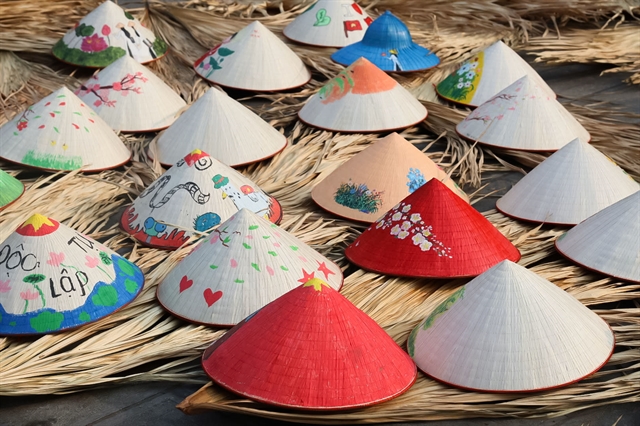 |
| Tri Lễ conical hats are given a fresh look through colourful decorative patterns. — Photo courtesy of TRILAF |
Đàm Minh Thủy, head of the Faculty of French Language and Culture at the University of Languages and International Studies, said equipping local residents with knowledge and skills in tourism organisation was a key factor in the context of tourism shifting strongly toward sustainability.
“We hope to accompany the locality in promoting the strengths of the traditional craft, gradually developing community-based tourism products that are suitable for both domestic and international markets, especially tourists from France and Francophone countries,” she said.
Looking ahead, Tri Lễ hopes to develop into a model destination for community-based cultural tourism, where visitors can experience not only the beauty of traditional conical hats but also the rhythm of rural life and the craftsmanship that has sustained the village for generations.
By blending tradition with creativity and sustainable tourism, the village is working to ensure that the quiet spirit of its conical hat craft continues to endure in contemporary Việt Nam. VNS
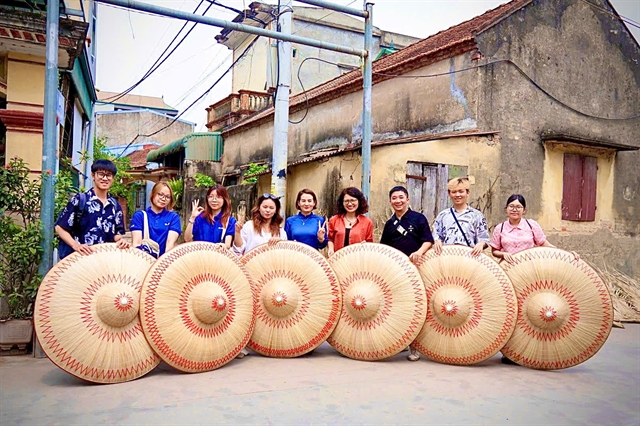 |
| Students and lecturers from the University of Languages and International Studies under Việt Nam National University pose with giant palm-leaf hats. — Photo courtesy of TRILAF |
Features
 Features
 Features
 Features
 Features
 Features
 Features
 Features
 Features
 Features
 Features
 Features
 Features
 Features
 Features