 Features

European higher education week opens new opportunities
1.
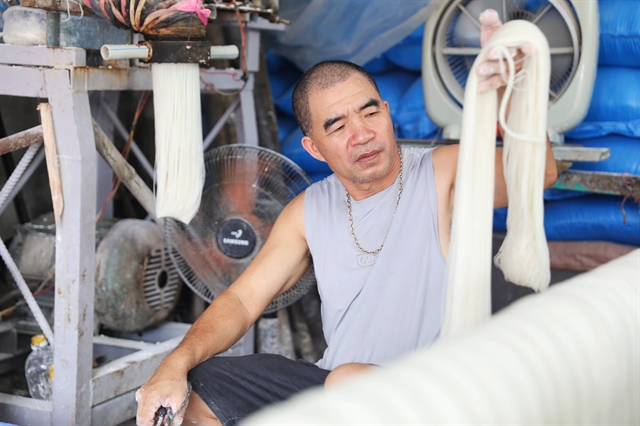 |
| Nguyễn Quang Đoàn makes rice noodles in Hùng Lô Village. VNS Photos Đoàn Tùng |
Chu Lan Hương
At 3am in Hùng Lô Village, while the world is still asleep, the soft grind of soaked rice breaks the silence as Nguyễn Quang Đoàn and his wife Nguyễn Thị Thuấn begin another day in a craft that has shaped their lives for decades.
Rice soaked overnight is lifted from water and drained in steady, practised motions before Thuấn grinds it into a smooth, milky paste, while outside, Đoàn carries out yesterday’s noodles, laying them carefully in the early light to dry.
“Making rice noodles is very hard work. Like other noodle makers in the village, we are busy from morning till night,” Đoàn said.
Located in Văn Phú Ward of Phú Thọ Province, a land known as the cradle of the Vietnamese nation, Hùng Lô rice noodles village has been a source of pride for residents for generations.
With a favourable position close to the urban centre of Việt Trì and convenient transport connections, the village not only serves the province's own rice noodle demand, but has also expanded its market to neighbouring regions and even some faraway provinces.
Long ago, Hùng Lô Village was famous for its rice-based products, such as bánh chưng (sticky rice square cake), bánh giầy (sticky rice round cake), bún (vermicelli) and bánh đa (rice crackers). Although these products are all high quality and popular, the region's most famous product is flat rice noodles.
Currently, about 30 households and one cooperative are producing flat rice noodles in the village.
Many generations have been born and raised in this craft. Although its origins are unclear, the people of Hùng Lô have maintained their flat noodles' distinctive flavour and unique secret recipe from one generation to the next.
“I am the third generation following the craft,” said Đoàn.
The 58-year-old man officially started working at his family business when he was 15 years old, while his wife began learning the craft when she was just eight.
From hand to machine
According to the couple, the traditional craft was even more labour-intensive in the past, because the entire working process was done by hand.
“As you can imagine, it was bearable in the summer. But in the freezing winter, having to wash rice in cold water early in the morning was truly difficult, especially for an eight-year-old girl like me and other girls my age in the village,” said Thuấn.
The constant soaking of hands in cold water for years has caused Thuấn's joints to ache and swell, while Đoàn also suffers from chronic wrist pain.
Rice plays a decisive role in making high-quality noodles. After soaking in water for at least eight hours, the rice is drained and ground up into wet flour. Traditionally, the rice was milled by hand using a stone mortar, a task typically completed by men in the family. Then the watery flour is spread into thin sheets, steamed, dried and cut into flat noodles.
Nowadays, machinery helps make noodles more easily.
“We soak rice overnight to soften the grains, then drain it in the early morning and grind it into rice milk with a machine that helps save time and labour,” said Đoàn.
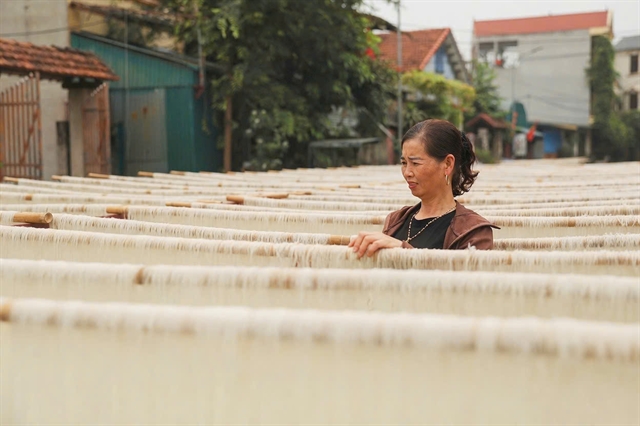 |
| Nguyễn Thị Thuấn dries noodles in the sun. |
Unlike traditional manual methods, the rice flour is no longer dried in thin sheets before cutting — instead, the dough is put directly into the rolling machine to form flat noodles. These are then fermented for two to three hours the next morning, before being rinsed and dried in the sun or in dryers on rainy days.
It takes two days to make one batch of rice noodles, according to Đoàn.
Machines have made the work much easier, but Đoàn had to admit that handmade noodles still taste better.
At present, the couple’s workshop produces 300kg of noodles per day, earning them a profit of VNĐ20 million (US$760) a month.
They've also hired two full-time workers with a monthly salary of VNĐ8 million (US$300).
Earnings from the noodle workshop have allowed them to raise two daughters and a son, sending them all the way to university.
“Although it is hard work, we have never thought about quitting, because it is the traditional craft of our ancestors as well as our livelihood and the income to raise our children,” said Đoàn.
Scaling up
In the 1980s and 1990s, up to 90 per cent of villagers were engaged in rice noodle production.
However, families produced noodles spontaneously, with no guarantee of scale or quality.
The quantity of noodles produced far exceeded consumer demand, leading to oversupply, affecting product quality, the village's reputation and price competition, resulting in unstable income for those involved in the trade.
But in 2004, Hùng Lô was recognised by the State as a traditional craft village.
This recognition upheld the historical and cultural value of the craft village, creating motivation for residents to continue developing their tradition.
Many households realised that working together would help expand production and make noodles with a consistent quality, which would help maintain the craft and even grow demand.
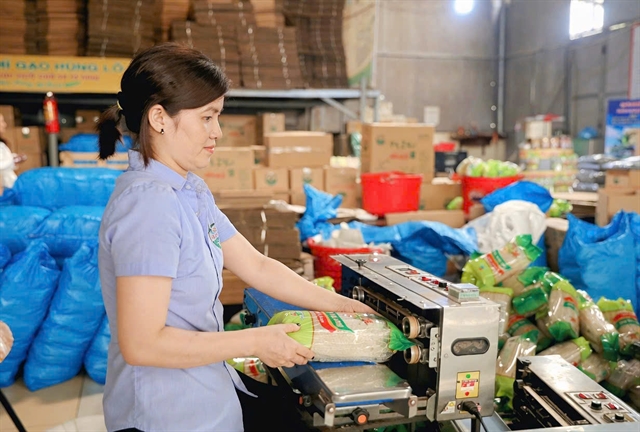 |
| A worker packs noodles at the Hùng Lô Rice Noodle Cooperative. |
As a result, the Hùng Lô Rice Noodle Cooperative was established in late 2016.
Building a brand
Cooperative director Cao Đăng Duy is the third generation of a rice noodle-making family. Duy is a pioneer in researching and applying modern equipment and machinery to production using traditional recipes, resulting in high-quality, delicious and high-yield products.
On average, the cooperative sells 70–80 tonnes of noodles per month domestically, and exports 8–10 tonnes to Chinese Taipei and Japan.
It currently employs 35 full-time workers with salaries of around VNĐ7.5 million per month.
“In peak periods, such as the months before Lunar New Year, we have to hire more part-time labour to meet deadlines,” Duy said.
The cooperative also has 13 members who own household workshops.
“The cooperative provides households with a stable supply of input materials, machinery, new technologies and markets,” said Cao Thị Trang, chief accountant at the cooperative.
Trang added that the household members earn higher incomes than they did before joining.
"On average, each household reaches a profit of VNĐ40-60 million ($1,500-2,200) per month,” she said.
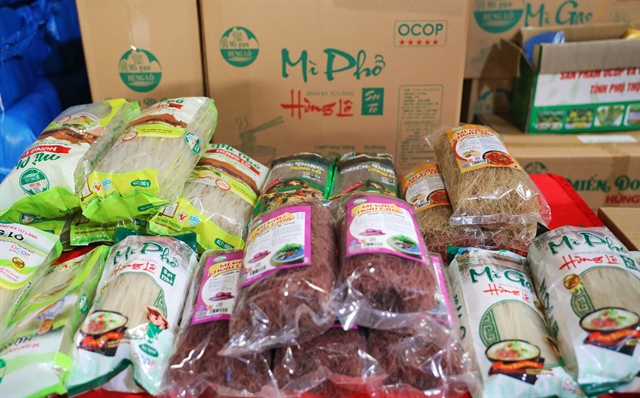 |
| Rice noodle products from the Hùng Lô Rice Noodle Cooperative. |
To date, the cooperative has sold nearly 10 types of products, including rice noodles, phở flat noodles, watermelon noodles, vegetable noodles, premium noodle gift boxes and vermicelli, three of which have been rated as four-star OCOP products.
Cooperative members have also submitted an application for a five-star OCOP rating for one product, called "Hùng Lô Flat Rice Noodles", according to Duy.
Focus has recently been placed on branding and developing other differentiated product lines, such as gluten-free rice noodles, rice noodles made from organic ingredients and noodles for dieters.
“We have been promoting Hùng Lô flat rice noodles on e-commerce platforms and apps like Zalo and TikTok to increase demand and help preserve our traditional craft,” Duy said.
As the day draws to a close in Hùng Lô, the rhythm slows but never stops — and long before the village sleeps, the work will begin again, carrying forward a craft that has quietly endured through generations. VNS
Features
 Features
 Features
 Features
 Features
 Features
 Features
 Features
 Features
 Features
 Features
 Features
 Features
 Features
 Features