 Features
European higher education week opens new opportunities
1.
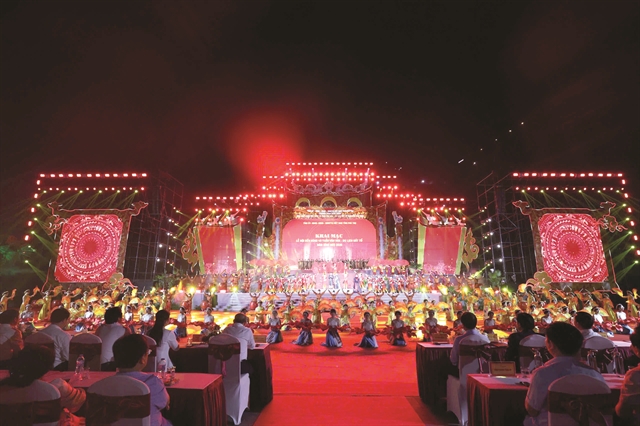 |
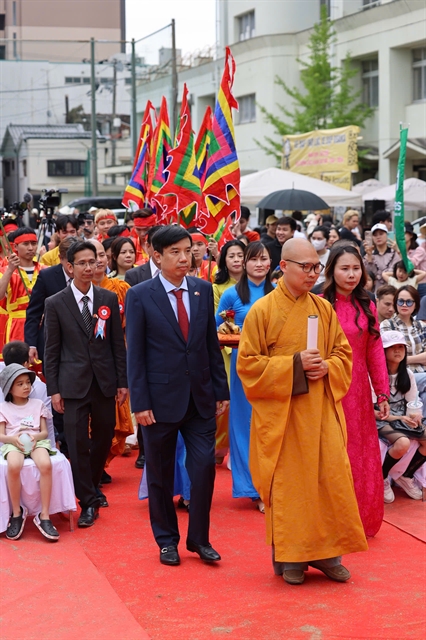
| An opening ceremony lights up Phú Thọ as Hùng Kings Festival and 2026 Roots Tourism Week begin. — Photo courtesy of the provincial Department of Culture, Sports and Tourism. |
On a late spring morning in Phú Thọ, the rhythmic beat of phách wooden clappers and drums echoes through the nearly 400-year-old Hùng Lô communal house. Beneath dark-tiled roofs and timeworn beams, women in deep crimson long dresses sway gently, their voices rising in ancient melodies.
Around them, crowds gather – some in quiet reverence, others in silent wonder – as if drawn not just by a performance but by something far older and deeply rooted: a shared memory of origin.
Outside, the streets bloom with colour. Flags ripple in the warm spring breeze, floral gates arch over village roads and banners stretch across bustling avenues. In every direction, there is a sense of anticipation – a feeling that something deeply rooted yet vividly alive is unfolding.
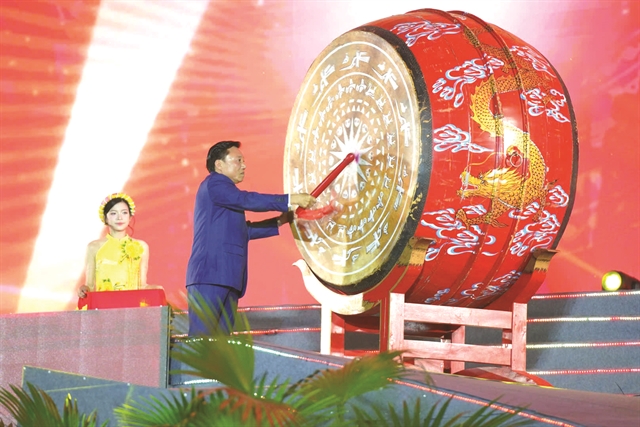 |
| Nguyễn Huy Ngọc, vice chairman of the Phú Thọ People’s Committee, beats a ceremonial drum to open the festival in the province. — Photo courtesy of the provincial Department of Culture, Sports and Tourism |
“Dù ai đi ngược về xuôi / Nhớ ngày Giỗ Tổ mùng mười tháng Ba.” (Wherever one may travel, never forget the tenth day of the third lunar month – the Hùng Kings’ Commemoration Day.)
For generations of Vietnamese people, this simple folk verse has served as both a reminder and a promise: that no matter how far one travels, the moment always comes to return, if not in body, then in spirit, to the ancestral land.
That sense of return finds its most powerful expression each year at the Hùng Temple Complex, where millions gather to honour the legendary founders of the nation.
Origins and legend
The origins of this shared memory stretch back thousands of years.
According to legend, Lạc Long Quân and Âu Cơ, revered as the ancestral Father and Mother of the Vietnamese people, gave birth to a hundred children. Fifty followed their father to the sea while fifty accompanied their mother to the mountains. The eldest remained in Phong Châu and became the first Hùng King, founding the ancient state of Văn Lang.
Across 18 generations, the Hùng Kings are said to have laid the foundation of the nation, not only in territory but in a shared sense of identity.
Over centuries, rituals honouring them evolved from local traditions into state-recognised ceremonies. By the Lê Dynasty (1428–1789), the commemoration had been formalised and under the Nguyễn Dynasty (1802–1945) the 10th day of the third lunar month was established as its official date.
Since 2007, it has been observed as a national holiday – a rare moment when an entire nation pauses in collective remembrance.
In 2012, the Hùng Kings worship belief was inscribed by UNESCO as an Intangible Cultural Heritage of Humanity, recognising its enduring cultural and spiritual significance.
Tradition renewed
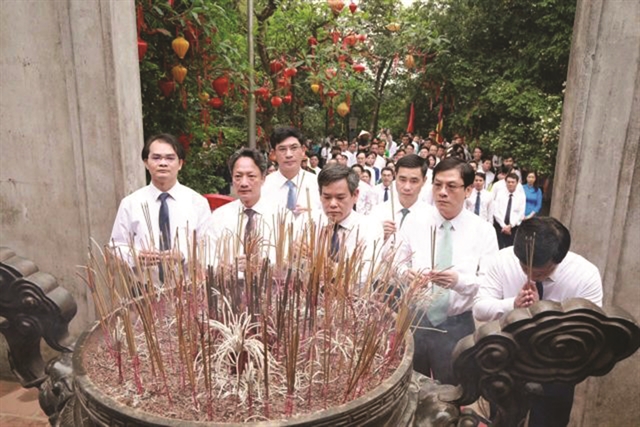 |
| Officials offer incense at Upper Temple, honouring Hùng Kings at Phú Thọ historical site. — Photo courtesy of the provincial Department of Culture, Sports and Tourism |
In 2026, the festival is being reshaped in ways that reflect both continuity and change.
For the first time, it is being organised within an expanded provincial framework following the merger of the provinces of Phú Thọ, Vĩnh Phúc and Hòa Bình – a shift that has broadened its cultural reach and strengthened regional links.
“Các Vua Hùng đã có công dựng nước. Bác cháu ta phải cùng nhau giữ lấy nước.” (The Hùng Kings founded the nation; we must together protect it.)
President Hồ Chí Minh
One of the most notable changes is the extension of incense-offering ceremonies from April 7 to 21, allowing more communities to take part in the sacred rituals.
A particularly symbolic feature is the organisation of activities into 18 commune clusters, representing the 18 Hùng Kings. Each cluster serves as both a cultural custodian and a creative hub, contributing its own traditions to a shared narrative.
From folk art performances and rice cake-making contests (bánh chưng – square sticky rice cakes – and bánh giầy – round glutinous rice cakes) to revived street cultural festivals, exhibitions and community showcases, the celebration has become more decentralised, participatory and immersive.
Speaking at a press briefing on the 2026 Hùng Kings Commemoration Day, the Hùng Temple Festival and Ancestral Land Culture and Tourism Week, Dương Hoàng Hương, director of the Phú Thọ Department of Culture, Sports and Tourism, said: “This festival is a powerful expression of national unity and the enduring tradition of remembering our roots.”
These changes align with the spirit of Resolution 80 initiated by the Communist Party of Vietnam, which emphasises heritage as a "living force that must be preserved but also activated, adapted and shared".
Heritage in life
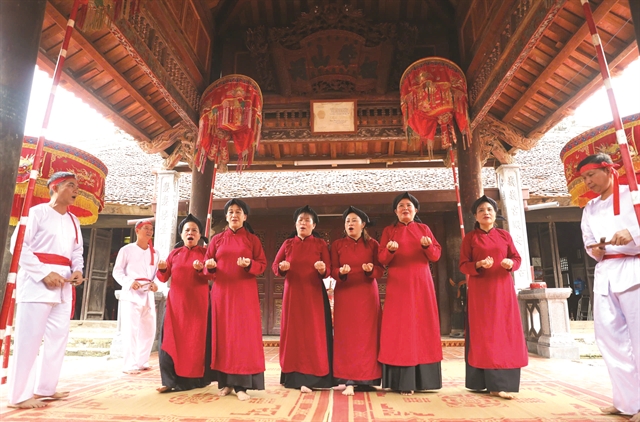 |
| Master singers perform 'xoan' folk songs at Hùng Lô communal house in Phú Thọ. — VNS Photo Đoàn Tùng |
Inside the ancient Hùng Lô communal house, tradition is not preserved behind glass. It is performed, taught and lived.
Trương Thị Vân, vice head of the Hùng Lô Xoan Singing and Folk Music Club in Vân Phú Ward, Phú Thọ Province, has devoted more than a decade to preserving xoan folk singing.
“In the past, life was difficult. We had to focus on making a living and singing was secondary,” she said. “But our passion kept us going.”
Today, performing in front of temples dedicated to the Hùng Kings carries a profound sense of meaning.
“It feels sacred,” she said. “The more people come, the more we feel responsible to keep this tradition alive.”
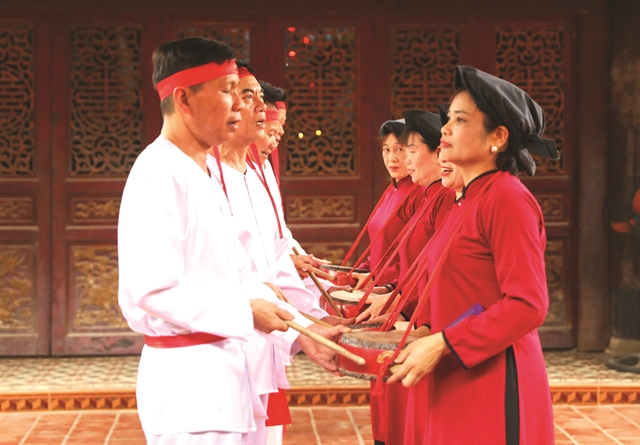 |
| Drumbeats accompany 'xoan' singers, grounding performance in ritual tradition at Phú Thọ festival. — VNS Photo Đoàn Tùng |
Unlike other musical forms, xoan relies solely on rhythm, drums and wooden clappers, yet its melodies carry a striking emotional depth.
Encouragingly, the tradition is being passed down. Her six-year-old grandson has already mastered several xoan songs and dances and eagerly asks for more lessons. “I am proud of the next generation,” she said.
That sense of continuity is echoed by Cao Thị Thu Hoa, a 17-year-old high school student, who first discovered xoan through her grandmother.
“At school, many of us choose xoan for performances,” she said. “It’s something we truly connect with.”
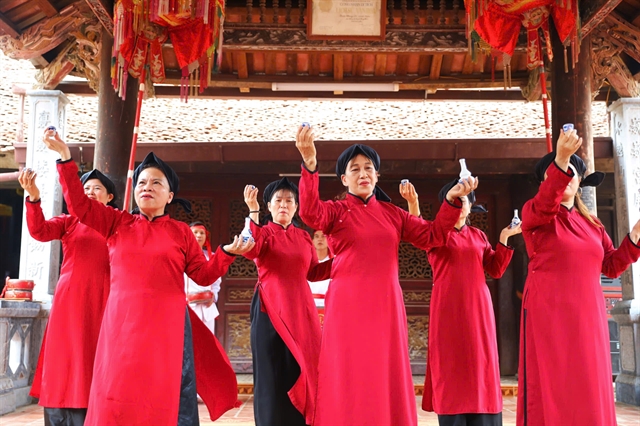 |
| 'Xoan' singers perform in front of an ancient communal house, voices echoing through sacred historic space. — VNS Photo Đoàn Tùng |
Living tradition
A short walk away, heritage takes another form in the careful wrapping of bánh chưng.
Nguyễn Văn Linh, head of the Hùng Lô Bánh Chưng and Bánh Giày Craft Village in Vân Phú Ward, has spent decades perfecting the craft.
Rooted in the legend of Lang Liêu, a son of King Hùng VI, these rice cakes are more than food; they are symbolic offerings representing earth and sky.
“We always choose the best ingredients,” he said. “But what truly defines the cake is the spirit – the respect for our ancestors.”
During peak festival days, his team works tirelessly, making hundreds of cakes daily. Yet for him, each one remains deeply personal – an offering rather than merely a product.
From ritual to destination
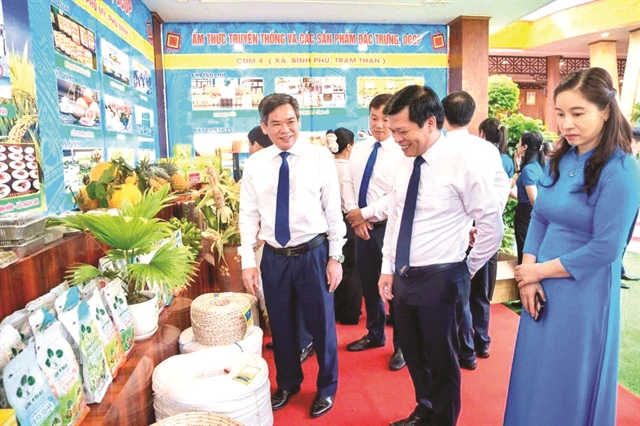 |
| Visitors explore traditional products and handicrafts showcasing Phú Thọ’s rich cultural heritage. |
According to the Phú Thọ Department of Culture, Sports and Tourism, the province welcomed more than 14.6 million visitors in 2025, including over 683,000 international arrivals. In 2026, that figure is expected to reach 15 million.
Tourism revenue reached approximately VNĐ14.948 trillion (nearly US$570 million) in 2025 and is projected to rise to VNĐ16.3 trillion (around $620 million) this year.
These figures reflect a broader ambition for the province: to position Phú Thọ as a leading centre for cultural and spiritual tourism not only in Việt Nam but across the region.
For many visitors, the experience is deeply personal.
“I bring my children here every year,” said Nguyễn Minh Anh, a visitor from Hồ Chí Minh City. “It’s important for them to understand where we come from.”
For James Carter from the UK, the festival offers something rare.
“This is unlike any festival I’ve seen. It feels deeply emotional, like stepping into a living history,” he said.
Meanwhile, Vice Chairman of the Phú Thọ Provincial People’s Committee Nguyễn Huy Ngọc described the festival as “an invaluable spiritual asset connecting millions of Vietnamese people worldwide”.
As the Hùng Kings’ Commemoration Day draws near, observances extend far beyond Phú Thọ, reinforcing its status as a truly national event.
Across the country – from southern provinces such as Cà Mau and Cần Thơ to major urban centres and rural communities – solemn incense offerings, traditional rituals and vibrant folk activities take place in unison, creating a shared atmosphere rooted in reverence and cultural pride.
The spirit of remembrance also reaches overseas, with Vietnamese embassies and diaspora communities in countries such as South Korea and Canada organising ceremonies that reconnect overseas Vietnamese with their ancestral roots. In these moments, distance recedes and a shared sense of origin takes centre stage, binding millions in a collective act of gratitude and identity.
It is this enduring connection across time and place that gives the commemoration its deepest meaning – one that lives not only in ritual but in a shared responsibility to remember, preserve and safeguard the nation.
A lasting message
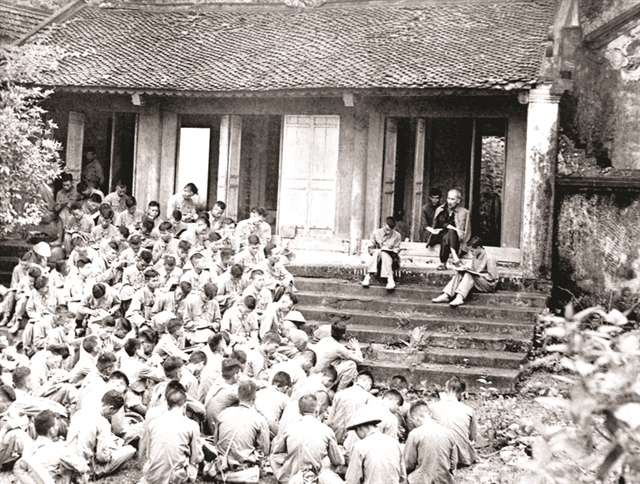 |
| President Hồ Chí Minh spoke to soldiers at Giếng Temple in the Hùng Temple Complex on September 19, 1954. — Photo hochiminh.vn |
Standing atop Nghĩa Lĩnh Mountain, where incense smoke drifts into the spring sky and generations of footsteps have worn smooth the ancient stone paths, the weight of history feels almost tangible.
In that moment, it is difficult not to recall the words of President Hồ Chí Minh: “Các Vua Hùng đã có công dựng nước. Bác cháu ta phải cùng nhau giữ lấy nước.” (The Hùng Kings founded the nation; we must together protect it.)
He spoke to the victorious Vietnam People's Army soldiers at Giếng Temple in the Hùng Temple Complex on September 19, 1954, on their way to take over Hà Nội following the defeat of the French forces at the Battle of Điện Biên Phủ.
The message continues to resonate across generations – not only as a call to defend the nation but to preserve its cultural soul.
As the festival unfolds, one truth becomes unmistakably clear: this is not merely a remembrance of the past. It is a reaffirmation of identity, a celebration of continuity, and a journey shared by millions back to where it all began.
As the final rhythms of phách and drums fade into the twilight and the last curls of incense drift beneath ancient roofs, what remains is a quiet summons to memory – a reminder that for the Vietnamese people, every journey forward begins with a return to a shared origin. — VNS
Features
 Features
 Features
 Features
 Features
 Features
 Features
 Features
 Features
 Features
 Features
 Features
 Features
 Features
 Features