 Features

Sơn La holds second coffee festival, targeting stronger businesses in future
1.
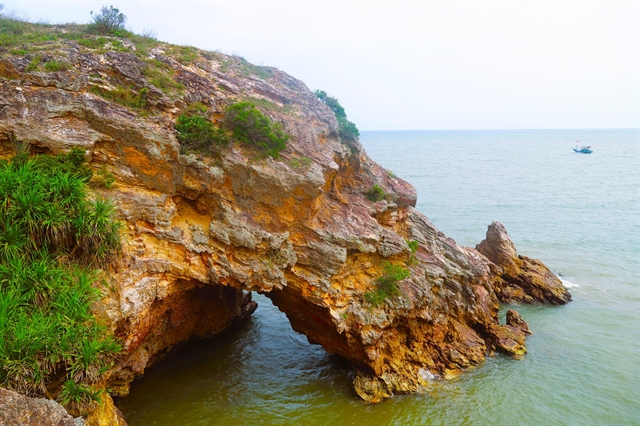 |
| CAVE GUIDE: Mũi Trâu Cave viewed from above. The cave is a natural lighthouse helping fishermen judge the current and steer their boats home from offshore. VNA/VNS Photos Xuân Tiến |
At the edge of the sea in Quỳnh Phú Commune in the central province of Nghệ An, where waves have carved the coastline over millennia, a hidden cave draws visitors into a world of shimmering rock, shifting light and the quiet power of nature’s artistry.
Mũi Trâu (Buffalo Snout) Cave features two headlands jutting into the sea, shaped over millions of years by wave-driven weathering and erosion that have hollowed the rock into twin cavities resembling a buffalo’s snout.
Inside the cave, a series of small to medium-sized chambers and interlinking passages are hidden in the stone, creating an alluring, almost hypnotic atmosphere. At low tide, visitors can easily reach Mũi Trâu to explore and be overwhelmed by nature’s works of art.
Nature’s sculpture
Nestled beside the Lạch Quèn estuary, Mũi Trâu Cave is not only a natural masterpiece with its colourful, shimmering rock arches but also a familiar landmark for fishermen of neighbouring communes.
Exploring the site, visitors feel as though they have entered an enchanted labyrinth where sea, time and geological forces have sculpted a unique work of art at the estuary.
To reach the cave from Lạch Quèn Bridge, visitors can travel by water, following the Mai Giang River out to the estuary, or walk along the shoreline beneath the Mành Sơn foothills.
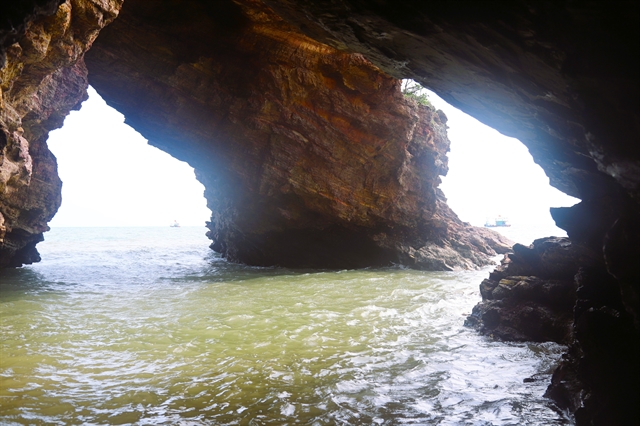 |
| BUFFALO NOSE: Mũi Trâu Cave has two openings that let light through to the sea resembling the nostrils of a buffalo. |
Local elders recall that on stormy days waves strike the cave and rebound, forcing strong jets of water through two small upper openings that resemble a submerged buffalo exhaling foaming white water. It is this striking resemblance that gave the cave its name.
The journey to Mũi Trâu Cave is a thrilling experience. To see the cave at its best, most visitors approach from the sea. As the small boat draws closer to the mouth of the Lạch Quèn estuary, the grandeur of the limestone cliffs becomes ever more apparent. Over millions of years, the relentless action of the waves has ground and hollowed the rock, creating vast interlinked arches and chambers that form an almost labyrinthine network.
Colours and light
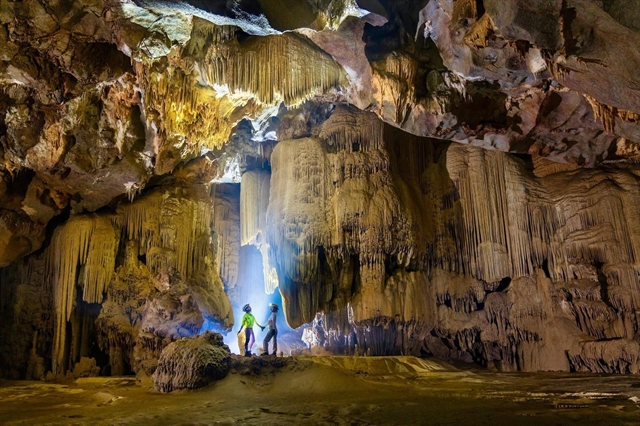
The cave mouth opens wide to the sea, welcoming the breeze and creating a space that is both airy and mysteriously intimate. Stepping inside, the first impression is a coolness that banishes the oppressive heat of the central coast. Here, the waves have sculpted the rock into sinuous, uncanny shapes, some walls are smoothed to a polished sheen, others rough and jagged like ancient bas‑reliefs.
The most distinctive feature that sets Mũi Trâu Cave apart from inland caverns is its colours. Under the influence of seawater and the minerals in the rock, the cave walls are not merely sombre grey but glow with a rich palette: straw yellows, brick reds, deep purples and mossy greens.
When sunlight pierces the cave mouth and reflects off the water onto the rock faces, the whole interior seems to come alight. The sinuous veins of stone appear to dance, producing a glittering, otherworldly scene. At times, one feels as if standing before a vast oil painting, where surreal purples and greens mingle to create a dreamlike atmosphere that leaves every visitor in awe.
Nguyễn Văn Hải, a Quỳnh Phú fisherman, says the cave is a familiar landmark to those who make their living from the sea. In days before modern navigation, Mũi Trâu served as a natural lighthouse, helping fishermen to judge the current and steer their boats home from offshore. Spotting the rock buffalo "drinking" from the sea told them they were on the correct course.
Local fishermen say the appearance of Mũi Trâu Cave changes with the sea’s moods. On calm days the water inside the cave lies flat and glassy, cloaking the interior in a veil of mist. The atmosphere becomes so quiet that one can hear the patter of droplets from the roof or the soft hiss of wind through the fissures; in those moments the cave is gentle and poetic.
When the sea is rough and the tide rises, Mũi Trâu takes on a wholly different aspect. Waves surge and roll, battering the rocky ledges and sending sheets of white spray soaring metres high. The sound of surf slamming into the arches and clefts produces booming echoes that proclaim the sea’s relentless power as it erodes and hollows the stone.
Tourism potential
After more than an hour exploring Mũi Trâu Cave, Lê Minh Đức, a visitor from Lâm Đồng Province, says he was impressed by the unique and untouched scenery at the cave and the Lạch Quèn estuary.
“I was particularly struck by the narrow passages that penetrate deep into the heart of the limestone. Carved over millions of years by weathering, tides and wave action, Mũi Trâu Cave’s interior displays a highly varied topography with countless rocks of eye‑catching shapes and colours,” he says.
“The cave’s focal point is a stately pillar of stone with a striking silhouette that juts out and plunges straight into the sea. Close to the cave mouth, there is also a small shallow cove where waves break gently year‑round, making it an ideal spot for swimming.”
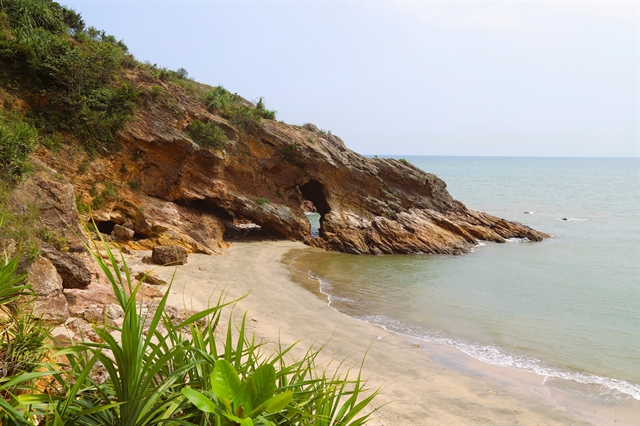 |
| BEACH ESCAPE: Next to Mũi Trâu Cave is a small beach with shallow water and waves year round, ideal for swimming. |
Nguyễn Văn Thương, a visitor from Diễn Châu Commune, Nghệ An Province, says he has visited Mũi Trâu many times at different hours to photograph the landscape.
“If you come at dawn, you may witness the sun as a huge red-hot orb slowly rising from the sea and then, in an instant, flooding the space with light,” he says.
“In the afternoon, the sea takes on a magical shimmering light, veiled by a thin mist and studded with the thousands of lights from fishing boats working offshore or making their way into the estuary.”
Notably, in the cave’s widest chamber, which can hold dozens of people, there are two openings that look out to the sea like the nostrils of a buffalo. From here, you can watch local boats navigating the Mai Giang River, riding the waves through the mouth of the Lạch Quèn estuary.
Although Mũi Trâu Cave possesses such majestic raw and singular beauty, it is mainly known to local residents and adventure enthusiasts.
The 20-kilometre stretch of coast around the cave also features many beaches with soft sand and year-round surf.
The shoreline is dotted with rocky outcrops and limestone ridges whose striking shapes have earned them evocative names: Kỳ Lân (Kylin), Mũi Rồng (Dragon Snout) and Con Chó (Dog), among others. Among the most notable are caves formed by geological uplift and millions of years of marine erosion and weathering, including Mắt Rồng (Dragon Eye) and Mũi Trâu (Buffalo Snout) Caves.
The two caves are the highlights of the coastal tourism area. While Mắt Rồng is reached by a roughly 20-minute boat trip, Mũi Trâu can be accessed by foot. Their majestic scenery and pristine, sculpted beauty are the main attractions of both sites, vivid testimony to the marvels of nature.
According to local authorities, exploring Mũi Trâu Cave is a return to the original unspoilt values of the land, sea and sky.
Once the lighthouse above Mũi Trâu Cave and the coastal road leading to it are finished and opened, the area is expected to attract visitors from across the country and boost local tourism, thereby raising the profile and value of the unique destination. VNS
Features
 Features
 Features
 Features
 Features
 Features
 Features
 Features
 Features
 Features
 Features
 Features
 Features
 Features
 Features