 Features

HIIVE by fusion brings business and golf closer in Bình Dương
1.
Hidden among the misty limestone mountains of the northern province of Ninh Bình, the critically endangered Delacour’s langur has found one of its last safe havens, where conservation efforts and nature now exist in a fragile but hopeful balance.
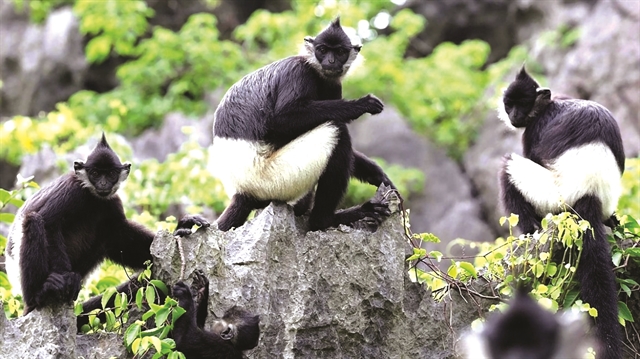 |
| Delacour’s langur, locally called 'voọc quần đùi trắng' (literally 'white-shorted langur' because of its distinctive white thigh fur), is a primate species endemic to Việt Nam, found mainly in Ninh Bình Province. — Photo courtesy of Di Sản Tràng An |
Covering an area of about 110 square kilometres, the site consists of three main components: Vân Long Wetland Nature Reserve, Kim Bảng Delacour’s Langur Species and Habitat Conservation Area, and the Tam Chúc scenic and archaeological complex. These areas are linked by a continuous ecological corridor, forming an integrated and unified landscape.
The site currently provides shelter for more than 90 per cent of the global population of endangered Delacour’s langur, locally called voọc quần đùi trắng (langur with white shorts because of its distinctive white thigh fur) – a symbol of the biodiversity of limestone karst ecosystems.
However, Delacour’s langur, or the “white-shorted” langur (scientifically known as Trachypithecus delacouri), a primate species endemic to Việt Nam, was once considered a forgotten species.
The first individuals were identified in 1930 during an expedition led by renowned French zoologist Jean Delacour, after whom the species was named.
For more than five decades, however, no confirmed sightings were recorded, leading many primatologists to believe the species had been wiped out during the war. Its rediscovery in 1987, following reports of live specimens in Cúc Phương National Park, was hailed as a major breakthrough in primate conservation.
The Delacour’s langur is classified as critically endangered on both the International Union for Conservation of Nature (IUCN) Red List and Việt Nam’s Red Data Book, making it one of the world's rarest primates.
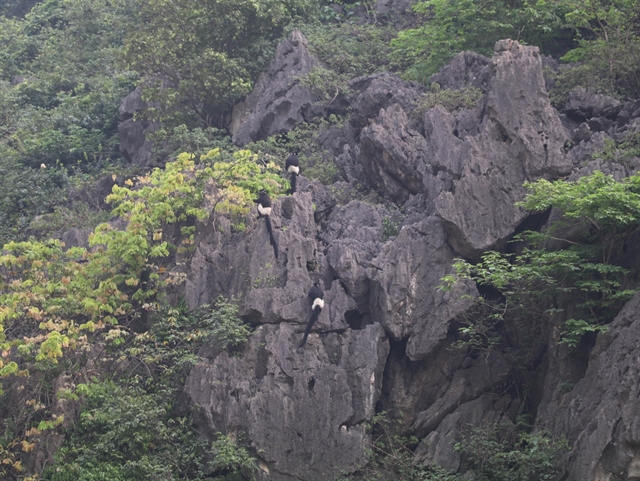 |
| A group of Delacour’s langurs lives in the Vân Long Wetland Nature Reserve in Ninh Bình Province. — VNA/VNS Photo Thùy Dung |
Growing conservation success
In recent years, the population of white-shorted langurs in the Vân Long–Kim Bảng–Tam Chúc complex has grown significantly, thanks to sustained conservation efforts by local authorities, conservationists and wildlife experts.
The most important remaining subpopulation is found in the Vân Long Wetland Nature Reserve. A 2022 survey recorded 44 groups comprising 308 specimens in the Vân Long–Đồng Tâm area, accounting for about 60 per cent of the species' total population.
Hoàng Văn Lâm, PhD, country director of Fauna & Flora International in Việt Nam, noted that the total population in the area reaffirmed the site’s role not only as a major stronghold for the Delacour’s langur, but also as a vital “genetic reservoir” for the species’ recovery.
Immediately north of the area lies the Kim Bảng Protection Forest, which supports the second-largest population of Delacour’s langurs. A 2022 survey recorded around 16 groups comprising just over 100 langurs in the area, accounting for around 20 per cent of the species' total population.
The third-largest subpopulation of white-shorted langurs is found in the Yên Mô Protection Forest. In 2024, the area recorded four groups totalling 37 specimens. However, this subpopulation is relatively isolated from the larger populations in Vân Long and Kim Bảng.
Specialists have assessed that the Delacour’s langur population in the Kim Bảng–Tam Chúc forest area has increased by about 120–121 individuals compared to estimates from a 2022 survey.
However, the conservation of approximately 500 Delacour’s langurs remaining in the area still faces significant challenges.
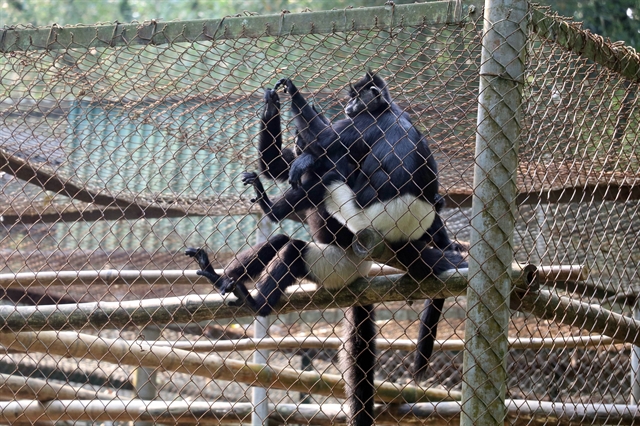 |
| Delacour’s langurs are rescued and conserved at the Endangered Primate Rescue Centre in Cúc Phương National Park. — VNA/VNS Photo Thùy Dung |
Protecting fragile habitats
Its habitat continues to be reduced and fragmented due to limestone extraction, infrastructure development and human activities. Many forest areas have become isolated habitats, weakening ecological connectivity between populations and further threatening the species’ long-term survival.
In addition, although hunting and snaring have declined, they have not been fully controlled and continue to pose a threat to individuals in the wild. Habitat quality is also showing signs of deterioration due to pollution from stone mining, stone dust, noise and changes in water sources.
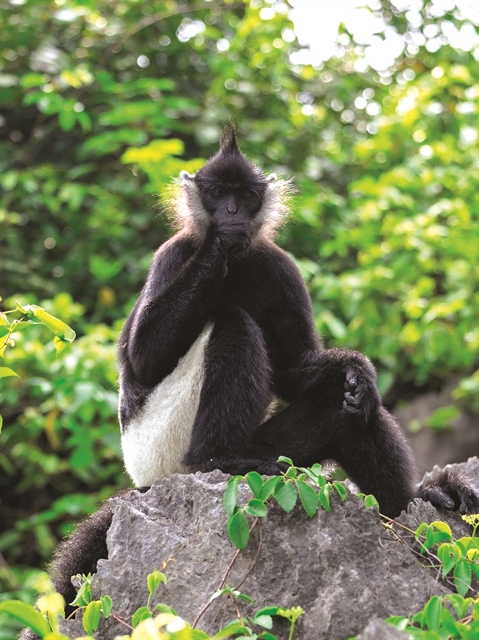 |
| Delacour’s langurs are a source of pride for Ninh Bình Province and Việt Nam. — Photo courtesy of Di Sản Tràng An |
According to Prof Dr Nguyễn Quảng Trường, Vice President of the Institute of Biology under the Vietnam Academy of Science and Technology, current conservation priorities for the Delacour’s langur include addressing the ongoing decline in habitat quality caused by mineral extraction, rock dust, noise and changes in water sources.
He also emphasised the need to reconnect fragmented habitats by establishing ecological corridors to link Vân Long Wetland Nature Reserve with Kim Bảng Protection Forest, Hương Sơn and surrounding areas, thereby improving and expanding habitat availability for local langur groups.
In addition, it is necessary to upgrade protection forests inhabited by white-shorted langurs into special-use forests in order to strengthen management effectiveness and conservation resources.
Expanding conservation areas and moving toward the establishment of large, interconnected transboundary protected landscapes are also essential.
Greater efforts should be made to restore forests and to develop coordinated ecological infrastructure, contributing to more effective protection of the species and supporting the long-term goal of establishing a natural World Heritage site.
Ecotourism and awareness
In the first quarter of 2026, the Vân Long Wetland Nature Reserve welcomed 30,000 visitors, including 30 per cent domestic tourists and 70 per cent international visitors.
"Conservation efforts linked with tourism development in Vân Long Wetland Nature Reserve are being carried out effectively, enriching local natural resources, creating livelihoods and promoting the development of sustainable ecotourism,” said Lê Thị Minh Huệ, a specialist from the Community Resource Development Centre at the University of Natural Sciences.
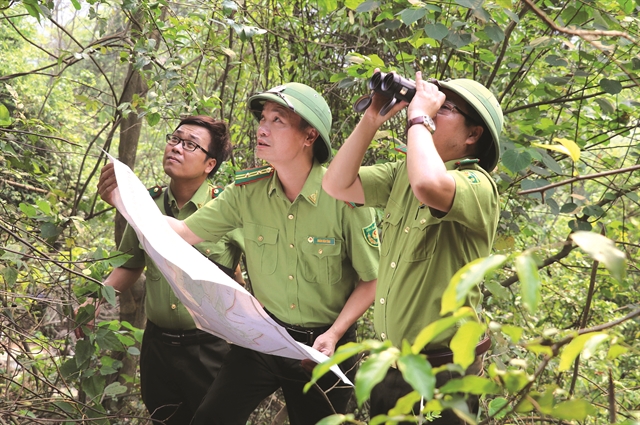 |
| Forest rangers patrol and monitor forest areas at the Vân Long Wetland Nature Reserve in Ninh Bình Province. — VNA/VNS Photo Thùy Dung |
Local authorities and relevant agencies, particularly the management board of the nature reserve, have strengthened communication and outreach efforts through various formats to raise awareness among local communities as well as domestic and international visitors.
Within the reserve, multiple QR-code scanning points have been installed, along with LED screens and free visitor guides, enabling tourists to learn more about the Vân Long Wetland Nature Reserve, its biodiversity and the threats facing its rare and endangered species of flora and fauna.
Tourism activities in the area are primarily conducted by boat, a low-impact form of travel that minimises disturbance to the environment and ecosystem while offering visitors engaging experiences along designated routes.
Particularly, reforestation and forest protection efforts have been carried out on a regular basis, contributing to increased forest cover and creating an ideal habitat for flora and fauna.
Being immersed in nature and discovering the remarkable diversity of local flora and fauna also helps foster a deeper appreciation and love for the natural world among visitors.
“Our group visited this place for the first time and was deeply impressed by its pristine landscape and fresh air,” said Henri Wahol, a visitor from the UK.
“When the boatman took us closer to the limestone mountains, we were able to see the beautiful Delacour’s langurs. It all came together into a stunning natural scene and also showed that conservation efforts here are working effectively.”
In 2023, the Vân Long Wetland Nature Reserve became the first protected area in Southeast Asia to receive certification from the IUCN. The site has also been recognised with two national records: the largest natural painting in Việt Nam and nature reserve with the largest population of Delacour’s langur in Việt Nam. It is also the country's ninth Ramsar site.
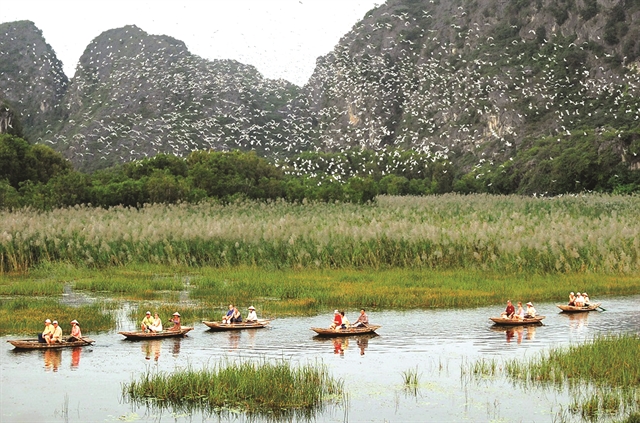 |
| Tourists sail along the Vân Long Wetland Nature Reserve. — Photo courtesy of Ninh Bình Department of Tourism |
The Ninh Bình tourism authority is actively coordinating relevant organisations, as well as a team of experts and scientists, to complete a dossier nominating the Vân Long–Kim Bảng–Tam Chúc Cultural and Ecological Landscape of the Delacour’s langur for UNESCO's inscription on the World Heritage List.
Meanwhile, the distinctive white-shorted langurs continue to move lightly across the limestone cliffs and forests of Ninh Bình, embodying both the fragile beauty of the region and the growing hope that one of the world’s rarest primates can survive through sustained conservation efforts and a renewed harmony between people and nature. — VNS
Việt Nam's living treasure of nature
The Delacour’s Langur is an endemic primate found only in Việt Nam, easily recognised by its jet-black fur and distinctive white patch around its hips.
Groups of Delacour’s langurs typically consist of around 10 individuals, usually including a single adult male, several females and their offspring. These monkeys are equipped with specially adapted pads on their hands, feet and rump that enable them to run, jump and sit on the razor-sharp limestone.
They move through their steep, treacherous and rugged habitat with supreme confidence, clinging to precipitous cliffs and making death-defying leaps. Delacour’s langurs feed mainly on leaves, although fruit, flowers and bark also form part of their diet.
Features
 Features
 Features
 Features
 Features
 Features
 Features
 Features
 Features
 Features
 Features
 Features
 Features
 Features
 Features