 Society

HKSTP Partners with Leading Science and Technology Company Merck to Open a New Chapter in I&T Collaboration
1.
|
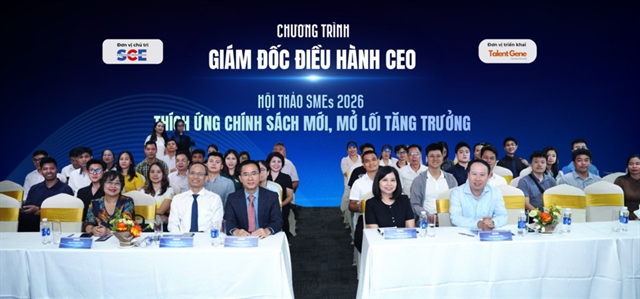
| Participants at the opening ceremony of the 'CEO 2026' programme, held by the Hanoi Support Center for Enterprise and Investment Promotion (SCE) in the capital city in early August. The programme aims to help business leaders adapt to the fast-changing business environment. — Photo doanhnghiepthuonghieu.vn |
HÀ NỘI — The Hanoi Support Center for Enterprise and Investment Promotion (SCE) recently launched a traning programme for chief executive officers of small- and medium-sized enterprises (SMEs).
The programme aims to help business leaders adapt to the fast-changing business environment and establish a solid foundation so that they can create new growth drivers, enhance their businesses' competitiveness towards sustainable development.
This year’s programme comprises eight training modules covering innovation, financial management, branding and business operations.
It also teaches organisational culture, leadership skills, talent management and workflow digitisation.
Two field trips will be organised to major corporations in Hà Nội and Cần Thơ City so that participants can gain insights into their management and operational practices.
The programme receives tuition subsidies of up to 70 per cent from Hà Nội's city budget, making it easier for SME leaders to access professional training at a reasonable cost.
Speaking at the programme's opening ceremony on August 3, Ngô Minh Toàn, director of the Hanoi Support Center for Enterprise and Investment Promotion stressed that as the capital city is building new growth drivers, its business community needs to improve, not only in terms of quantity but also in management capacity, productivity, innovation and competitiveness.
"Amid rapid developments of technology, artificial intelligence and market dynamics, as well as the increasingly high standards for finance, human resources, governance, compliance and sustainability, business leaders must stay one step ahead if their businesses are to achieve sustainable growth," he said.
“The CEO 2026 programme was designed to support the leadership teams of small and medium-sized enterprises in the city, by providing knowledge and focussing on resolving practical issues facing their businesses."
Nguyễn Anh Đức, programme director at MCG Talent Gene, which partners with SCE to carry out the programme, said that the company is committed to supporting participants throughout the training process.
"We will help business leaders connect theoretical knowledge with specific management, operational and growth challenges their businesses are facing, and through that, enabling managers to immediately apply what they learn in practice," he said.
Following the ceremony, a discussion was held where programme participants and business experts exchanged views on challenges in corporate management and growth strategies, as well as ways to take advantage of new support policies.
Lê Thị Minh Thảo, CEO of Phenikaa Group, presented various global case studies and higlighted the differences between companies that maintained their market position through continuous innovation, and those that struggled due to slow responses to change.
In the current landscape, a CEO needs to possess five core competencies, which are strategic thinking, innovation capabilities, the ability to lead people and build organisational culture, a global mindset and a commitment to social responsibility and sustainable development, according to Thảo.
“Among those, strategic thinking serves as the decisive foundation for other competencies to develop,” she said.
Dr Cấn Văn Lực, chief economist of the Joint Stock Commercial Bank for Investment and Development of Việt Nam (BIDV) reviewed the overall economic outlook for Việt Nam and the world for the 2022-26 period, and updated on the various incentive mechanisms and policies that Hà Nội is offering to enterprises and business households.
To effectively leverage these policies, businesses need to review their development strategies and core business areas while implementing four simultaneous transformations, which are the digital, 'green', energy and workforce transitions, according to Lực.
"Furthermore, enhancing human resource quality, strengthening management capabilities and ensuring financial transparency will help improve your business' access to sources of financial support," he said. — VNS
Society
 Society
 Society
 Society
 Society
 Society
 Society
 Society
 Society
 Society
 Society
 Society
 Society
 Society
 Society