 Society

National Assembly President meets Polish Prime Minister
1.
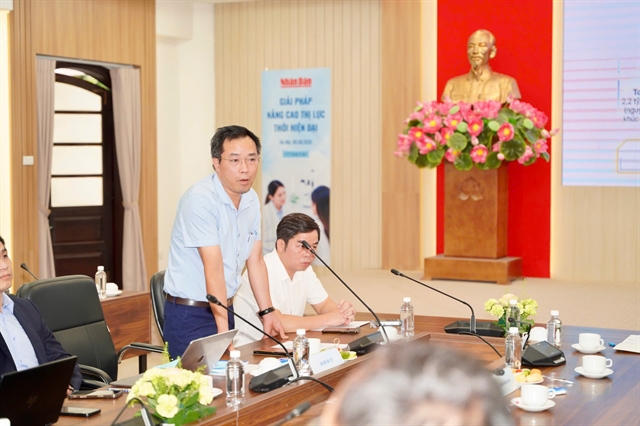 |
| Dr Bùi Hữu Toàn from the Ministry of Health's General Department of Preventive Medicine speaks at the seminar. — VNS Photo Thanh Hải |
HÀ NỘI — The prevalence of refractive errors among children is rising, particularly in major urban areas like Hà Nội and HCM City.
Experts warned that prolonged use of electronic devices, a lack of outdoor activity and substandard learning environments are causing myopia to affect increasingly younger children, necessitating concerted action from families, schools and the healthcare sector to protect the eyesight of the next generation.
Health experts discussed measures to curb the rising trend of refractive errors among younger people in Việt Nam at a seminar in Hà Nội on August 6.
At the event, the experts focused on this worrying trend as well as solutions for safe vision care and correction for young people in a digital environment.
At the event, Bùi Hữu Toàn from the General Department of Preventive Medicine under the Ministry of Health noted a significant rise in these conditions among school-aged children in recent years.
Toàn said: "The target for reducing the prevalence of refractive errors among children set under the national population programme through 2020 was not met.”
The issue also stems from improper eye care habits, such as maintaining poor posture and substandard lighting conditions. Data released by local Centres for Disease Control indicates that in 2024, over 22 per cent of classrooms still fail to meet lighting standards, specifically regarding a lack of natural light, according to Toàn.
A survey conducted by the Việt Nam National Eye Hospital shows that the prevalence of refractive errors among children stands at 51 per cent in Hà Nội and 75.6 per cent in HCM City. Nationwide, an estimated three to five million children aged 5-15 suffer from refractive errors.
The World Health Organization has also warned that without effective interventions, up to 90 per cent of Vietnamese children could be at risk of developing myopia by 2050.
There is a clear trend of refractive errors affecting younger age groups and rising rapidly in urban areas, a phenomenon linked to the increasing amount of time students and young professionals spend using electronic devices for study, work and leisure.
 |
| Associate Professor Dr Nguyễn Đình Ngân, Vice President of the Vietnam Ophthalmological Society and Deputy Director of Hospital 103, speaks at the seminar. — VNS Photo Thanh Hải |
Vice President of the Vietnam Ophthalmological Society and Deputy Director of Hospital 103, Associate Professor Dr Nguyễn Đình Ngân, said that myopia is a common refractive error, currently affecting approximately 30 per cent of the global population. In Việt Nam, the prevalence of myopia is also rising sharply.
“This trend is driven by increased use of electronic devices among young people, often for prolonged periods and at close range. Many young people lack outdoor activity, and schools in major cities often lack playgrounds, depriving children of the opportunity for expansive, open-field vision,” said Dr Ngân.
Experts warn that as the prevalence of refractive errors among children rises, uncontrolled cases can lead to vision deterioration, causing eye strain and headaches, and may ultimately impair learning ability. In the long term, children may suffer irreversible damage, such as glaucoma or retinal detachment.
They recommend that parents ensure children undergo annual eye screenings, mitigate risks associated with the learning environment, standardise classroom lighting, integrate electronic health records and mandate outdoor activities for children.
Experts said that the current challenge lies in effectively carrying out these policies, ensuring that young people and families alike have access to accurate, scientifically grounded information when choosing solutions to protect their eyesight.
Deputy Director of the Vietnam National Institute of Ophthalmology Dr Nguyễn Văn Huy said that all eye-related products — including contact lenses — must be quality certified and inspected by State regulatory agencies. Users should follow an ophthalmologist's instructions regarding the insertion, removal and cleaning of contact lenses; failure to do so can lead to keratitis and other eye conditions.
In response to this situation, the Party and the State have established very specific guidelines. The Việt Nam Health programme sets targets to increase the proportion of students screened for vision impairment and who receive prescriptions for corrective eyewear and guidance on vision-strengthening exercises.
Government Decree 98/2021/NĐ-CP also established a legal framework for the strict management of medical devices, including refractive correction products, mandating that any vision care solution provided to the public must meet safety standards, possess a circulation licence and have a clear origin.
Organised by Nhân Dân (People) Newspaper, the seminar aimed to create a space for regulatory bodies and health experts to jointly provide the community with accurate, verified information on safe vision care.
The organisers said that insights shared at the seminar would assist authorities in refining policies for school and community vision care, while also providing data to help healthcare and educational facilities improve the effectiveness of eye examinations, consultations and treatments, particularly for the younger generation. — VNS
Society
 Society
 Society
 Society
 Society
 Society
 Society
 Society
 Society
 Society
 Society
 Society
 Society
 Society
 Society