 Economy


Top leader proposes Việt Nam, Poland step up sci-tech ties
1.
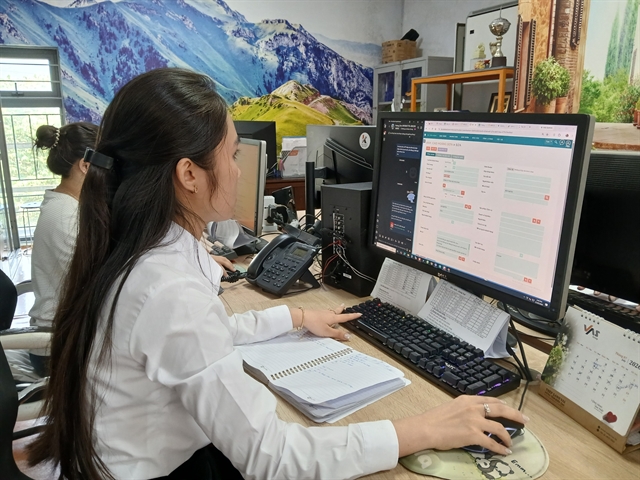 |
| A company in Đà Nẵng operates a customer relationship management system supported by AI chatbots. — VNA/VNS Photo Mỹ Hà |
HÀ NỘI — Enterprises that never sleep are emerging as a new trend to boost competitiveness in the artificial intelligence (AI) era, as Vietnamese businesses increasingly deploy AI to keep operations running around the clock, freeing employees to focus more on strategy and innovation.
The concept of a sleepless enterprise does not necessarily mean making employees stay on the job all the time. Instead, it's about building intelligent systems that can respond to customers, process transactions, monitor operations, analyse data and flag risks continuously.
As customers no longer operate only within traditional business hours and markets and data change by the minute, companies that can respond faster and operate continuously could gain an edge over rivals still relying heavily on manual processes, deputy chairwoman of MISA Corporation Đinh Thị Thuý said.
“Previously, CEOs often asked how to grow. Today, the question must be how to grow faster, smarter and reduce dependence on manual processes," Thuý noted.
At the centre of this shift is the emergence of AI agents — digital workers capable of performing a growing range of tasks, from finding potential customers and providing sales support to processing invoices, monitoring inventories, analysing financial data and warning of risks, she said.
However, Thuý stressed that AI was not designed to replace humans.
"Machines free us from repetitive, time-consuming tasks, allowing people to focus on things AI cannot replace, such as strategic planning, innovation and building relationships," she said.
For businesses, the important question is how to effectively integrate AI into their operations.
"The value of technology does not lie in how modern it is, but in measurable results, such as higher productivity, lower costs, better service quality and stronger competitive advantages," said President of the Vietnam Young Entrepreneurs Association Đặng Hồng Anh.
A fundamental restructuring
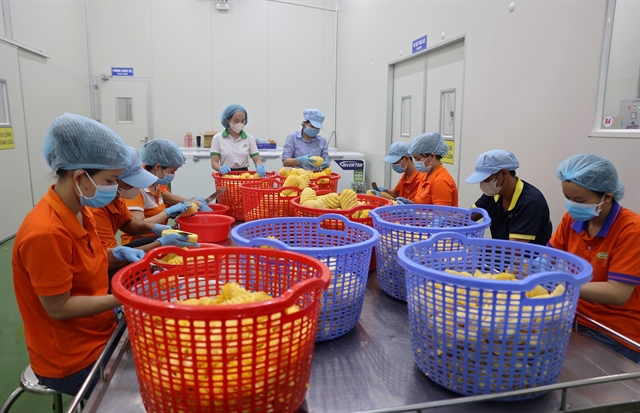 |
| Production at Wana Beverage Factory in HCM City. Vietnamese businesses are increasingly deploying AI to keep operations running around the clock. — VNA/VNS Photo Hoàng Nhị |
According to Thuý, the foundation of an AI-driven enterprise must be built on three pillars: data, processes and people.
Data must be accurate, complete, clean and connected across departments. Business processes need to be standardised before they can be effectively automated, while leaders must be directly involved in driving organisational change.
"Many businesses fail not because AI is inadequate, but because their management foundations are not ready," she said.
At many companies, data remains fragmented across departments, while employees continue to rely on manual and disconnected processes, making it difficult for AI systems to produce reliable insights or support real-time decision-making, said Nguyễn Thị Phương Quyên, director of enterprise digital transformation solutions at MISA.
"AI can only become a true assistant to a business when data is accurate, complete, clean and connected, and closely integrated with operating processes," she said.
According to AI Academy Vietnam Director Nguyễn Xuân Hoài, businesses should not deploy AI simply to make employees less busy.
"The right goal must be to increase productivity," he said, adding that the next phase of AI adoption will be measured not by how many tools a company uses, but by how deeply AI is embedded in its core operations.
Instead of spending time choosing AI tools, businesses should first focus on standardising data, processes and people, he said.
Competitive advantages will not come from whether a company uses ChatGPT, Claude or any other AI model, but from its ability to give AI what machines cannot learn on their own: context, experience, emotion and human understanding.
"Only then can AI move beyond being just a tool and become a digital colleague that helps businesses create value that neither humans nor AI could achieve on their own,” Hoài said.
A recent report by UOB found that around 80 per cent of Vietnamese businesses have begun applying AI to their operations, although most remain in the early stages of digital transformation. About one quarter have deployed AI at an advanced level.
The report found that AI is already generating tangible benefits, with 49 per cent of businesses reporting improved labour productivity, 47 per cent citing cost savings and 46 per cent reporting revenue growth as a result of AI adoption. Around two thirds of businesses also plan to increase their AI investment budgets by more than 25 per cent this year.
However, the report also pointed out major challenges, including investment costs and limited financial resources, the lack of mature AI solutions and partner ecosystems, and limitations related to data and technological readiness.
A report by Amazon Web Services in 2025 showed that 18 per cent of Vietnamese businesses, equivalent to nearly 170,000 companies, had adopted AI in 2024, with adoption growing 39 per cent from the previous year. Of these, 61 per cent reported higher revenue, with average growth of 16 per cent, while 58 per cent expected AI to help reduce costs by around 20 per cent. — VNS
Economy
 Economy
 Economy
 Economy
 Economy
 Economy
 Economy
 Economy
 Economy
 Economy
 Economy
 Economy
 Economy
 Economy