 Features

Education in the age of AI
1.
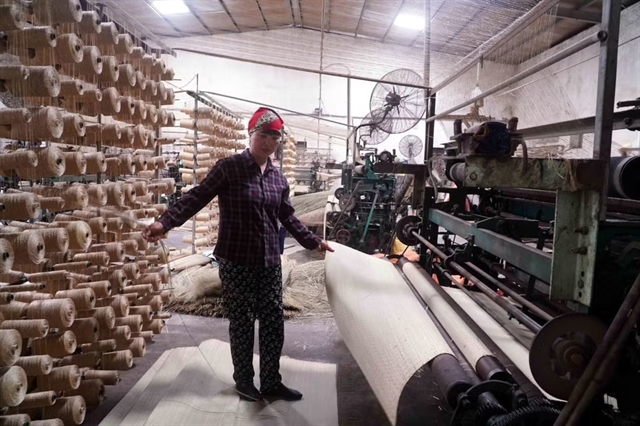 |
| A female worker operates a mat-weaving machine in the Xuân Hòa workshop. — VNS Photo Nguyễn Công Hải |
In Vũ Hạ Village, the day begins quietly. Bundles of sedge lie drying in the sun, their pale strands catching the light as the morning breeze carries their dry, rustling sound through the village.
For generations, the sedge mat has been a familiar presence in Vietnamese homes – a place where families gathered for meals, children played and people stretched out to rest at the end of the day.
Today, the tradition continues, with skilled hands and modern machinery working together to keep the craft alive.
“In the past, every house had several mats,” said Nguyễn Thanh Bình, owner of the Xuân Hòa mat workshop in Vũ Hạ Village, located in Phụ Dực Commune of Hưng Yên Province. “We used them for everything – sleeping, sitting, even when guests came.”
That sense of familiarity has not disappeared. Even today, many people still prefer sedge mats for their natural feel. In the summer, they stay cool. After being dried in the sun, they carry a faint, grassy scent that feels close to the countryside.
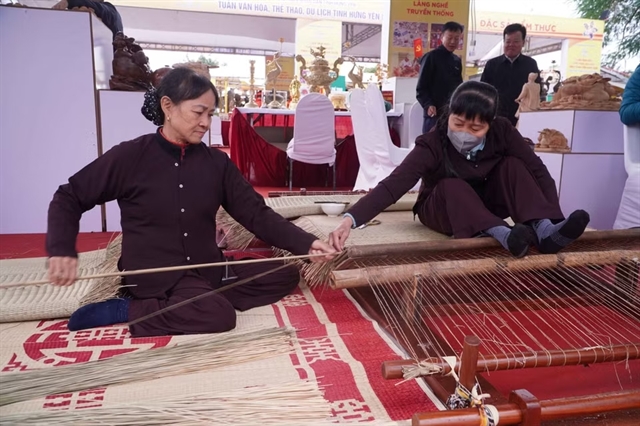 |
| Vũ Hạ workers demonstrate traditional sedge mat weaving at Hưng Yên Province's Culture, Sports and Tourism Week. — VNS Photo Nguyễn Công Hải |
But behind that simplicity is a process that requires patience at every step. Making a mat starts with selecting the right sedge. The sedge stems must be long, straight and even. After harvesting, they are split into thin threads, then dried carefully under the sun. Too little sun and the stems remain damp; too much and they become brittle.
“The drying stage is very important,” Bình said. “If the stems are not evenly dried, the colour won’t be nice, and the mat can warp later.”
Once dried, the sedge threads are sorted again before being fed into the loom. Weaving, whether done by hand or with machine support, still requires close attention. The threads must be aligned tightly and evenly. A small mistake at this stage can affect the whole surface.
After weaving comes a series of finishing steps that are often overlooked but crucial to the final product. The mat is polished to smooth the surface, sometimes lightly pressed to ensure it lies flat, then printed with patterns and sewn along the edges.
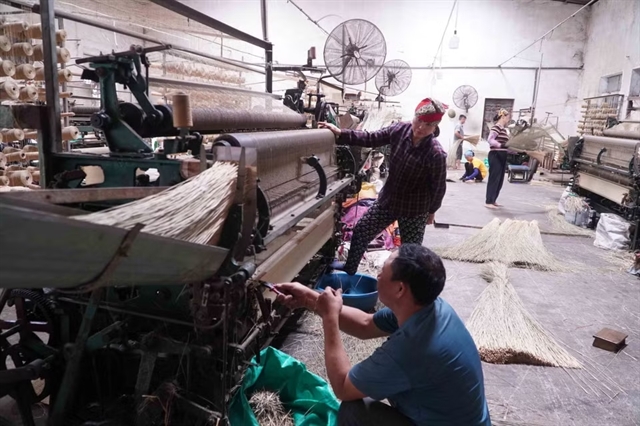 |
| The support of machinery has brought about higher productivity in sedge mat weaving — VNS Photo Nguyễn Công Hải |
Tradition meets machinery
At the Xuân Hòa workshop, 54-year-old worker Điều, who gave only her first name, has spent more than 20 years giving the final touch to finished products. Sitting beside stacks of newly woven mats, she runs her hands across their surfaces, checking for rough spots and removing them.
“The machine weaves it, but the surface still depends on the worker,” she said. “If it’s not smooth, you can feel it right away.”
Her work requires a steady hand and a good eye. Too much pressure can damage the threads, too little leaves the surface uneven. It is a skill built over years, not something that can be rushed.
Like many others in the village, Điều balances her work at the workshop with farming. The flexible schedule allows her to return to the fields during busy seasons, something she says suits rural life.
In the past, weaving was done in almost every household in Vũ Hạ. Today, the craft is mainly concentrated in workshops, where machines have taken over the heavier tasks. This shift has helped increase productivity significantly.
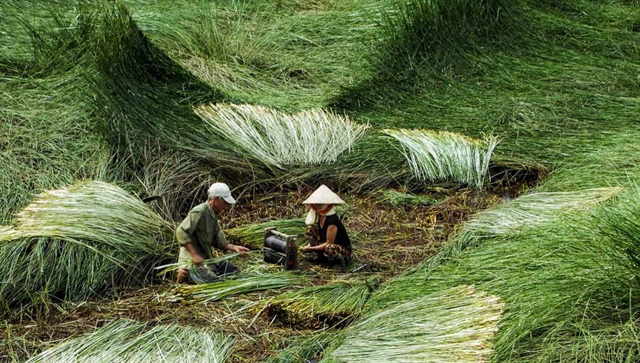 |
| Harvesting sedge. Sedge used to make mats is replanted every 10–15 years and requires almost no cultivation or maintenance. |
“A worker used to make just a couple of mats a day by hand,” Bình said. “Now, with machines, we can produce much more. But the quality still depends on people.”
That balance between machinery and craftsmanship has allowed the village to keep its trade alive. Mats continue to be produced daily, supplying markets across the country.
At the same time, local producers are beginning to look further ahead. Some visitors from abroad have shown interest in the products, raising the possibility of export.
“Foreign customers like the mats,” Bình said. “But to export, we need stable source of materials and consistent quality.”
At present, sedge is sourced from different areas, which makes it difficult to maintain uniform standards. Building a stable supply of raw materials, he noted, would be an important step if the village wants to enter larger markets.
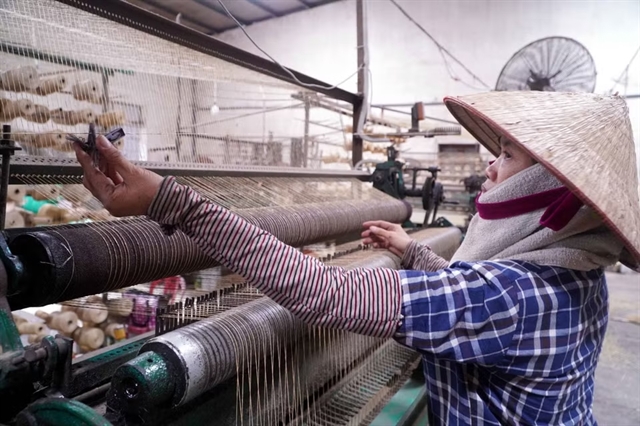 |
| In Vũ Hạ, mat weaving is still maintained at workshops, where sedge mats are produced daily through the skilled hands of artisans with the support of machinery. — VNS Photo Nguyễn Công Hải |
Even so, the direction is slowly taking shape. Workshops are improving production methods, paying closer attention to quality, and adapting designs to suit changing tastes.
In Vũ Hạ, the work continues much as it always has - shaped by the weather, guided by experience, and carried out with quiet care. Each mat, simple as it may seem, holds the effort of many hands and the weight of long-standing tradition.
For those who remain with the craft, that is reason enough to keep going. — VNS
Features
 Features
 Features
 Features
 Features
 Features
 Features
 Features
 Features
 Features
 Features
 Features
 Features
 Features
 Features