 Features
Bắc Ninh and Samsung launch new business support programme
1.
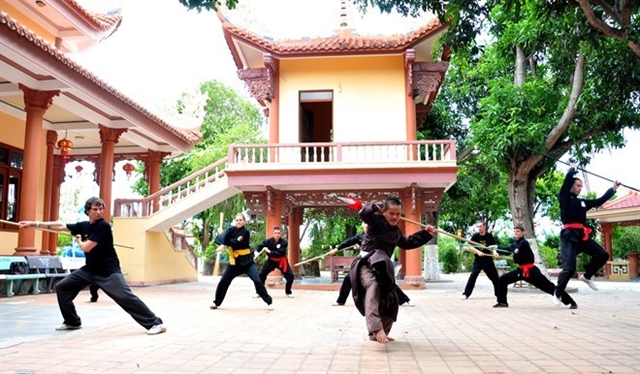 |
| Martial arts practitioners train at Long Phước Pagoda — Photo quynhontourist.com |
Nestled amid vast rice fields in Tuy Phước Commune of Gia Lai Province, Long Phước Pagoda is far more than a place of worship.
For more than two centuries, it has quietly preserved a rare tradition where Zen Buddhism and Vietnamese martial arts exist side by side, creating a sanctuary of both spiritual reflection and physical discipline.
Located about 15km from the coastal city of Quy Nhơn, the pagoda sits in Tân Thuận Village, surrounded by open countryside.
The setting is simple and tranquil, with ancient architectural structures, shaded gardens and carefully arranged Buddha statues creating a space closely connected to local community life.
According to the provincial Executive Board of the Việt Nam Buddhist Sangha, Long Phước Pagoda was built in 1802.
Since then, it has undergone several restorations while retaining its original character.
Statues of Buddha are arranged across the compound, contributing to a peaceful environment that remains closely woven into the life of the local community.
The pagoda complex includes the main hall, bell and drum towers, ancestral houses dedicated to former abbots and monks, and living quarters for resident monks.
A nine-storey stupa rises at the centre, while under the shade of old trees lies a martial arts training ground – a distinctive feature that sets Long Phước apart from many other pagodas.
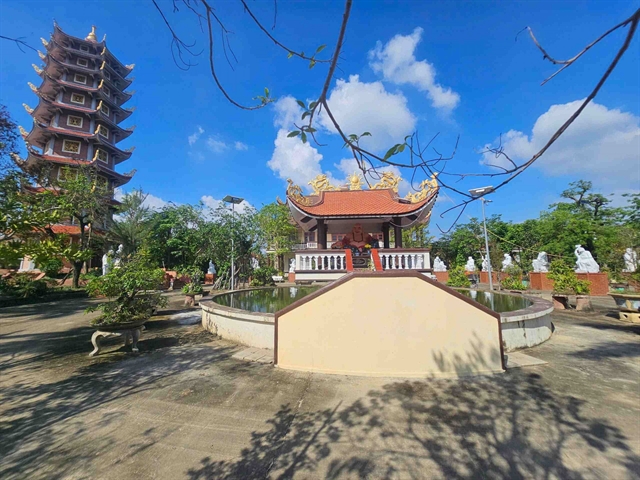 |
| Long Phước Pagoda in Gia Lai Province has preserved a unique tradition that combines Zen Buddhism with Vietnamese martial arts for more than two centuries. — Photo langngheviet.com.vn |
Martial arts legacy
Long Phước is best known for its role in preserving and promoting traditional Vietnamese martial arts.
Historically, monks practised martial arts to maintain physical fitness and preserve ancient techniques.
In 1986, the pagoda established a traditional martial arts club, offering free training to local residents.
According to Nguyễn Thanh Viện, a coach at the club, it currently has five instructors and around 30 trainees.
“In addition to preserving traditional routines, we also teach the use of 18 types of weapons. Our free classes help spread a passion for martial arts while identifying promising athletes for provincial teams," he said.
Over the years, the pagoda’s training ground has produced hundreds of practitioners, many of whom have become well-known figures in the martial arts community.
Others have gone on to establish their own training centres, continuing to pass on traditional martial arts to younger generations.
One such figure, Trần Duy Linh, is now director of the Bình Định Traditional Martial Arts Centre in Gia Lai Province.
During his competitive career, he won multiple gold medals and contributed to promoting traditional Vietnamese martial arts, particularly the Tây Sơn-Bình Định school, to wider audiences.
With years of experience, Linh has taken part in training and staging performances involving hundreds of athletes at international festivals of Vietnamese traditional martial arts.
He has also contributed to major cultural events, including commemorations of the Ngọc Hồi-Đống Đa victory at the Quang Trung Museum.
According to Linh, Long Phước Pagoda is one of the region's leading training centres for martial artists.
“Many of its students later became coaches and contributed to training at provincial centres. The pagoda also provides elite athletes for the provincial team, contributing significantly to local sport achievements,” he said.
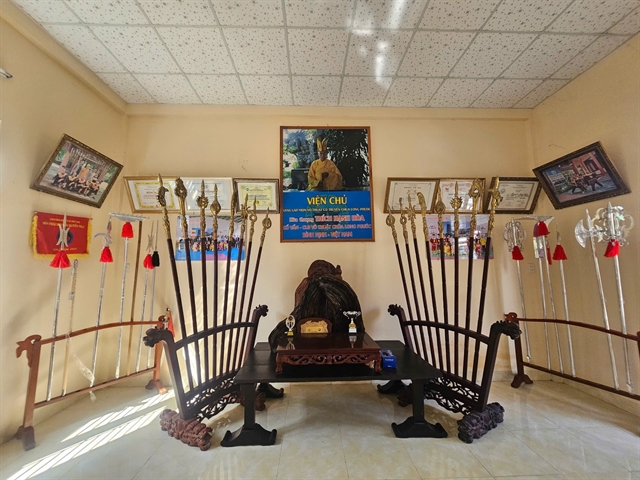 |
| Traditional martial arts weapons are displayed at Long Phước Pagoda. — Photo langngheviet.com.vn |
Another former Long Phước disciple, Nguyễn Văn Cảnh, has helped bring Vietnamese martial arts to international audiences.
Each year, he is invited to France and Switzerland to provide technical training for practitioners of the Sơn Long Quyền Thuật school, helping introduce Vietnamese techniques to international communities.
Safeguarding tradition
Beyond training activities, Long Phước Pagoda is also known for preserving rare martial arts manuscripts and techniques associated with historical Vietnamese figures.
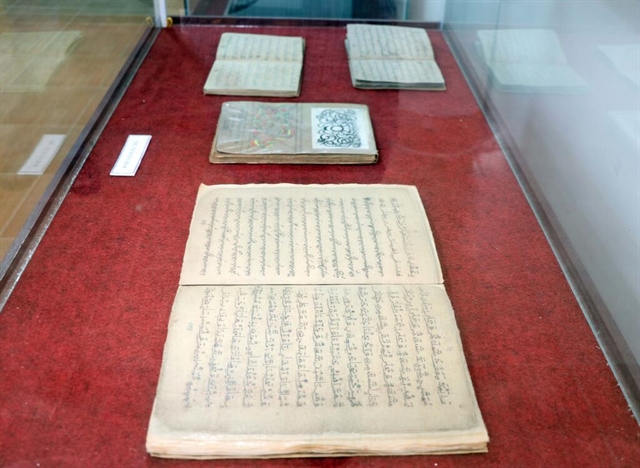
Among its most notable collections are two ancient manuals known in English as Combat Techniques from Military Manual of the Six Generals and The Tây Sơn Secret Manual of the Great Generals' Heroic Strategy.
These works compile martial techniques, strategies and combat philosophies developed across different dynasties.
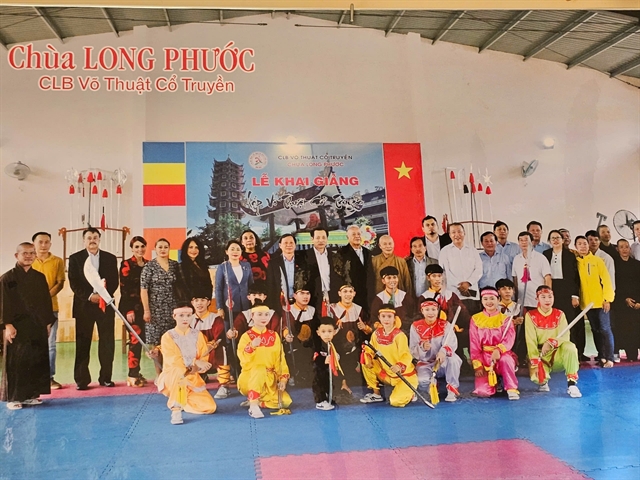 |
| For over 40 years, Long Phước Pagoda Traditional Martial Arts Club has trained thousands of students. — Photo langngheviet.com.vn |
According to Venerable Thích Vạn Nguyên, who oversees the martial arts club, the first manual was compiled in the 16th century by Hư Minh, founder of the Long Hổ Không Hồng school.
The text documents military strategies and more than 150 traditional routines, including techniques associated with historical figures such as Đinh Tiên Hoàng, Lý Công Uẩn, Trần Quang Khải and Lê Lợi.
Hư Minh, whose real name was Nguyễn Minh Khôi, began studying martial arts at a young age, travelling widely in search of teachers.
In 1561, he started compiling his research into a systematic body of knowledge, marking an important step in preserving traditional martial arts.
In the 18th century, Nguyễn Trung Như, the eighth patriarch of the Long Hổ Không Hồng school, continued developing this tradition.
After participating in the Tây Sơn peasant uprising, he compiled The Tây Sơn Secret Manual of the Great Generals' Heroic Strategy, systematising techniques associated with prominent Tây Sơn generals such as Nguyễn Huệ, Nguyễn Lữ, Bùi Thị Xuân and Trần Quang Diệu.
These manuals are considered valuable not only within the Long Hổ Không Hồng lineage but also as part of the broader heritage of Bình Định martial arts.
The Bình Định Traditional Martial Arts Centre has collected and adapted selected routines for training programmes, while also inviting masters from different schools to share their techniques.
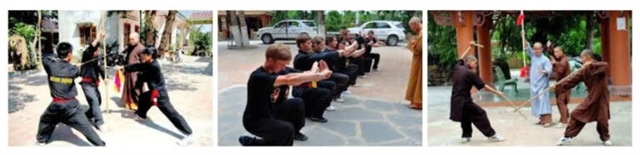 |
| Martial arts masters and students train under the guidance of Venerable Thích Hạnh Hòa at the pagoda's training ground. — Photo goldenlifetravel.vn |
Today, the martial arts club at Long Phước Pagoda is recognised as one of the province's six leading clubs.
Beyond its role as a training centre, the pagoda has become a destination for visitors interested in both culture and martial arts.
Each year, it welcomes thousands of tourists who come to explore its peaceful surroundings and experience traditional martial arts first-hand. — VNS
Features
 Features
 Features
 Features
 Features
 Features
 Features
 Features
 Features
 Features
 Features
 Features
 Features
 Features
 Features