 Features

HIIVE by fusion brings business and golf closer in Bình Dương
1.
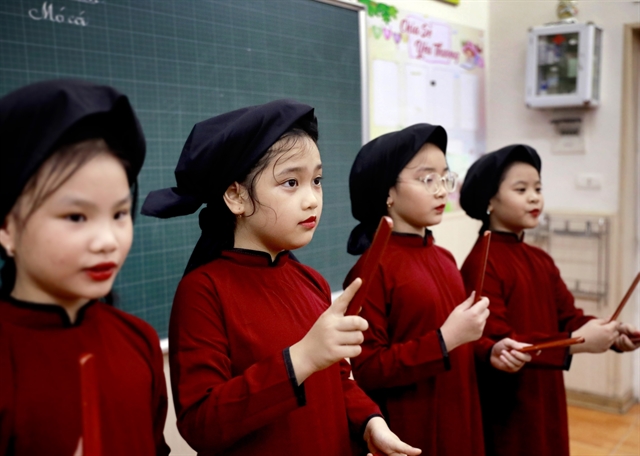 |
| LEARNING YOUNG: School students perform traditional Xoan singing. VNA/VNS Photos |
PHÚ THỌ —In a small classroom at Hùng Lô Primary School in Phú Thọ Province, the lively rhythms of drums and clappers blend with the clear voices of children singing ancient Xoan melodies.
At the front of the class, a veteran Xoan artist and a music teacher patiently guide each movement, adjusting the beat of the clappers and refining every graceful gesture.
Once heard only in village communal houses and sacred temples, these centuries-old folk songs are now finding new life in schools, carried proudly by a younger generation eager to preserve the cultural soul of Việt Nam’s ancestral land.
Xoan singing is one of the oldest forms of traditional ritual performance in Việt Nam, originating from Phú Thọ.
Closely associated with the worship of the Hùng Kings, this precious heritage has been inscribed by UNESCO as a Representative Intangible Cultural Heritage of Humanity.
No longer confined to traditional Xoan singing villages, Xoan singing has for many years been present in schools through classroom lessons, extracurricular activities and arts clubs.
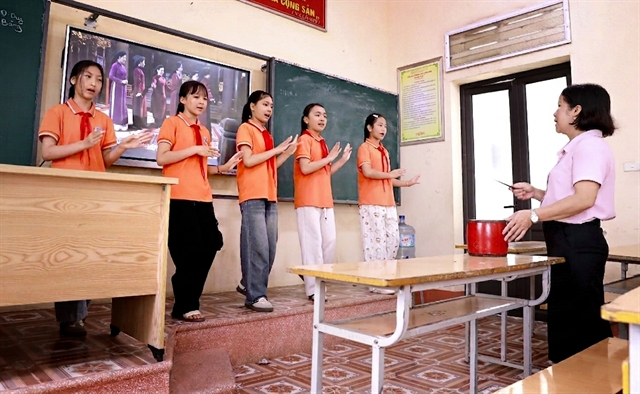 |
| GETTING TO GRIPS: Students practise Xoan singing under the guidance of a music teacher. |
Bringing this heritage into schools is considered an important approach to preserve and transmit the unique intangible cultural values of the ancestral land to today's young generation.
Heritage in school
In efforts to bring Xoan singing close to students, the Phú Thọ education sector has identified heritage education as an important measure to nurture love of traditional culture among young people.
Nguyễn Quang Minh, vice director of the Department of Education and Training, said that during the country’s development and international integration, the issue of values education, particularly cultural education, would continue to be a top priority for the education sector.
In the coming years, the department would continue working with relevant bodies and schools in the area to strongly promote the intangible cultural heritage of Xoan singing, contributing to improving the effectiveness of traditional education for younger generations, Minh said.
So far, Xoan singing has become part of the primary and secondary education programme in Phú Thọ.
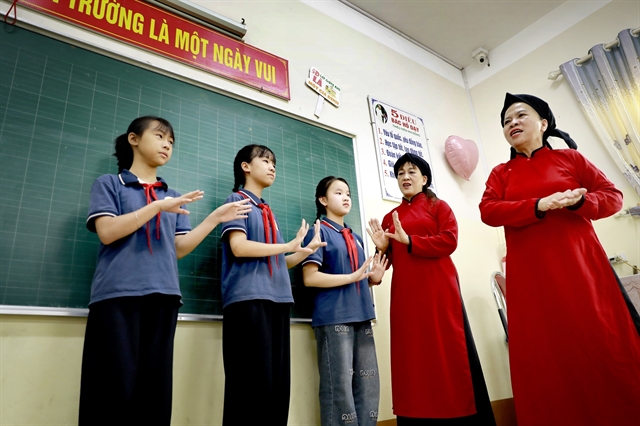 |
| MASTERING: Master artisans guide students in learning traditional Xoan melodies. |
Xoan singing clubs continue to be regularly maintained in many educational institutions, attracting a large number of students and creating cultural spaces rich in the colours of the ancestral land, where the heritage lives alongside the childhood of students.
Music teachers from preschool to junior high school in the province have been participating in systematic training courses, honing their skills in singing, dancing and performing ancient Xoan songs.
They serve as important bridges, bringing Xoan melodies from traditional religious spaces into classrooms so that the heritage continues to resonate, becoming deeply ingrained in memories and nurturing the souls of today’s young generation.
In the core areas of the Xoan singing heritage such as Kim Đức, Hùng Lộc, Văn Phú and Gia Cẩm, the model of cooperation between schools and ancient Xoan singing troupes has continued to be maintained.
Students not only learn in classrooms but also directly visit village communal houses and ancient temples, listen to Xoan singers tell stories about the tradition of forming brotherhoods within Xoan singing troupes, learn how to play clappers and drums, and practise courtship dances in traditional cultural settings.
Heritage keepers
Gia Cẩm Primary School in Việt Trì Ward is one of the bright spots in integrating Xoan singing into school activities, making Xoan melodies more accessible to students.
The school has nearly 2,000 students, many of whom can sing basic Xoan melodies proficiently while performing the rhythm and traditional dance movements correctly.
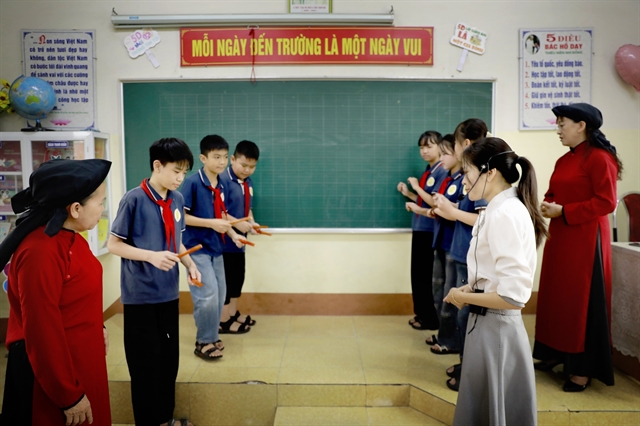 |
| STYLISTIC: Xoan singing artisans guide students in learning traditional clapper rhythms. |
The school currently maintains a Xoan singing club organised by class and interest group, and has built a core group of approximately 250 students who regularly participate in performances and exchanges at local cultural events and festivals.
During club activities, the sounds of drums and percussion instruments, together with the love songs, have become familiar in the schoolyard, contributing to nurturing a love for heritage among students.
Behind the Xoan singing activities in school are the perseverance and dedication of performers, music teachers and cultural and educational staff in their journey to pass this heritage on to younger generations.
Master Artisan Nguyễn Thị Lịch, head of Xoan An Thái Troupe, said the children learned Xoan melodies very quickly and loved singing.
“However, for Xoan singing to be truly passed on in schools, it is essential to create conditions for master artisans to continue collaborating with schools in teaching, helping students understand and appreciate the cultural heritage of their homeland even more,” Lịch said.
Lê Thị Lan Anh, principal of Hùng Lô Primary School, expressed hope that the provincial education sector and government would pay more attention and create favourable conditions for schools to set up programmes and organise activities relating to Xoan singing on a wider scale.
As a music teacher at Kim Đức Secondary School, Nguyễn Thị Bích Việt understands the difficulties in bringing Xoan folk songs closer to students.
“Many Xoan folk songs have melodies, rules and local dialect that are quite difficult for students accustomed to modern music to understand,” Việt said.
“Therefore, teachers often choose cheerful, easy-to-remember melodies to teach first, combining them with the use of clappers, drums and visual aids, while also organising field trips to ancient Xoan villages to create interest for students,” the teacher said.
Keeping heritage alive
The devotion and patience of artists and teachers have yielded sweet fruit. Nguyễn Ngọc Quỳnh Anh, a student at Kim Đức Secondary School, said she was very happy when performing Xoan singing at some traditional festivals.
“Every time I wear traditional costumes, hold the clappers and perform with my friends, I feel very proud of my hometown. I want to continue learning Xoan singing to introduce more friends and tourists to the heritage of Phú Thọ,” Quỳnh Anh said.
In the modern flow of today’s entertainment trends, bringing Xoan singing into schools is considered an appropriate approach for preserving and promoting heritage within the community.
In the coming time, the Phú Thọ Department of Education and Training and the Department of Culture, Sport and Tourism plan to apply digital technology in preserving and passing on Xoan singing.
Along with hands-on teaching models, the province has gradually established a digital database of Xoan singing including video, images, electronic resources and online lectures to create more accessible ways for students to engage with this ancient folk art in the digital era.
As today's students enthusiastically learn each rhythm and each love song, these ancient Xoan melodies continue to be cherished, preserved and passed on to future generations. VNS
Features
 Features
 Features
 Features
 Features
 Features
 Features
 Features
 Features
 Features
 Features
 Features
 Features
 Features
 Features