 Features

Top Vietnamese leader highlights new horizon for Việt Nam–Denmark cooperation
1.
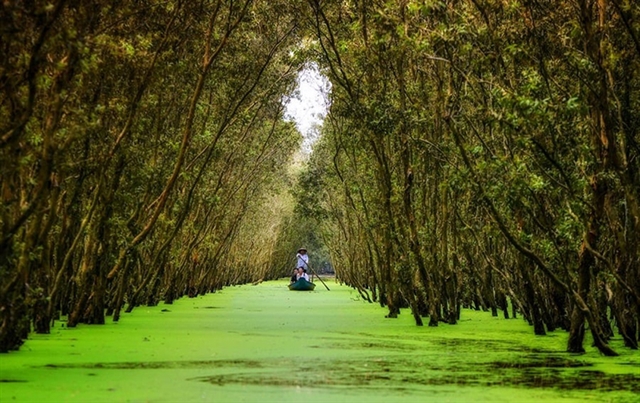 |
| A tourist boat navigates through narrow waterways beneath the cajuput canopy. Trà Sư has also become one of An Giang’s main eco-tourism sites, now attracting hundreds of thousands of visitors annually. Photo vietnam.travel |
To many visitors, Trà Sư is a peaceful maze of green canals and towering cajuput trees. But beneath its tranquil surface lies a living wetland, carefully guarded day and night to preserve one of the Mekong Delta’s most fragile ecosystems.
Spread over more than 1,050 hectares in the southern province of An Giang, the Trà Sư cajuput forest plays a vital role in safeguarding wetland biodiversity and maintaining the ecological balance of the upper Mekong Delta.
Recognised as a protected landscape since 2005, the forest has become a key conservation stronghold, as well as a prominent eco-tourism destination.
Behind its tranquil waterways and lush cajuput trees lies the constant, often unseen work of forest rangers tasked with protecting one of the delta’s most important natural buffers.
Trà Sư forms part of Việt Nam’s system of special-use forests and lies close to the country’s southwestern border.
Its wetland ecosystem supports a wide range of plant and animal species, including several listed in the Việt Nam Red Book.
The area also contributes to flood regulation, climate resilience and environmental security for surrounding agricultural zones.
Quiet vigilance
In mid-December, as floodwaters gradually recede and the northeast monsoon brings cooler air to the delta, ranger patrols intensify their work inside the forest’s strictly protected core zone.
Access to this area is limited and carefully controlled.
The rangers travel first along perimeter dykes before switching to small hand-rowed boats to navigate narrow canals deep beneath the cajuput canopy.
According to Nguyễn Thái Trọng, a forest protection officer of the An Giang Forest Management Board, Trà Sư’s land-use structure reflects the complexity of a managed wetland.
The landscape includes cajuput forests planted in acidic soil, seasonally flooded open land and water surfaces, agricultural lands, and a smaller service zone designated for eco-tourism activities.
Functional zoning divides the area into strictly protected, ecological restoration and service–administrative sub-zones.
Despite its protected status, the forest continues to face pressure from illegal activities.
“Bird hunting and unauthorised fishing still occur, and the methods used are becoming more difficult to detect,” Trọng said.
The forest borders rice fields and residential areas, and the number of rangers is limited relative to its size.
Night patrols are among the most demanding tasks, with rangers often moving without lights or sound to avoid detection.
Encounters with poachers can be dangerous, as some carry knives and homemade hunting tools. With minimal equipment, rangers rely heavily on experience and coordination with local authorities to ensure safety and enforcement.
Fire prevention is another constant concern.
During the dry season, thick ground vegetation and nearby field burning significantly increase fire risk. The rangers have to remain on constant alert, as even a small spark could cause extensive damage under dry conditions.
Lâm Văn Xương, a senior forest protection officer, said that since the beginning of 2025, the unit had detected multiple cases of illegal intrusion and prevented several unauthorised entries, with case files transferred to competent authorities for further handling.
He noted that climate change was adding new challenges, with longer dry seasons, faster water recession and increasingly erratic rainfall altering habitats and affecting wildlife patterns.
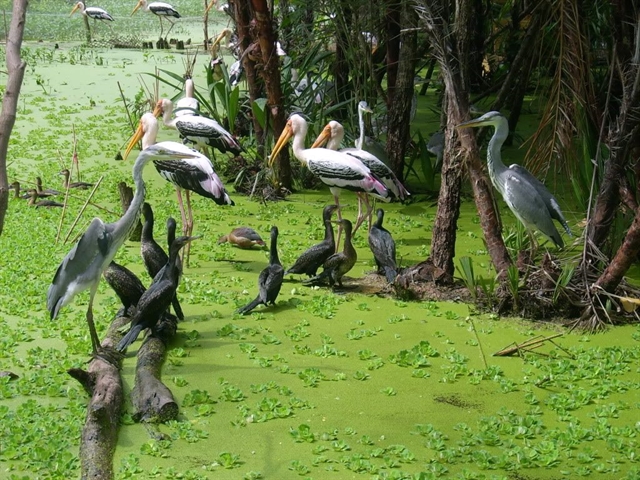 |
| Waterbirds gather beneath the cajuput canopy at Trà Sư, a protected wetland habitat that attracts numerous rare and migratory species. Photo vinpearl.com |
Living wetland
Located around 10 kilometres from the Việt Nam–Cambodia border and approximately 15 km from the Mekong River, Trà Sư is directly influenced by the river’s annual flood cycle.
This natural flooding underpins the forest’s biological diversity and productivity.
The area supports dozens of bird species, including rare and endangered waterbirds, mammals, reptiles and amphibians adapted to wetland conditions.
Aquatic biodiversity is particularly rich, with a wide range of fish species that play an important role in maintaining ecological balance and supporting scientific research.
Trà Sư has also become one of An Giang’s main eco-tourism sites, attracting hundreds of thousands of visitors annually.
Tourism activities, however, are confined to designated zones to minimise ecological disturbance.
According to Trần Nguyên Kháng, a deputy director of the An Giang Forest Management Board, updated plans clearly define functional zones within the protected landscape alongside a buffer zone of more than 1,150 ha across neighbouring communes.
These buffer areas are critical for reducing human pressure on the forest core and for engaging local communities in conservation efforts.
Looking ahead, the management board plans to strengthen cooperation with local authorities and relevant agencies to improve public awareness of forest protection regulations, prevent illegal hunting and fishing, and reduce environmental pollution.
Fire prevention and control remain a priority, particularly during prolonged dry periods.
At the same time the board aims to develop sustainable revenue streams from eco-tourism and forest-based services, so that income generated from the site can be reinvested in conservation and management.
Mechanisms are also being expanded to allow communities in the buffer zone to participate in forest protection, fire prevention and eco-tourism activities.
By combining strict protection with community involvement and sustainable use, Trà Sư is expected to continue serving as a representative wetland ecosystem of the western Hậu River area, while contributing to regional conservation cooperation in the lower Mekong basin. VNS
Features
 Features
 Features
 Features
 Features
 Features
 Features
 Features
 Features
 Features
 Features
 Features
 Features
 Features
 Features