 Features

Việt Nam reaffirms ASEAN support for UN radiation scientific committee
1.
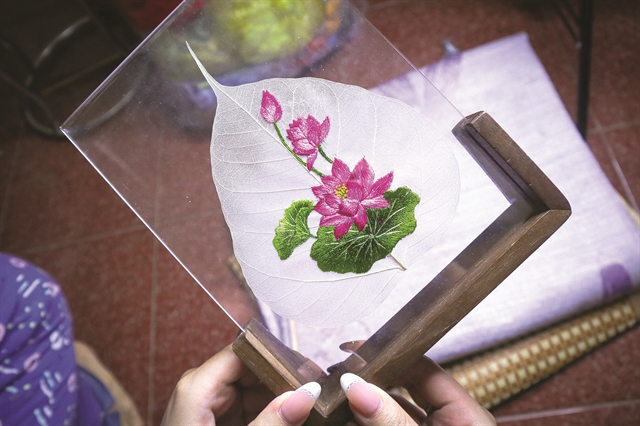 |
| Fragile bodhi skeleton leaves are transformed into exquisite works of art, a testament to the artisan’s exceptional skill in working with delicate natural materials. VNS Photo Tường Vi |
Tường Vi, Như Yến & Xuân Nhi
Just beyond the hum of tour boats and souvenir stalls in Tam Cốc–Bích Động, Văn Lâm embroidery village unfolds at a different pace. For more than seven centuries, needles have moved steadily here, stitching stories of labour, belief and quiet endurance into cloth.
In this small corner of Ninh Bình Province, embroidery is not a performance for visitors but a living inheritance – patiently preserved by hands that refuse to let time erase what history has entrusted to them.
Tracing its roots back to the 13th century, the art of embroidery in Văn Lâm blossomed under the Trần Dynasty, becoming a defining cultural pulse of this ancient land.
During its peak, the village was a thriving hub where nearly 80 per cent of households depended on the needle and thread for their livelihood. Today, while market forces have dimmed the trade’s financial allure, the artisans of Văn Lâm remain steadfast.
For them, embroidery transcends economic necessity; it is an indelible part of their cultural identity.
Đinh Đức Hùng, a 60-year-old master artisan with four decades of experience, recalls the old days with nostalgia: "Back then, the whole village lived and breathed embroidery. We would finish working the rice fields and immediately sit at our frames; even just five or ten minutes was enough to add a few stitches.
"This trade put food on the table and sent my children to school. Orders are scarcer now, but I can't bring myself to quit. It’s a family tradition – once you fall in love with it, you simply keep going."
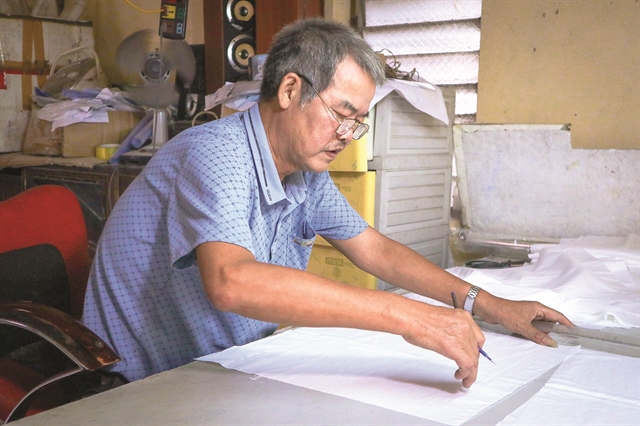 |
| Artisan Đinh Đức Hùng, 60, works diligently at his embroidery frame, preserving an ancestral craft that has supported his family for decades. VNS Photo Tường Vi |
It is this humble devotion that has quietly bound generations together, keeping the flame of the trade alive in Văn Lâm’s small cottages for hundreds of years.
Innovation on canvas
If you believe embroidery is confined to the weave of fabric, Văn Lâm is about to challenge your perception. Here, the artisans’ ingenuity has touched a medium that seems impossibly delicate – the sacred bodhi leaf.
Đinh Thị Nguyên, 65, a master artisan who first picked up a needle at the age of ten, speaks with animation about this creative pivot.
“Rather than embroidering on conventional cotton fabric, I work on preserved bodhi leaf skeletons,” she explains.
“The leaf skeleton is incredibly fragile; one wrong move and it tears, but a finished piece is priceless. The provincial authorities even commissioned me to lead three training courses, all of which were a success. My greatest joy is simply seeing the next generation keep our ancestors' craft alive.”
Inside her modest showroom, embroideries on bodhi skeleton leaves are nothing short of exquisite. Depicting scenes from the Bái Đính Pagoda and the ancient capital of Hoa Lư, as well as spiritual motifs like the Buddha and the lotus, each stitch serves as a testament to immense patience and deep reverence.
The highlight of the gallery is The Red Phoenix, a striking, vibrant 3D embroidery piece that seems ready to take flight.
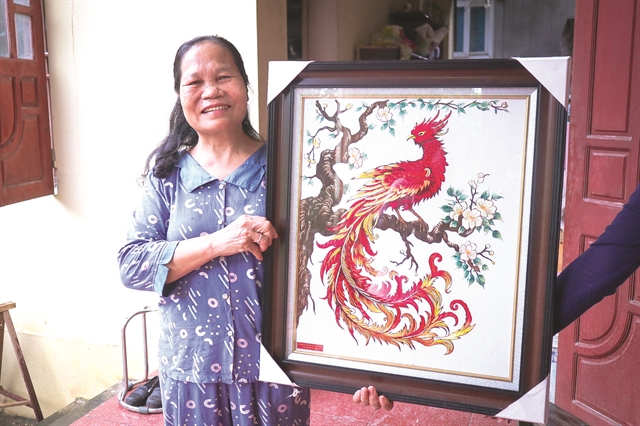 |
| Master artisan Đinh Thị Nguyên beams with pride beside her vibrant 3D embroidery piece, 'The Red Phoenix'.VNS Photo Tường Vi |
As she explains how to create 3D effects on fabric, Nguyên proudly shares the story of her masterpieces: a huge 4sq.m picture of the Chiếu Dời Đô (Royal Edict on the Transfer of the Capital) and the landscapes of Hoa Lư. This work was made specially for the 1,000th Anniversary of Thăng Long–Hà Nội.
Whether currently on display or recalled from memory, Nguyên’s art is a perfect example of meticulous hand craftsmanship. Every soft thread is stitched with the care of a painter's brush.
Threading tradition
While Văn Lâm’s diverse array of handcrafted goods is impressive, what truly captivates international visitors is the unique opportunity to sit down and thread their first needle under the direct guidance of local artisans.
The setting itself is undeniably charming. With sturdy bamboo frames, spools of vibrant thread, and soft, warm lighting, the workshop offers a rustic, immersive atmosphere that guests find irresistible.
Nguyên shares her experience with a smile. “I guide them hand-over-hand, she says. "Some guests pick it up incredibly fast, creating a flower pattern in just a few minutes. They absolutely love it, often signing their names on the fabric to keep as a souvenir. Embroidery isn't magic; it just takes a little patience.”
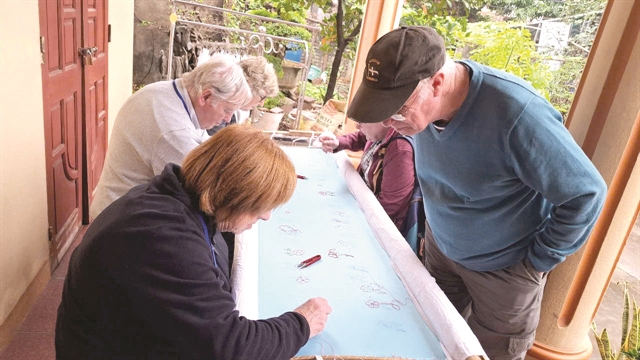 |
| Foreign visitors try their hand at embroidery on rustic bamboo frames – an unforgettable highlight of their journey to Văn Lâm Village. Photo courtesy of Đinh Thị Nguyên |
However, the experience goes far beyond technical instruction. Visitors get a front-row seat to watch artisans perform complex traditional techniques while listening to intimate stories of their lives and the trade tales you won't find in any guidebook.
This exchange brings the village to life. The air is often filled with a sense of warmth and infectious laughter, especially when guests giggle at their own "debut masterpieces" – stitches that might be a little wobbly, but are woven with genuine joy.
The spark of tradition
Despite its growing reputation as a cultural hub, the craft of embroidery still faces persistent challenges of modest income and a shrinking workforce.
Nguyên speaks with open-hearted honesty about the future: "My only wish is for the authorities to support us so the craft can survive. I also hope the younger generation will take this online so the world knows we are here. As long as we have visitors and students, the craft will breathe."
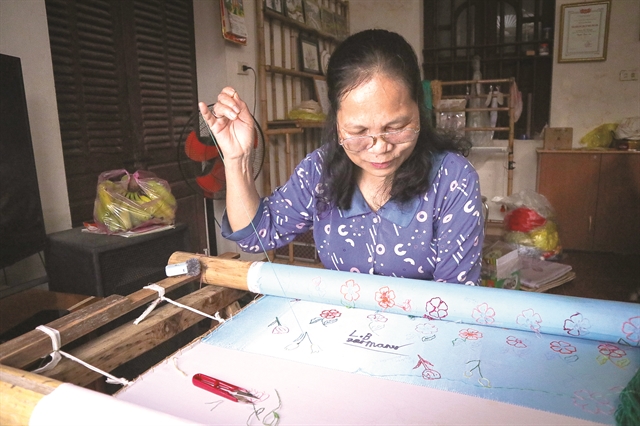 |
| Quietly guarding the flame amid the modern hustle, artisans like Nguyên place their hopes in the next generation to carry this legacy forward. VNS Photo Tường Vi |
In fact, this digital shift is already underway. Young creators have begun filming vlogs and workshop reviews, effectively pinning Văn Lâm onto Ninh Bình’s experiential tourism map.
From a different perspective, Hùng expresses a simple yet touching wish: "If our daily wages were just a little higher, the embroiderers would remain. The craft is here, the masters are here, and we still hold our annual village competitions. We just need that extra bit of motivation to ensure this legacy lasts."
Though modest, these hopes act as the essential pulse keeping this rare craft alive within the heart of Việt Nam's ancient capital.
Stepping into Văn Lâm is stepping away from the hustle into a deeper, slower realm. Here, heritage isn't locked behind glass cabinets; it lives in the hands of artisans who diligently stitch through sunny afternoons and rainy days alike.
Văn Lâm embroidery isn't loud or flashy. Yet, it is that very meticulous, enduring patience that breathes life into this rare tradition of Ninh Bình. VNS
Features
 Features
 Features
 Features
 Features
 Features
 Features
 Features
 Features
 Features
 Features
 Features
 Features
 Features
 Features