 Features
Hit Vietnamese song featured in British album
1.
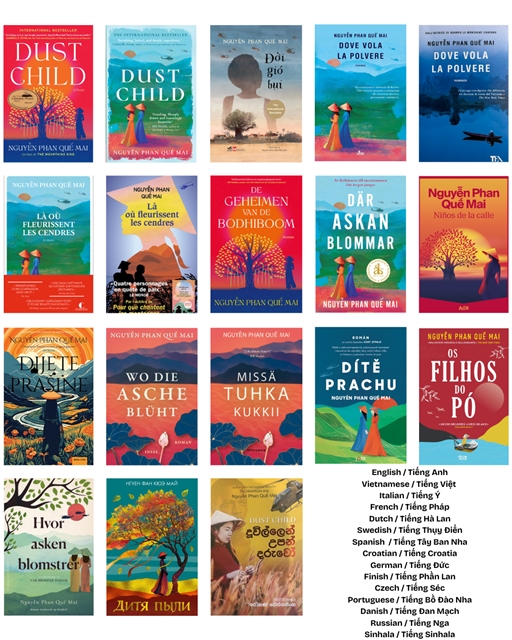 |
| POWER OF WORDS: The cover of the book 'Dust Child' in 15 languages. Photo coutersy of Nguyễn Phan Quế Mai |
Nguyễn Hồng Anh
Once again, it is about war. Brutal battlefields. Postwar trauma. Heroic epics. Psychological wounds. What, then, has not yet been spoken of in this collective memory of war?
Amid an abundance of narratives already told – about soldiers, about loss, about reconciliation and forgiveness – readers have become increasingly demanding when faced with a new novel written within the same thematic constellation.
That thought came to me as I held in my hands Nguyễn Phan Quế Mai’s novel Dust Child. Along with it arose a series of questions: What remains untold? Which wounds have yet to be named? What forms of forgetting might the writer uncover?
Upon reaching the final page, I did not wish to set the book down immediately. Instead, I turned back to the author’s dedication:
“For Amerasians and their family members who shared with me their personal stories and who inspire me with their courage. For the millions of men, women and children who were pulled into the vortex of the Vietnam War. For anyone whose life has been touched by violence…”
And I lingered there for a long time – not because the book offers a new perspective on war, but because it draws forgotten lives back into the centre of history: bar girls, mixed-race children, the silent witnesses of a war not of their own choosing. They are the ones who remain after everything. And it is they who compel us to reread history from the bottom up.
Rich in detail
The novel is structured through multiple interwoven narrative strands: the 1969 past, following the footsteps of Trang and Quỳnh, two young women from the countryside who go to the city and become bar girls, entwined with the love affair between Trang and an American soldier named Dan; a more recent past, from 1984 to 1993, recounting the early years of Phong, an abandoned Amerasian child; and finally the present of 2016, where these narrative strands converge and the characters gradually encounter one another, directly or through memory.
Despite its many characters and temporal layers, the story remains easy to follow thanks to a plain, detail-rich but unhurried mode of narration, which maintains a measured rhythm throughout.
This narrative rhythm is perhaps most clearly felt in the love affair between Trang and Dan – a bar girl and an American helicopter pilot: at times intense and feverish in their passionate lovemaking; at other times hushed and tender, as in the afternoon when Trang sits on the bed reading poetry to Dan, or when she sings him to sleep, or when the two of them watch the rain fall together – Dan, who’d “been frightened of it, but Kim [Trang’s other name] had said rain was her music”.
Sadly, those heart-stilling moments of quiet beauty are not enough to save anyone, not enough to heal the wound steadily gnawing at Dan’s spirit as he sinks deeper into the war, nor enough to protect Trang and her dream of love. War ultimately surges into what once seemed a sanctuary, like a flood impossible to hold back, despite all of Trang’s efforts.
Perhaps there is no need to further analyse these tragedies – they are rendered all too clearly through a straightforward narrative form that neither embellishes nor conceals. What drew my attention instead was the way the author allows her characters to survive those tragedies: through the telling of stories that are not true.
Indeed, the novel contains many fabricated stories. Some are invented for profit or to conceal political schemes. Mr Khuất concocts a story of adopting Phong so that the whole family can go to the United States under the Amerasian repatriation programme. A mother fabricates an American dog tag in the hope that her child might find his father and sponsor her passage to America. Stories are distorted, turned into instruments of propaganda.
No, those are not the fabrications I wish to speak of. I want to address the stories imagined in order to soothe pain, to hold on to dignity, to go on living. Stories that are made up not to deceive, but to heal.
Stories create history, and history – as we often assume – may not necessarily be the truth. History becomes history when people believe in the stories that are told. Perhaps Trang’s and Quỳnh’s parents went to their deaths believing that their daughters had gone to Saigon to work as office employees, then married American husbands and lived happily abroad, through the letters sent home – “Those letters hardly contained any truth, but they were beautiful to read. And upon rereading them, she saw how writing them had enabled not just herself but her loved ones to escape horror, and to experience the taste of another life.”
Perhaps Phong, until the very end of the novel, still believes that his father was an American administrative worker named Tim, who loved his mother deeply and died in a military sweep, unaware that Quỳnh, his mother, fabricated that entire biography so that he would not have to live in shame, when his real father could have been any one of the men who slept with her.
Truthful reflection
Such fictional stories are passed down like an inheritance, forming the history of an individual, a family, and gradually a community, with a single purpose: survival. The function of storytelling is not merely to conceal wounds; it creates another reality – one that can contain imagination and turn dreams into truth – where Trang, Quỳnh and Phong alike may find love and an authentic origin.
People can endure tragedy through imagination. In ordinary circumstances, one might easily criticise such a response: hiding trauma within fabricated stories. But in a reality as brutal as war, one can fully understand and empathise: imagined stories are the most truthful reflection of the history of the human soul, set against the history of events, a double-sided mirror reflecting both a hypothetical history and a history that has actually taken place.
Grand historical narratives always bear the imprint of events, numbers, proclamations, and victories. Personal history, by contrast, consists only of fragmented tellings, of memories, and of stories that no one can verify.
But which is more true?
As I neared the end of the novel, I found myself returning to the question of how to tell a true war story. This is also the title of one of Tim O’Brien’s most famous short stories, How to Tell a True War Story, included in The Things They Carried. And within that very story, I found O’Brien’s definition of a “true war story”: that they “do not generalise” and that they are "never about war”.
For this very reason, Mai’s novel does not produce a panoramic map of the war. It speaks only of those people regarded as marginal to history: a bar girl named Trang, another named Quỳnh, a mixed-race child named Phong, a former Saigon soldier named Thiên.
Yet it is precisely they who, through their bodies, their memories, and even their silences, add to the catastrophic face of the American war in Vietnam. Not through battlefields, weaponry, or peace talks, but through smouldering wounds that extend across decades – private life stories no one wishes to hear.
The moment when Dan stands gazing at Trang’s photograph – a photograph of an 18-year-old girl, “beautiful and full of life” – is one of the novel’s quietest yet most moving scenes. It is the moment when Trang is restored whole within the memory of her former lover. Though more than 40 years have passed between them, that moment still arrives. Late, but better than never.
And perhaps that is the most moving thing literature can do: bring a life buried beneath social prejudice back into the light, restore the full dignity of people once despised and forgotten by history. — VNS
An Award-Winning AuthorNguyễn Phan Quế Mai is a Vietnamese novelist, poet and translator whose work bridges cultures and generations shaped by war. Born and raised in Việt Nam, she came of age in the postwar period, an experience that deeply informs her writing. Before turning to fiction in English, she published several award-winning poetry collections in Vietnamese, earning recognition for her lyrical voice and commitment to memory, reconciliation and social healing.Her international breakthrough came with The Mountains Sing (2019), a multi-generational saga about a Vietnamese family across the 20th century, which received numerous literary prizes and was translated into many languages. With Dust Child (2023), she turned her focus to the lives of Amerasians — children born to Vietnamese mothers and American soldiers during the Vietnam War — exploring identity, stigma and the long shadow of the war.
Features
 Features
 Features
 Features
 Features
 Features
 Features
 Features
 Features
 Features
 Features
 Features
 Features
 Features
 Features