 Features
Hit Vietnamese song featured in British album
1.
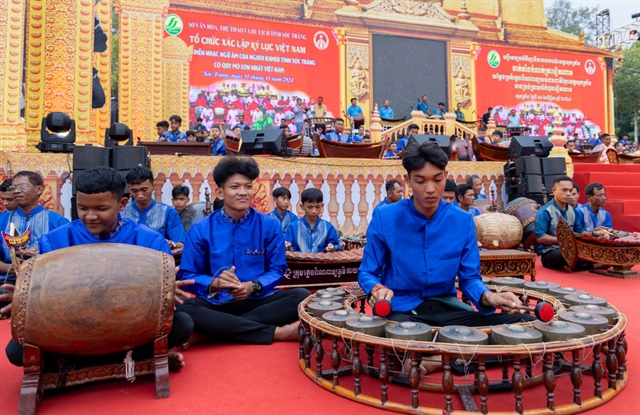 |
| A Khmer art ensemble is performing pentatonic music, a form of ritual and religious music distinctive to Khmer communities practising Theravada Buddhism. VNA/VNS Photo |
On quiet mornings in the Mekong Delta, the sound of drums and gongs drifts gently from Khmer pagodas – a reminder that an ancient musical tradition is still very much alive.
Once confined to pagodas and religious rituals, the traditional Southern ethnic Khmer pentatonic music is now increasingly finding new spaces for expression, carrying forward a living heritage rooted in spiritual life, communal memory and cultural identity.
From the tranquil Khmer pagodas of the Mekong Delta to cultural exchange spaces in the heart of Hà Nội, Khmer music based on a five-note (pentatonic) scale is moving beyond ritual settings to sustain the enduring journey of a “living heritage”.
Sounds of memory
In each drumbeat and melodic phrase reside communal memories, spiritual beliefs and the aspiration to preserve Khmer identity amid modern change.
Khmer pentatonic music is a form of ritual and religious ensemble music distinctive to Khmer communities practising Theravada Buddhism.
Closely intertwined with community life in pagodas, villages and hamlets, this art form bears the influence of Indian court and religious music while also interacting with musical traditions across Southeast Asia.
Sharing his journey of introducing pentatonic music to audiences in Hà Nội, Thạch Anh Xuân, celebrated artist and producer of Khmer traditional musical instruments, expressed his pride in bringing a pentatonic music ensemble from the Mekong Delta to the capital to perform and engage with local residents and international visitors.
“It is a great honour for us to present sounds deeply rooted in our ethnic identity, to foster cultural exchange and to spread the unique values of the Khmer people right in the heart of the capital,” Xuân said.
According to the artist, preserving heritage is not limited to maintaining original forms but also requires adaptation to contemporary life.
“We are always conscious of our responsibility to safeguard Khmer culture and arts. In the development process, fellow artists reflect on cultural interaction and create more representative works, perhaps combining Khmer music with Vietnamese, French or English melodies, to make them more accessible to the public. When listeners find resonance in the music, that is when traditional music truly becomes part of the global cultural flow,” he noted.
The structure of the pentatonic ensemble is built on the principle of the five elements, including metal, wood, water, fire and earth, reflecting balance and harmony of yin and yang in Eastern philosophy.
The ensemble typically consists of percussion-dominated instruments, including roneat (wooden or bamboo xylophones), kuong vong (sets of tuned gongs arranged in a circular frame), skor (barrel drums), and chhing (small hand cymbals).
In Cần Thơ City today, more than 20 musical pieces remain in common use.
Among them, the ancestral piece (Sa thô ka) is the most important, always performed at the opening of pentatonic music performances in all Khmer religious ceremonies and funerals.
Together with other formal pieces, it forms the core repertoire with long historical roots, serving as the foundation for the development of subsequent compositions.
Within the ensemble, the roneat plays a central role, leading melodic lines and guiding harmonic coordination, as well as opening and closing performances.
Each instrument, with its distinct role and technique, contributes to a seamless and complete musical whole.
The music is characterized by cyclical rhythms, ornamented melodies and strong ritual function.
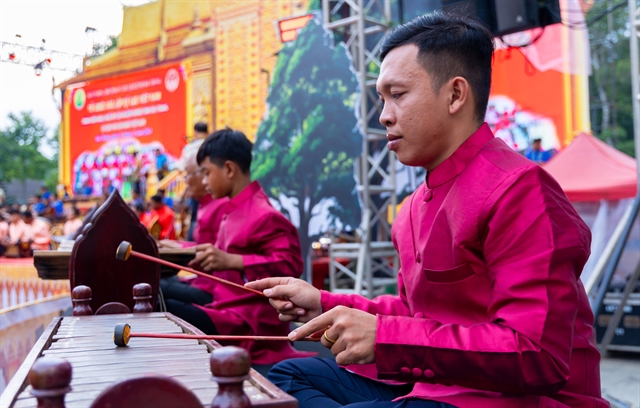 |
| Beyond serving traditional cultural life, pentatonic music should be brought into broader public spaces. VNA/VNS Photo |
According to Xuân, five-note-scale music is deeply embedded in the spiritual life of Khmer communities, performed in pagoda rituals, Theravada Buddhist ceremonies and major communal events such as the Ok-Om-Bok Festival, Chôl Chnăm Thmây (Khmer New Year), Sene Dolta, and household merit-making rites.
Khmer pagodas have become the central spaces for preserving and promoting pentatonic music.
Beyond serving as centres for religious practice, they are also closely connected to the lives of Khmer men.
Alongside Buddhist teachings and life knowledge, generations have naturally learned, practised and absorbed pentatonic music within this environment.
According to Venerable Lý Hùng, a member of the Executive Council and deputy head of the Central Legal Affairs Committee of the Việt Nam Buddhist Sangha, preserving and promoting ethnic cultural identity, particularly the intangible heritage of pentatonic music, is of special importance, as it is indispensable to social life and the year-round system of traditional rituals within the community.
He noted that for the first time, a Khmer pentatonic music ensemble was invited by the Việt Nam National Authority of Tourism (under the Ministry of Culture, Sports and Tourism) in coordination with the Việt Nam Museum of Ethnology to perform and engage with other ethnic communities, including the Mường.
This initiative not only introduced distinctive artistic performances but also demonstrated concrete efforts to preserve pentatonic music, alongside the attention and support of authorities through ethnic policies aimed at improving the cultural and spiritual life of the Khmer people.
Venerable Hùng emphasised that pagodas and Theravada Buddhist dignitaries played a pivotal role in ensuring the continuity of pentatonic music, closely linking it to religious practice and strengthening community solidarity.
Beyond serving traditional cultural life, Khmer pentatonic music should be brought into broader public spaces, acting as a bridge for other ethnic communities and domestic and international visitors to access, interact with and experience the unique values of Khmer cultural heritage.
Passing it on
At present, the transmission of the traditional music to Khmer younger generations is mainly carried out through classes held at pagodas in Cần Thơ City.
Several institutions have actively maintained training and preservation activities, including Dơi Pagoda, Chén Kiểu Pagoda and Som Rong Pagoda.
In addition, more institutions are now involved in training, such as ethnic boarding schools, intermediate schools of culture and arts, and local cultural centres.
This diversification of teaching methods has played an important role in preservation and promotion, while also opening new creative pathways for pentatonic music in contemporary life.
Lâm Hồng Nhựt, from Phú Tâm Commune in Cần Thơ City, works in farming on ordinary days and only performs during festivals or ceremonial events.
Thanks to training classes the provincial cultural authority organised at pagodas, he and fellow performers receive formal instruction, certification and partial financial support.
However, income from performances remains unstable, requiring him to take on other work to support his livelihood.
He said that pagodas consistently provided favourable conditions, and local authorities had invested in musical instruments for pagodas, as purchasing instruments independently is extremely difficult for artists.
A complete, high-quality pentatonic ensemble could cost hundreds of millions of đồng.
Occasionally, artists have opportunities to perform for tourists at resorts or cultural tourism sites, though performances remain irregular.
“I hope there will be support to replace deteriorating instruments and to open more classes at pagodas. As long as there are learners and performers, pentatonic music can continue to live within the community,” Nhựt said.
From a tourism perspective, Nguyễn Văn Duy, a tour guide at Sam Rong Pagoda, said that when leading visitors through Khmer pagodas, he not only introduced architectural features but also explained Khmer history and culture, in which traditional music based on five-note scale plays an important role in religious life.
Previously, many visitors were unaware of this musical form.
Today, social media helped pentatonic music gain wider recognition, though in-depth understanding remained limited.
According to Duy, if pentatonic music were incorporated appropriately into tourism programmes, with organised performances and reasonable fees, visitors would be supportive, as feedback from tourists had been consistently positive.
Recognising the challenges in preserving and promoting ethnic cultural values, Venerable Hùng said the Buddhist Sangha was coordinating with relevant departments and agencies while proposing greater attention to training successive generations of performers, gradually raising skill levels from basic to intermediate.
The focus, he stressed, would be on creating sustainable livelihoods so that traditional music could become a viable profession, enabling artists to serve wider audiences. VNS
Features
 Features
 Features
 Features
 Features
 Features
 Features
 Features
 Features
 Features
 Features
 Features
 Features
 Features
 Features