 Features

SBV to curb property price inflation, enforce lending rate rules
1.
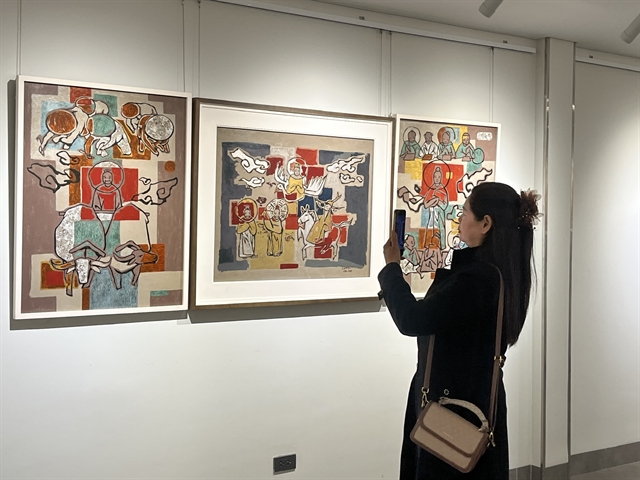 |
| A visitor view artworks at the exhibition. VNA/VNS Photo |
Công Bắc & Lương Hương
Painter Đỗ Đức has devoted decades to the northern mountainous regions, capturing landscapes where horses are not merely subjects, but faithful partners in human survival, reflecting resilience, dignity and an enduring bond with the land.
In his works, these noble creatures endure hardships alongside their human companions, embodying a profound bond of resilience and mutual reliance – a relationship forged through shared survival in the wilderness.
In his latest experiment, the 81-year-old artist embraces a fresh approach by selecting lacquer as his medium for the series Mùa Xuân Biên Cương (Spring in the Borderlands), allowing the material’s depth and texture to reveal new dimensions in his artistic vision.
The series is currently showcased in the exhibition Sắc Xuân Bính Ngọ (Spring Colours of the Year of the Horse), which is taking place at the Hoàn Kiếm Lake Cultural Information Centre in Hà Nội until March 1. It is organised by the Management Board of Hoàn Kiếm Lake and the Old Quarter of Hà Nội to celebrate the upcoming Lunar New Year, the Year of the Horse, which falls on February 17 this year.
Speaking about his connection to the mountainous regions, Đức said that it was not a fleeting choice but rather a lifelong attachment, a life that has deeply rooted itself within him.
"My life and work over the past 38 years have been intertwined with the mountains. That is my true existence," he said.
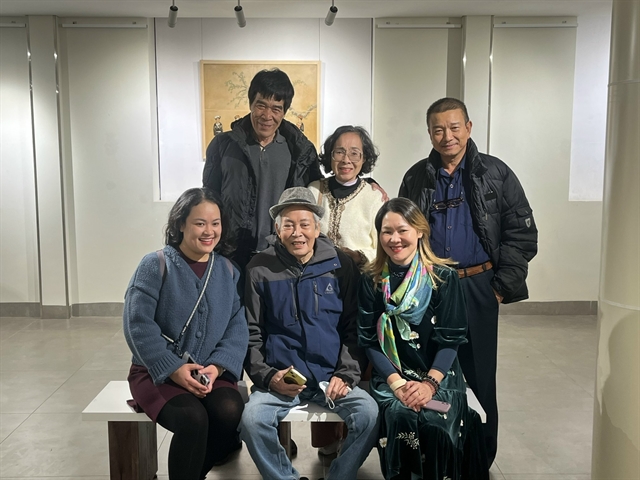 |
| Painter Đỗ Đức (centre, seated) is pictured with his friends and family at the exhibition. VNA/VNS Photo |
From here, the artist has dedicated many years to creating works centred on mountainous themes, not through grand ideas but through quiet, cherished reflections about the land, gradually accumulated over time.
As he describes it, this is a process of creation that unfolds "drop by drop, year by year, akin to ants gathering over time to fill their nest", ultimately resulting in a body of work marked by patience and quiet intensity.
Close to humanity
In his artistic legacy, the images of horses are infused with the beauty of rocky mountains and the vibrant yet harsh wilderness, a theme introduced to the public in the 2014 exhibition Ngựa Trên Núi (Horses on Mountains).
In the series Spring in the Borderlands, the image of the horse continues to make its mark, representing the familiar mountainous horse that always accompanies humanity within the majestic landscapes of the borderlands.
Đức said he had been painting horses since his early days in art school. Initially drawn to the animal's form, he began to recognise, as he spent more time immersed in the life of the mountains, that horses share many qualities with humans.
"As I painted continuously, I realised that horses are gentle, loyal, patient, and truly kind to people. There is something very close to humanity in them," he noted.
It is precisely from this perspective that painting horses gradually transforms for Đức into an act of portraiture, a practice akin to painting people.
"With my perceptions of horses evolving in a distinct way, I consider painting a horse as painting a human. With this mindset, I can paint horses extensively without feeling monotony, without repeating myself,” the artist explained.
As a result, the depiction of horses in his paintings does not mean merely illustrating reality; instead, it always carries emotional depth, invoking reflections on the human condition and character.
 |
| 'Dốc Phiềng Sa' (Phiềng Sa Slope). |
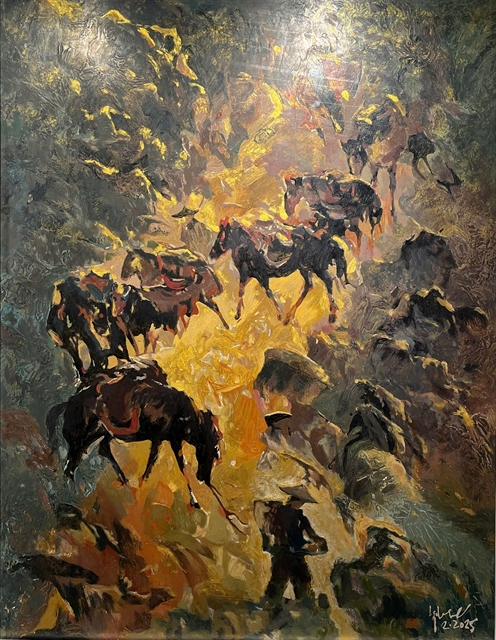
For example, in the painting Dốc Phiềng Sa (Phiềng Sa Slope), the image of the horse is tied to a journey uphill, presenting a dynamic composition that is restrained rather than dramatic. The horses are aligned in a continuous flow, with humans and horses blending into a unified movement.
The thick, layered lacquer surface creates a weighty, rough texture, reminiscent of the mountainous terrain. Here, the horses transcend their individual imagery, becoming symbols of shared hardship alongside humanity.
 |
| 'Chọn Ngựa' (Choosing Horses) |
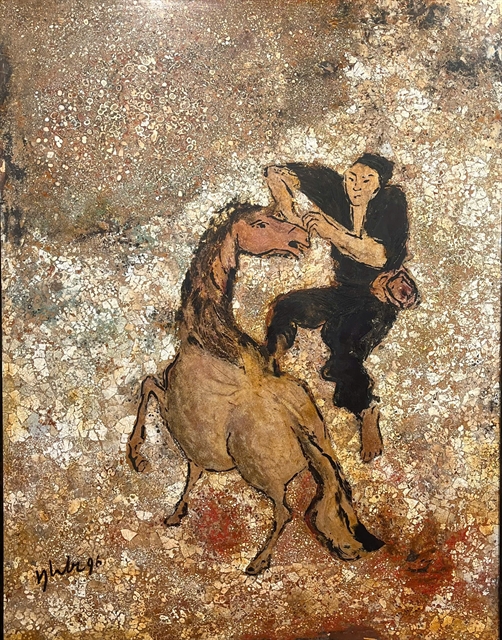
The painting Chọn Ngựa (Choosing Horses) highlights the direct relationship between humans and horses, evoking a sense of both conflict and harmony. The use of eggshell in various areas creates a visual effect that allows the figures and background to blend, blurring the lines between subject and object.
Consequently, the act of "choosing" here becomes a moment of encounter between two beings that appear bound by a quiet yet profound connection.
 |
| 'Đi Chợ' (Going to the Market) |
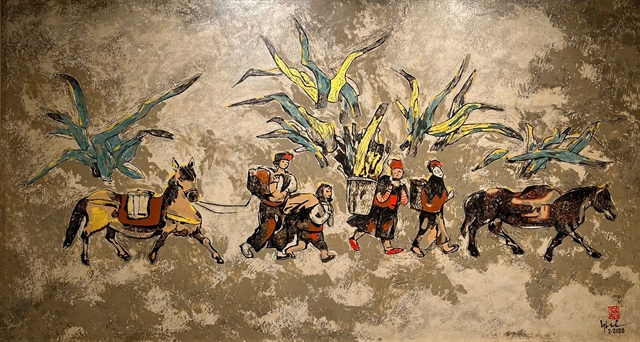
Meanwhile, the image of horses in Đi Chợ (Going to the Market) is closely intertwined with everyday life. The composition stretches horizontally, with characters and horses following one another in a leisurely, rhythmic procession.
Here, the horses are not depicted as mythical or war steeds, but as faithful companions in the journey of survival – quiet, resilient and deeply connected to the lives of the mountain people with every step.
Experiment
Another significant highlight of Spring in the Borderlands is the painter's debut introduction of works using traditional lacquer. This shift is not merely a change in medium; it opens a new chapter in his decades-long artistic journey. Many pieces have been in development for years, driven by a desire to test and explore the expressive possibilities of lacquer.
Đức said that he was trained in woodblock printing, and then spent around 30 years painting on dó (poohnah) paper before transitioning to oil. Only in recent years has he returned to lacquer. For him, working with lacquer is not a return to tradition but rather a process of rediscovery.
"In the past, each medium had its own fixed formulas. But later, I noticed many young artists thinking differently, blending materials and often achieving unexpected results,” he said.
From this observation, Đức began his experiments with lacquer. "My lacquer paintings are experimental. I adapted elements from oil painting and poohnah paper to see how the material and its language responded — whether perspectives from oil and paper could translate onto lacquer,” he added.
Many of his lacquer works might be mistaken at first glance for poohnah paper or oil paintings. The matte, opaque surface lacks shine, creating an impression that is more grounded and tactile rather than decorative. He sees this as part of his exploration, focusing on understanding the intrinsic expressive potential of the medium.
In the series, some works are adapted from poohnah paper, oil paintings and even woodblock prints. This adaptation not only creates fresh visual effects but also demonstrates the transformative and expressive qualities of lacquer when approached with a contemporary mindset.
"The image of the horse - the symbol of the Year of the Horse - runs through various works and encompasses more than just physical beauty," said Ngô Thị Thùy Dương, head of the Management Board of Hoàn Kiếm Lake and the Old Quarter of Hà Nội.
"It represents the spirit of freedom, resilience, and the strong desire for advancement of the Vietnamese people."
“I am very impressed by Đức's artworks at the exhibition. His lacquer series Spring on the Borderlands is a result of a serious artistic endeavour, rich in cultural, heritage and ethnological values," she added. - VNS
Features
 Features
 Features
 Features
 Features
 Features
 Features
 Features
 Features
 Features
 Features
 Features
 Features
 Features
 Features