 Opinion

84 individuals investigated for transnational online frauds
1.
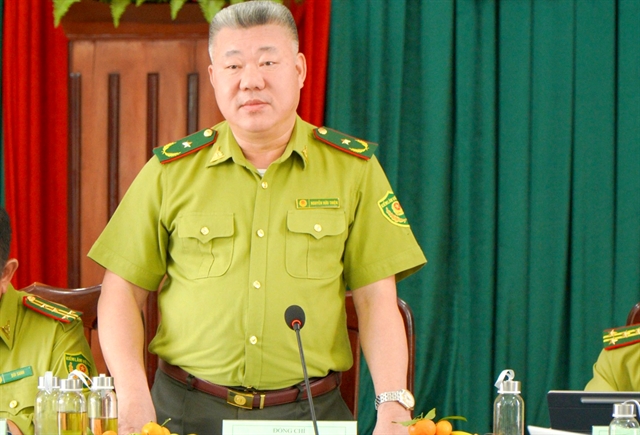 |
| Nguyễn Hữu Thiện, deputy director of the Việt Nam Forestry Administration. — VGP/VNA Photo |
Nguyễn Hữu Thiện, deputy director of the Việt Nam Forestry Administration, speaks to the Việt Nam Government Portal about increasing deterrence to prevent acts harming forest resources in the context of digital transformation.
Why did the Government promulgate the Decree No. 146/2026/NĐ-CP to replace the Decree No. 35/2019/NĐ-CP, and how have the main shortcomings of the old regulation been addressed?
The issuance of the Decree No. 146/2026/NĐ-CP stems from both the need to improve the legal framework and practical requirements.
From a legal standpoint, the decree was drafted to ensure consistency with the new provisions of the amended Law on Handling Administrative Violations 2025, the amended Forestry Law 2025, related guiding decrees and the Party and State’s policies on promoting decentralisation, delegating authority, streamlining organisational structures and enhancing the effectiveness and efficiency of State management.
In practice, after more than six years of implementation, the Decree No. 35/2019/NĐ-CP made an important contribution to forest protection and to preventing and strictly handling administrative violations in the forestry sector. However, over time the decree revealed a number of shortcomings: it did not cover newly emerging violations; some provisions were unclear and hard to apply consistently; the penalty levels for certain acts were insufficiently deterrent; and the sanctioning powers no longer matched the current two-tier local government structure and the present network of specialised agencies.
The Decree No. 146/2026/NĐ-CP overcomes these shortcomings by adding many newly identified violations; providing clearer provisions on encroachment and occupation of forests, forest harvesting and management of forest products; introducing penalties for offences committed in the digital environment; substantially increasing fines for many acts that harm forest resources, particularly those affecting natural forests; and revising sanctioning powers to comply with the new legal framework.
These measures help ensure consistent, transparent and effective application nationwide.
One notable new element is the inclusion of penalties for violations in the digital environment. Could you specify what types of conduct this covers and why it is an urgent requirement now?
The addition of provisions on administrative penalties in the digital environment is intended to implement the policy of digital transformation in State management, enabling penalty procedures to be carried out quickly, transparently and conveniently where technical infrastructure permits. This regulation helps reduce the time and cost of case processing, improves management effectiveness and aligns with the current trend of building a digital government.
The new decree raises penalty levels for many acts that damage forest resources. How do you assess the impact of increased deterrence on compliance by the public and businesses?
Increasing penalty levels is not intended to raise the number of sanctions but to strengthen deterrence and prevent violations.
When sanctions are proportionate to the nature and seriousness of an act, organisations and individuals will be more likely to comply with the law and refrain from harming forest resources.
At the same time, stricter penalties create a fairer competitive environment for businesses that operate in accordance with regulations. This also provides the basis for enhancing management, protection and development of forests in the new phase.
At a recent conference, localities raised difficulties in species identification and in handling seized rare wild animals. What technical guidance will the administration provide to support local forest protection forces in enforcing Decree 146 uniformly?
For species identification, the administration requests that localities proactively use court-appointed expert examiners on a case-by-case basis or organise judicial expert examinations in specific cases that are recognised by the Ministry of Agriculture and the Environment or by the province, or announced by the locality in accordance with the law. This will ensure species are identified accurately, consistently and in compliance with legal requirements.
For seized items that are rare wild animals, units must follow the provisions of the Law on Management and Use of Public Assets and Government’s Decree No. 77/2025/NĐ-CP dated April 1 last year on authority, procedures for establishing national ownership of assets and the handling of assets vested with national ownership.
At the same time, the administration asks localities to advise competent authorities to designate specialised management agencies (pursuant to Clause 3, Article 7 of Decree No. 77/2025/NĐ-CP) that meet the conditions to receive, manage, care for and handle seized items under the regulations, so that handling can be timely and consistent nationwide.
Decree 146/2026/NĐ-CP took effect on June 25 this year. What steps has the administration taken to ensure immediate, nationwide implementation and to train forest protection officers?
To ensure the decree is conducted uniformly and synchronously from June 25, the administration organised rollout conferences in two regions, the northern region in Hải Phòng City and the southern region in Cần Thơ City.
In addition, the administration coordinated with provincial forest protection divisions to hold in-depth training courses for forest protection officers who are directly responsible for enforcing the decree, and for some state forest owners.
Training focused on the decree’s new points, operational scenarios for identifying violations, drafting minutes and imposing administrative penalties, thereby ensuring forest protection forces at all levels apply the rules consistently from the date the decree takes effect.
Concurrently, immediately after the issuance of Decree No. 146, the administration advised the Ministry of Agriculture and the Environment to issue an implementation plan and sent guidance to ministries, competent sanctioning agencies and provincial people’s committees requesting them to carry out.
The administration has also directed provincial forest protection divisions to continue training all civil servants, public employees and frontline enforcement personnel, contributing to the rapid practical application of the decree and to improved management, protection and development of forests. — VNS
Opinion
 Opinion
.jpg) Opinion
Opinion
 Opinion
 Opinion
 Opinion
 Opinion
 Opinion
 Opinion
 Opinion
 Opinion
 Opinion
 Opinion
 Opinion
 Opinion