 Opinion
Việt Nam, Singapore promote cooperation through Party-to-Party channel
1.
|
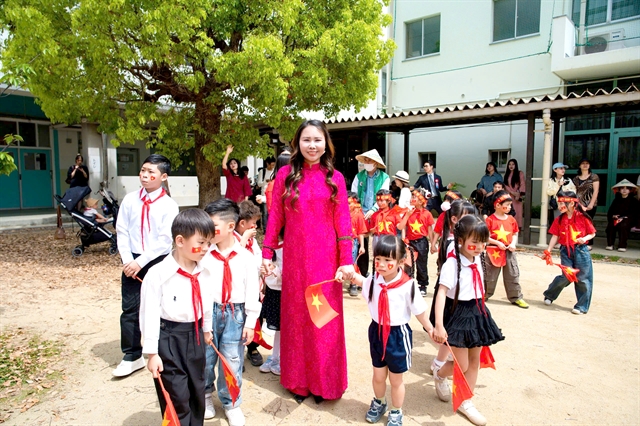
| Lê Thương and Vietnamese children partake in a cultural festival held early this year in Japan. Photos courtesy of Lê Thương |
Lê Thương, President of the Vietnamese Association in the Kansai region, Japan and Director of the Center for Vietnam-Japan Culture and Education Promotion, is the only foreign recipient of the Global Citizen Community Award 2026 presented by the International Friendship Promotion Association (IHA) in Osaka, as part of the 18th International Friendship Cultural Exchange Programme. She talked to Việt Nam News reporter Nguyễn Khánh Chi about the honour, its significance and the contributions she made to the community.
Could you please share your personal feelings and emotions about being the only foreign recipient of the 2026 award?
First and foremost, I would like to express my gratitude to the International Friendship Promotion Association of Japan for their recognition and for presenting me with this significant award.
Honoured as the only foreign recipient of the Global Citizen Community Award 2026, I truly felt both deeply moved and greatly responsible. I’m moved because my efforts over the past years have been recognised, and I feel responsible because I understand that this title does not belong solely to me as an individual but also represents the image of the Vietnamese community in Japan. This serves as a motivation for me to continue contributing even more to the connection between the two nations.
What does the award mean to you personally and to the Vietnamese community in the Kansai region and in Japan in general?
Personally speaking, the award is a great sense of encouragement, showing a strong message that community exchange, education and connection activities that I have pursued are of overriding importance and on the right track.
For the Vietnamese community in the Kansai region and Japan in general, I do hope this will bring about a positive signal, contributing to promoting images of Vietnamese people who always stay positive and responsible, and well integrate into and work toward the common development of the host country’s community.
Concurrently, this also serves as the connection to strengthen mutual understanding and trust between the Vietnamese community and Japanese people as well as with people from other countries.
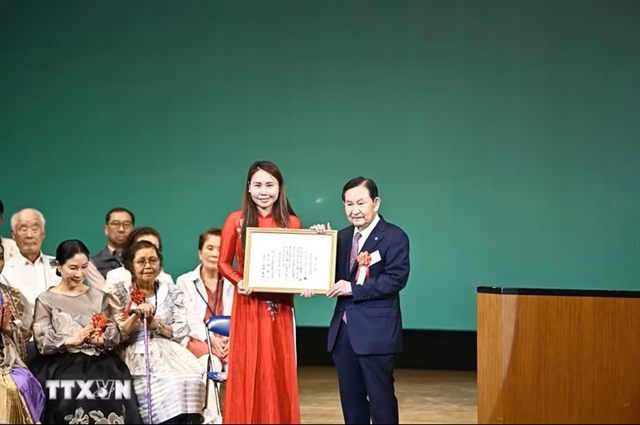
|
| Lê Thương, President of the Vietnamese Association in Japan's Kansai region, is presented with the Global Citizen Community Award by the International Friendship Promotion Association (IHA) in Osaka on Sunday. VNA/VNS Photo Nguyên Tuyến |
The concept of a 'Global Citizen' has become ubiquitous today. From the perspective and experience of a recent honouree, what qualities must an overseas Vietnamese citizen possess to successfully integrate into the global mainstream while still preserving their national identity?
In my view, a Vietnamese citizen in the era of globalisation should embody three core pillars.
First is the capacity for integration – encompassing foreign language proficiency, international knowledge, and the ability to adapt to multicultural environments.
Second is a mindset of responsibility and respect for diversity, which involves abiding by the laws and respecting the culture and values of the host country.
Third is the preservation of national identity, regardless of where one lives, it is essential to cherish the Vietnamese language, culture, and ancestral roots.
When these three elements are harmoniously combined, an individual truly becomes a "Global Citizen" in the truest sense.
How do you perceive the role of people-to-people diplomacy and cultural exchange in promoting international integration and cooperation?
I think that people-to-people diplomacy and cultural exchange are of overriding importance to promoting international integration because they act as a 'soft bridge', which creates an enduring and sustainable influence.
If state-level diplomacy creates the legal framework and cooperation orientations, people-to-people diplomacy goes deeper into the human element where understanding, trust and goodwill are naturally formed. It is through activities in culture, education, the arts, and community outreach that nations can bridge gaps, minimise misunderstandings, and foster mutual empathy.
In the era of globalisation, where human mobility and interaction are more intense than ever, cultural exchange does more than just showcase national identity; it creates a space for mutual learning. This represents a process of 'understanding to cooperate' rather than simply 'cooperating to understand'.
|
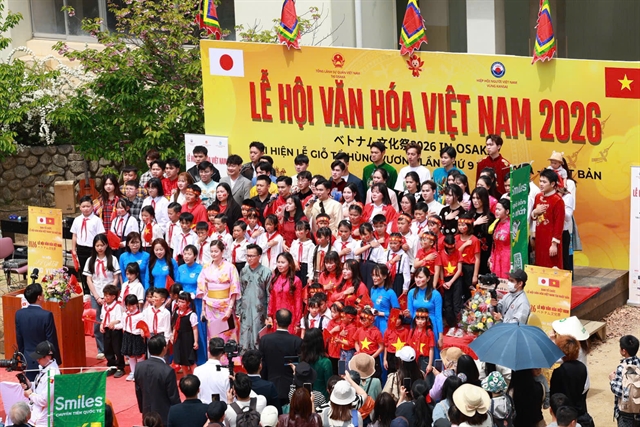
| The Vietnamese Association in Kansai region has been an organiser and co-organiser of numerous Việt Nam cultural festivals like the Việt Nam Culture Festival 2026. |
Specifically regarding Việt Nam and Japan, I believe people-to-people diplomacy is increasingly significant as the Vietnamese community in Japan, social organisations, and cultural exchange programmes continue to build trust and strengthen the bonds between our two nations. This serves as a vital foundation for cooperation to flourish not only at the state level but also within every community and for future generations.
Vietnamese people living abroad must not only preserve their language, culture and national identity but also contribute to the development of their host communities. How has the Vietnamese community in Japan, and specifically in Kansai, taken practical steps to contribute to Japanese society?
The Vietnamese community in Kansai and across Japan has not only integrated well but has also made significant positive contributions to the local society. Many Vietnamese nationals work in fields such as nursing, engineering, education and services, helping to address Japan’s labour shortage. Furthermore, the community actively participates in volunteer work, disaster relief efforts, cultural exchanges and the promotion of Việt Nam’s image.
Particularly in Kansai, various organisations and community groups have organised Việt Nam–Japan connection programmes. These initiatives foster mutual understanding, help newcomers integrate and build a reputation for Vietnamese people as friendly, hardworking, and responsible members of society. Over the years, the Vietnamese Association in Kansai has grown steadily, establishing itself as a reputable organisation that enhances the lives of Vietnamese residents and strengthens the friendship between Việt Nam and Japan.
|
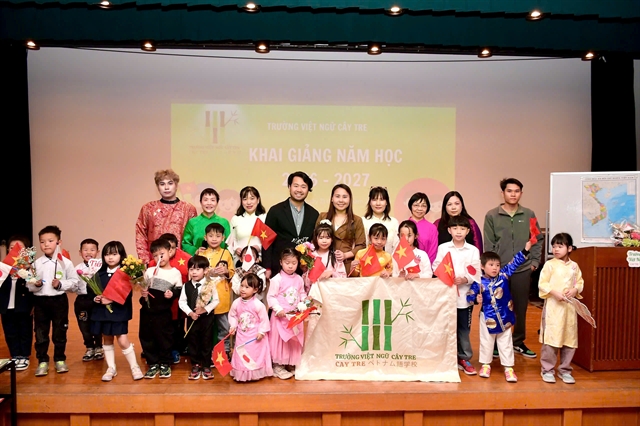
| Lê Thương (centre) attends the opening day of the Bamboo Vietnamese Language School's 2026-2027 schoolyear. |
The association members have been deeply involved in city-level volunteerism. For my part, I have served as a city volunteer for 10 years, participating in street clean-ups, providing interpretation services, and supporting local schools and medical clinics.
For nine consecutive years, the association has been a key organiser or co-organiser of Việt Nam cultural festivals. These events attract a large number of both Vietnamese and Japanese attendees. The festivals focus on showcasing traditional culture (such as the áo dài, Vietnamese cuisine and folk arts), featuring Việt Nam–Japan artistic performances, and promoting the country and people of Việt Nam. These activities are vital in elevating the image of the Vietnamese community and helping the Japanese public understand Việt Nam more deeply.
The association has established and maintained several Vietnamese language classes in Kansai, most notably the Bamboo Vietnamese Language School and the Center for Vietnamese Studies in Japan. These institutions support Vietnamese children born and raised in Japan, as well as those from families living there long-term.
Beyond teaching the language, these classes preserve cultural identity, introduce Vietnamese history and traditions, and connect the younger generation with their roots. This is a meaningful, long-term endeavour to maintain Vietnamese heritage within the overseas community. VNS
Opinion
 Opinion
.jpeg) Opinion
Opinion
 Opinion
 Opinion
 Opinion
 Opinion
 Opinion
 Opinion
 Opinion
 Opinion
 Opinion
 Opinion
 Opinion
 Opinion