 Opinion
Sơn La holds second coffee festival, targeting stronger businesses in future
1.
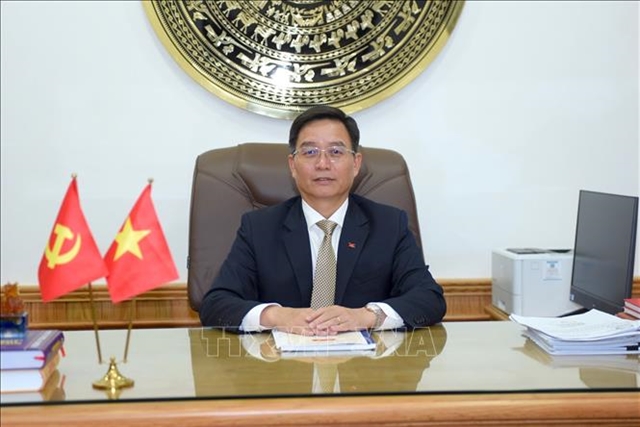 |
| Huế City's Party Secretary Nguyễn Đình Trung. — VNA/VNS Photo |
As the centrally-run Huế City enters a new stage of development with greater ambitions, the shift to a two-tier local government model is both an organisational restructuring effort and an opportunity to enhance quality of governance and public service delivery. Nguyễn Đình Trung, member of the Party Central Committee and secretary of the Huế Party Committee, shared his views on the city’s transition in an interview with the Vietnam News Agency.
How effectively has the two-tier local government model been operating in Huế after one year, and what challenges remain?
After one year of implementation, Huế has largely maintained organisational stability and uninterrupted governance, ensuring that services for citizens and businesses have not been disrupted.
The new model has begun to demonstrate its effectiveness by streamlining the administrative apparatus, reducing intermediary levels, strengthening decentralisation and delegation of authority, and enhancing the accountability of local administrations.
Leadership and direction in socio-economic development, national defence and security, Party building and political system development have been implemented in a coordinated and unified manner. Administrative capacity and the ability to address issues arising in practice have improved, while public outreach and communication work have been carried out flexibly and effectively.
Administrative reform and digital transformation have delivered positive results. The processing of dossiers in the digital environment, expanded use of digital platforms in governance and professional support have helped improve operational efficiency. The rate of dossiers processed on or ahead of schedule reached 96 per cent at the city level and over 98 per cent at the commune level.
Public and business satisfaction with administrative services has remained high, with most localities and agencies recording satisfaction rates of between 90-100 per cent. The business and investment environment has improved markedly. In 2025, Huế ranked among the top five localities nationwide in the Satisfaction Index of Public Administrative Services.
The city’s response to major floods in late 2025 also demonstrated the effectiveness of the two-tier model. Command and coordination capacity improved, response time was shortened and losses were minimised, while public safety was better protected.
After one year under the new model, the number of petitions submitted directly to the Party Secretary for intervention fell by 41 per cent. This reflects the effectiveness of strengthening leadership accountability, improving dialogue with citizens and addressing complaints at the local level.
Challenges in implementing this governance model are being addressed. Workloads at the commune level have increased significantly, while the local workforce remains insufficient and uneven in quality, particularly in specialised areas such as land management, construction, information technology (IT) and project management.
Physical facilities and IT infrastructure have yet to fully meet practical needs, and data connectivity and sharing among specialised information systems remain limited.
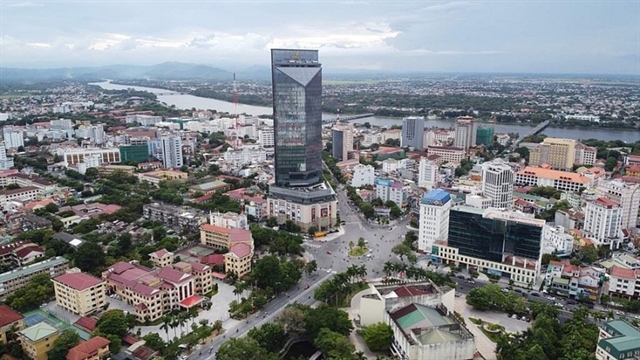 |
| An aerial view of Huế City. — VNA/VNS Photo Đỗ Trưởng |
Huế has promoted decentralisation and delegation of authority under the two-tier model. What oversight mechanisms are in place to encourage initiative and responsibility?
The city has implemented decentralisation and delegation in a comprehensive manner, following the principle of ‘clear responsibilities, clear tasks, clear authority, clear coordination mechanisms and clear resources,’ while ensuring consistency with central regulations and local conditions.
Huế authorities have reviewed the functions and responsibilities of each agency and unit, under the principle that one task is assigned to only one lead agency responsible for implementation.
Within the Party system, 84 tasks have been decentralised. Of these, the Standing Board of the municipal Party Committee delegated 65 tasks to commune- and ward-level Party committees. Eleven tasks require consultation with the standing board before decisions are made, while eight remain under the board’s direct authority.
The municipal People’s Council has promptly issued resolutions on decentralisation across sectors to ensure commune- and ward-level administrations can operate effectively and without disruption.
Meanwhile, the municipal People’s Committee has decentralised or delegated a total of 411 tasks, including 209 decentralised tasks and 202 delegated tasks from the committee and its chairman to commune-level departments, agencies and administrations.
The municipal Việt Nam Fatherland Front (VFF) has assigned and delegated a total of four responsibilities to the commune-level VFF and socio-political organisations.
Looking ahead, Huế will continue expanding decentralisation in personnel management, granting greater autonomy to departments and localities in managing, deploying and evaluating officials while linking authority to accountability. The city will also continue decentralising revenue sources, expenditure responsibilities and revenue-sharing ratios between the city and commune-level budgets for the 2027-30 period to strengthen local financial autonomy.
In terms of oversight, the Standing Board of the municipal Party Committee has directed the development of growth scenarios and plans, translating growth targets into specific sectoral and local objectives. Key projects, both funded by the State and private budgets, have been identified alongside implementation roadmaps and resource allocations. Responsibilities are clearly assigned to each agency, locality and especially to their leaders.
The city conducts quarterly KPI-based performance evaluations linked to measurable outputs, ensuring clear accountability and results. Weekly monitoring and evaluation mechanisms are also maintained to promptly address bottlenecks and improve administrative responsibility.
In practice, the overlap that previously existed between district- and commune-level administrations has largely been eliminated following the abolition of district-level government. Responsibilities have been assigned with clear lead agencies and accountability. The functions and authority of city- and commune-level administrations are now more clearly defined, with many tasks directly assigned to communes and wards under the principle of giving local authorities greater autonomy and accountability.
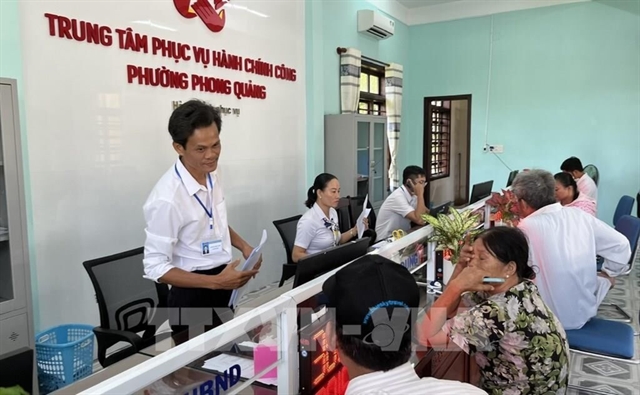 |
| Public employees process administrative procedures for residents at the Public Administrative Service Centre in Phong Quảng Ward, Huế City. — VNA/VNS Photo Văn Dũng |
Prime Minister Lê Minh Hưng recently issued Official Dispatch 39/CĐ-TTg, calling for faster handling of surplus public offices and land assets resulting from administrative restructuring. How is Huế addressing this issue?
This is an enormous task, as the city has 3,198 offices and public land and property facilities that must be rearranged under the new organisational model. Together with members of the Standing Board of the municipal Party Committee, I have worked directly with wards and communes to review and agree on plans for each facility. Our guiding principle is that no public asset should be left abandoned, deteriorate or be used inefficiently.
The city is not merely reorganising office space, but is integrating the handling of surplus assets into urban planning, land-use planning, social infrastructure development and efforts to generate additional resources for investment. Many facilities are being considered for conversion to educational, healthcare, cultural, sports or community uses. Properties in advantageous locations are being evaluated for auction or investment projects in accordance with regulations to maximise the value of public assets.
To date, 2,656 of the 3,198 facilities in the city have been reorganised, accounting for more than 83 per cent. The city has also completed a comprehensive review of surplus public assets and developed plans for the remaining 542 facilities. However, difficulties remain, particularly for properties left unresolved for many years, facilities in poor condition and cases involving legal documentation, changes in function or planning adjustments.
The city will continue refining plans to make effective use of surplus assets in line with urban development, socio-economic needs and local demand. For issues beyond its authority, it will coordinate with central ministries and agencies to remove obstacles and accelerate implementation.
Based on the past year’s experience, what key solutions will Huế pursue to create new growth drivers and achieve double-digit growth during this term?
Huế is establishing a new growth model and restructuring the economy by increasing the share of green industry and accelerating industrialisation and modernisation. Growth will shift from being driven mainly by expansion to a balanced combination of expansion and growth. Priority sectors include deep-processing industries, IT, software development, medicinal herb production and medical equipment manufacturing. Huế will also promote the knowledge-based economy, digital economy and circular economy.
The city will further develop its strengths in services, high-tech industry and the marine economy. Tourism remains the spearhead sector, while specialised healthcare, high-quality education, finance, banking, seaports, logistics and workforce development serve as key pillars. IT and high-tech industries are expected to drive breakthroughs.
Huế is also stepping up investment promotion and significantly improving the business environment to attract development resources. The city will foster enterprise growth across all economic sectors, especially the private sector. It will maximise the advantages of its heritage urban status by prioritising the development of the heritage economy linked to tourism, integrating heritage assets in developing services.
Cultural industries are also a priority, particularly film, fashion, cuisine, design and digital heritage tourism. Heritage spaces will be transformed into new growth drivers.
The city will also pursue breakthroughs in science, technology, innovation and digital transformation in line with the Politburo’s Resolution 57, with the goal of raising the digital economy’s share of GDP to 30 per cent by 2030, making it a major driver of growth during the 2026-30 period.
The Standing Board of Huế Party Committee has directed the establishment of a 'green lane' mechanism to streamline administrative procedures and cut processing times by 50 per cent. A steering committee for key projects has also been established.
Public investment will be optimised by reducing the number of public investment projects in 2026-2030 by at least 30 per cent compared to the previous period. Resources will instead be concentrated on inter-commune projects and those with significant socio-economic impact, while long-delayed projects will be resolved and key projects accelerated and brought into operation. — VNS
Opinion
 Opinion
 Opinion
 Opinion
 Opinion
 Opinion
 Opinion
 Opinion
 Opinion
 Opinion
 Opinion
 Opinion
 Opinion
 Opinion
 Opinion