 Life & Style
Top leader gives policy speech in Brussels, sharing vision for Việt Nam–EU ties
1.
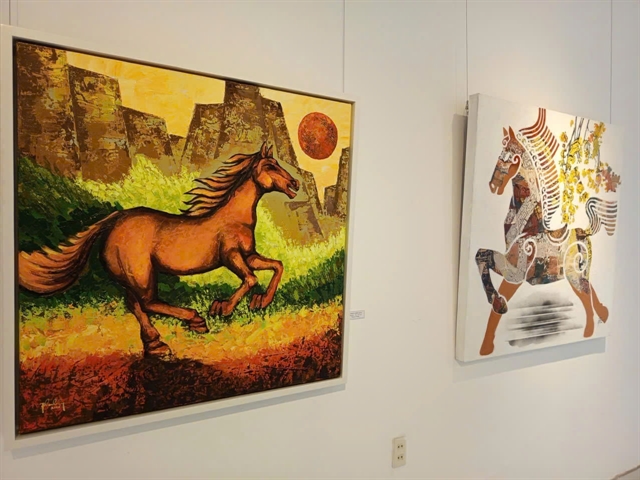 |
| Paintings of horses displayed as part of the 'Horses and the Colours of Spring 2026' exhibition in Huế City. — Photos vov.vn |
HUẾ — Imagery of horses in a wide variety of artistic styles are now on display, with works ranging from traditional to contemporary, at two exhibitions in Huế City.
The exhibition 'Horses and the Colours of Spring 2026' is being held to celebrate the traditional Tết (Lunar New Year) holiday at the Huế Fine Arts Museum.
Rich in cultural identity, the art space offers the public an exploration of the horse in multiple dimensions. On display are 34 artworks in diverse materials including oil paint, lacquer, acrylic, ceramics, iron, aluminum, powder paint, monoprint and mixed media.
The exhibited works portray the image of the horse from various perspectives, ranging from realistic to expressive, from traditional forms to contemporary innovations. Beyond simply depicting the animal's physical beauty and movement, the artists also convey reflections on humanity, the creative journey, the spirit of the times and hope for a prosperous new year.
In Eastern art, the horse is often regarded as a powerful and free-spirited symbol, embodying freedom intertwined with loyalty, and reflecting the enduring rhythm of life as well as the aspiration for progress. These qualities are expressed by artists through diverse visual languages, creating an exhibition space charged with vitality and energy.
Aside from new creations by 23 painters and sculptors from Huế and other localities, the exhibition also features representative works on the theme of horses by the late renowned painter Lê Bá Đảng, including the piece 'Saint Gióng's Horse'.
Painter Nguyễn Thiện Đức's artwork draws visitors' attention through his special expression in the language of graphic arts, using a carefully selected colour palette that creates a modern and rhythmic feel. At the same time, his horse sculpture shows both spatial and volumetric thinking, emphasising the strength, movement and inner power of the form.
Phan Quang's horse sculpture is a highlight of the display. The work doesn't flaunt its strength, but instead emphasises inner power. Rather than sturdy material that shows bulging muscles, Quang's horse was created from thin, delicate, woven steel wires, allowing light to get through its gaps.
The sculpture made visitors feel that the horse is almost breathing and moving gently, evoking the feeling that life has emerged from winter, not yet fully blossomed but already brimming with vitality.
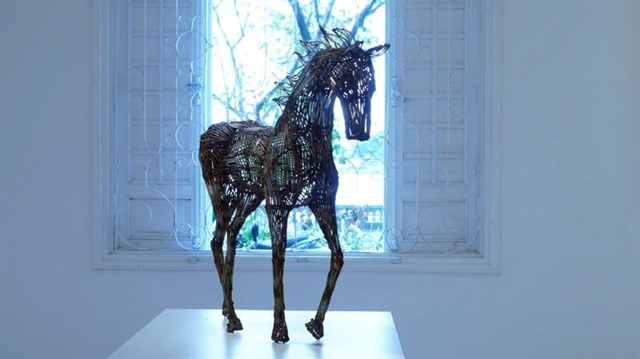 |
| Artist Phan Quang's horse made of steel wires. |
The exhibition is open to the public at 15 Lê Lợi Street until February 27, including during the Lunar New Year holiday.
Meanwhile, visitors can also admire horses at the 'Horses and Dragon Horses in the Royal Court Culture of the Nguyễn Dynasty' exhibition in the Huế Imperial City Heritage Conservation Centre.
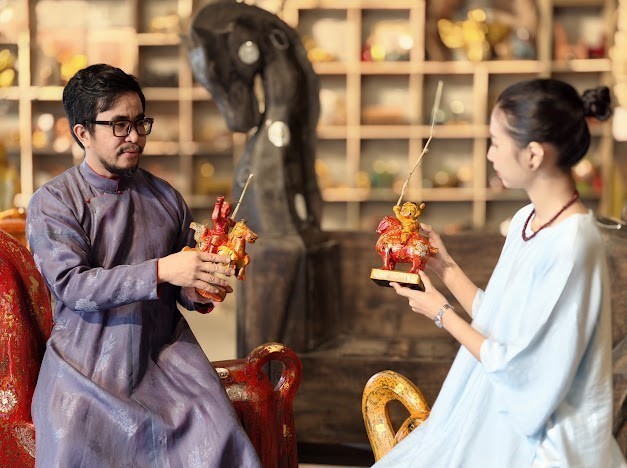
The Dragon Horse is a powerful Eastern mythical hybrid symbolising good fortune, wisdom, unstoppable energy and imperial authority. Combining a dragon's head and scales with a horse's body, it represents cosmic balance, carries divine knowledge and acts as a feng shui guardian against evil.
Commonly found in royal and folk architecture and art, especially on screens in Huế, the image has become a recurring symbol throughout the Huế Festivals.
 |
| Horses depicted on pottery vases. — Photos courtesy of the Huế Imperial City Heritage Conservation Centre |
Horses were closely associated with the royal court of the Nguyễn Dynasty, playing an important role in military affairs, transportation and ceremonies.
During the reign of Emperor Minh Mạng, an imperial horse training institute was established to raise and train horses to serve the court, demonstrating the special position of this animal in the feudal state.
Through its exhibits, documents and images, the exhibition is expected to offer insight into the role of horses in court life, while highlighting the symbolic value of the Dragon Horse in Huế culture.
Several artefacts are being displayed for the first time, contributing to a richer understanding of the history, art and culture of the Nguyễn Dynasty.
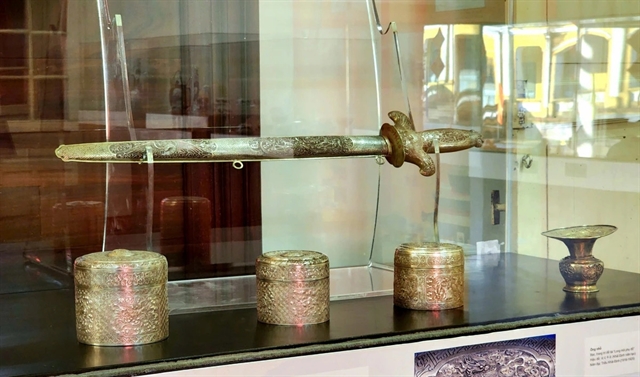 |
| Horse motifs on sword scabbards from the Nguyễn Dynasty. |
Touring the exhibition on opening day, visitor Phan Thanh Bình said: "Perhaps the most surprising thing is the image of the dragon horses on a range of materials and objects.
"This is the first time I have seen swords, silver boxes and gold books with images of dragon horses. I find that the dragon horse carvings and horse imagery evoke memories of the history of Vietnamese handicraft making. The exquisite detail of the fine lines on the silver shows that there was once a truly professional silver-making craft in Huế."
In addition to the exhibition, the centre is also holding several activities and experiential programmes over the holiday, including royal court games, folk games and games integrated with heritage education.
All of the activities aim to help the public – especially children – learn, explore and appreciate the value of the Nguyễn Dynasty's cultural heritage, helping to foster love for the homeland and raise awareness of preserving the heritage of the ancestors. — VNS
Life & Style
 Life & Style
 Life & Style
 Life & Style
.jpg) Life & Style
Life & Style
 Life & Style
 Life & Style
 Life & Style
 Life & Style
 Life & Style
 Life & Style
 Life & Style
.jpg) Life & Style
Life & Style
 Life & Style
 Life & Style