 Environment

Atlantis Studio's Two-Player Horror Game Beyond the Dark: Nightwatch to Be Published by Q-Games!
1.
|
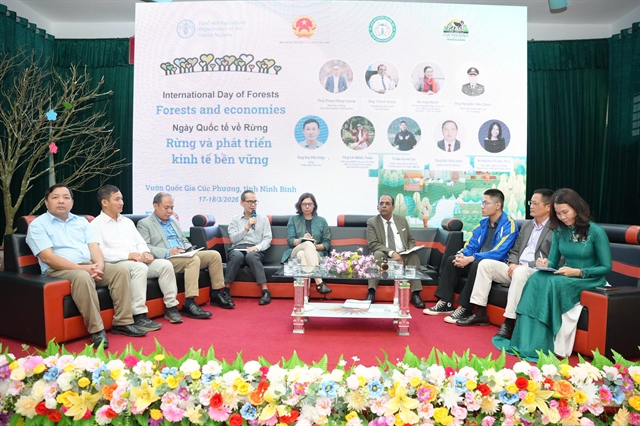
| Delegates at the event commemorating International Day of Forests 2026, held on Wednesday in Binh Bình Province. — Photo courtesy of Forestry and Forest Protection Department |
NINH BÌNH — Forests contribute trillions of US dollars annually to the global economy, yet their value remains insufficiently reflected in policy and investment, experts said at an event marking the International Day of Forests 2026 in Việt Nam.
The event, held on Wednesday under the theme “Forests and Sustainable Economic Development,” was co-organised by the Food and Agriculture Organization of the United Nations (FAO) and the Forestry and Forest Protection Department under the Ministry of Agriculture and Environment.
According to FAO, more than half of global GDP depends on nature, with forests playing a vital role in protecting water resources, preventing soil erosion, regulating the climate and reducing disaster risks – all essential for long-term growth, particularly in developing countries.
Việt Nam currently has nearly 14.87 million hectares of forest, with coverage exceeding 42 per cent. The forestry sector has maintained steady annual growth of around 5 per cent, supporting industries such as agriculture, hydropower, tourism and processing.
In 2025, export turnover of timber and forest products surpassed US$18.3 billion, making forestry one of the country’s key economic pillars. In addition, forest environmental services have generated significant financial resources each year, helping create stable incomes for communities living in and near forests, estimated at around 25 million people.
Experts emphasised that sustainable forest management must go hand in hand with improving local livelihoods.
Experience from Cúc Phương National Park, Việt Nam’s first national park, shows that conservation efforts are most effective when local communities benefit directly. Over the past decade, livelihood models such as agroforestry, household livestock farming, medicinal plant cultivation and ecotourism have been implemented in buffer zones, contributing to higher incomes and reduced pressure on forest resources.
Yên Trị Commune in Phú Thọ Province offers a typical example.
In recent years, residents have developed community-based tourism linked to local products, including medicinal plants such as a precious type of ginseng – Bố Chính ginseng, golden camellia and xạ đen (Celastrus hindsii), combined with Mường ethnic cultural experiences.
“We see community-based tourism as a way to help local people sell their products directly to visitors. This creates stable demand for farm produce, boosts incomes, and reduces pressure on forests,” said Bùi Phi Diệp, chairman of the Advisory Council of Yên Trị Agricultural Cooperative.
The model has attracted thousands of visitors and helped hundreds of households improve their livelihoods.
Lê Trọng Đạt, head of the Cúc Phương National Park’s Science and International Cooperation Division, said the buffer zone of Cúc Phương National Park covers parts of Ninh Bình, Thanh Hóa and Phú Thọ provinces, with a population of over 80,000, mostly Mường people.
Over the past decade, various livelihood support programmes have been implemented, contributing to improved incomes and easing pressure on forest resources, he said.
“When local communities have stable and sustainable livelihoods, they not only benefit from forests but also become an important force in conservation,” said Nguyễn Văn Chính, Director of Cúc Phương National Park.
Trần Quang Bảo, Director General of the Forestry and Forest Protection Department, said Việt Nam is among the leading countries in the region in forest restoration and sustainable management. Forests contribute directly to sectors such as agriculture, tourism, energy, water security and disaster prevention.
“The value of forests is not only measured by timber or export turnover, but also by protected water sources, climate regulation, biodiversity conservation and sustainable livelihoods for millions of people,” he said.
In the coming years, the forestry sector will focus on sustainable forest management, development of deforestation-free value chains, expansion of ecosystem services, promotion of forest carbon markets and the application of science and technology, while placing local communities at the centre.
Việt Nam will also continue to strengthen cooperation with international organisations such as FAO, GIZ, WWF and UNDP to enhance capacity and promote green growth.
“Việt Nam’s forests are not only a natural treasure but also a driver of economic opportunities and rural livelihoods,” said Vinod Ahuja, FAO Representative in Việt Nam. “Investing in forests means investing in water security, climate resilience and sustainable growth for millions of people.”
Experts said that as global climate and biodiversity challenges intensify, forests must be placed at the centre of development strategies. — VNS
Environment
 Environment
 Environment
 Environment
 Environment
 Environment
 Environment
 Environment
 Environment
 Environment
 Environment
 Environment
 Environment
 Environment
 Environment