 Society

NA President visits Beijing legislative liaison station
1.
|
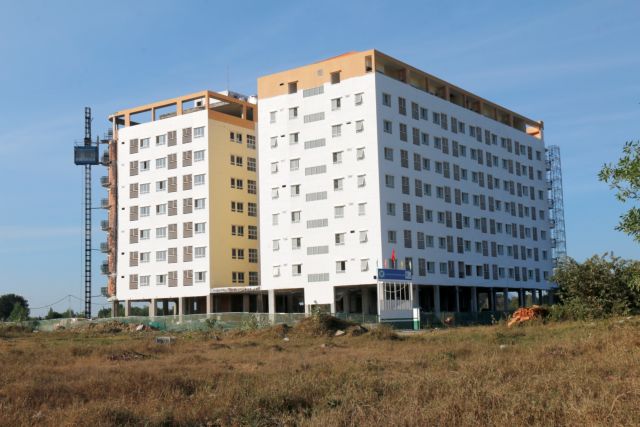
| A social housing apartment building for workers. As many as 10,700 social housing units will be built by 2030 so that workers have stable accommodation. — VNA/VNS Photo Nguyễn Thanh |
HÀ NỘI — The Việt Nam General Confederation of Labour (VGCL) has announced plans to construct around 10,700 social housing units by 2030, so that workers in industrial zones can access stable accommodation and help ensure their long-term employment with their companies.
At a press briefing on the outcomes of the 14th VGCL Congress, Lê Văn Nghĩa, deputy chairman of the VGCL, said the 2023 Housing Law explicitly identifies the VGCL as one of the entities authorised to invest in social housing.
On that basis, the VGCL drew up a plan in 2024 to create more social housing projects for workers.
From 2024 to 2025, the trade union focused on investing in three rental housing projects for workers in Bắc Ninh Province and the former Bến Tre province, now merged into Vĩnh Long Province.
Construction has started on all three projects, adding up to 1,722 apartments.
These projects are expected to be completed and put into operation from next year, meeting workers’ housing needs in industrial zones.
Under the Prime Minister’s decision to develop at least one million social housing units by 2030, the VGCL was assigned the task of building 10,000 homes for workers from 2023 to 2030.
To achieve this target, in addition to the three ongoing projects, the VGCL plans to invest in a further 10 to 15 new projects nationwide starting this year through 2030, with a combined scale of about 9,000 apartments.
Nghĩa reported that the VGCL expects to build roughly more than 10,700 apartments. Given the current pace, the target set by the PM is fundamentally on track to be met.
He said implementing rental housing projects for workers not only contributes to the Government’s social housing development goals, but also enables workers to access stable accommodation and maintain long‑term ties with enterprises.
Provincial and municipal labour federations have also noted that, especially in localities with large numbers of workers, demand for social housing and workers’ housing remains urgent, while welfare facilities such as kindergartens, cultural houses, sports areas and recreational facilities serving workers in industrial zones are still limited.
The Hà Nội Labour Federation said the city currently has about 2.7 million workers, of whom more than 70 per cent live in rental boarding houses.
Hà Nội Department of Planning and Architecture director Nguyễn Trọng Kỳ Anh said that in its housing development orientation, the city prioritises building large concentrated social housing zones, ensuring solid technical and social infrastructure.
The zones will be located in areas with convenient connections to public transport systems, particularly the urban rail network, to serve low‑income earners and workers in industrial parks.
Allocating land for trade union facilities, social housing and workers’ housing has been identified as a priority by the city in industrial sub‑zone plans, the housing development programme for 2021–2030 and the scheme to build at least one million social houses for low‑income earners and industrial park workers.
Hà Nội has currently planned 19 land lots for concentrated social housing development, covering a total area of about 995ha.
To implement the capital’s 100‑year master plan, the city People’s Committee has issued a scheme to develop multi‑purpose urban areas linked to the city's nine development axes. Social housing is expected to account for about 20 per cent of total residential floor area.
The city also aims to increase the proportion of rental and rent‑to‑own housing to meet the diverse accommodation needs of residents and workers.
To date, the city has built 92 social housing development projects with a total area of approximately 1,405ha, offering various forms of housing for sale, rent and rent‑to‑own. — VNS
Society
 Society
 Society
 Society
 Society
 Society
 Society
 Society
 Society
 Society
 Society
 Society
 Society
 Society
 Society

 Rikkeisoft ký kết MOU với LAC.Co, LTD - thúc đẩy hợp tác kinh doanh toàn diện trong lĩnh vực an ninh mạng.jpg)