 Society

Vietnamese community in China urged to stay united, contribute to homeland
1.
|
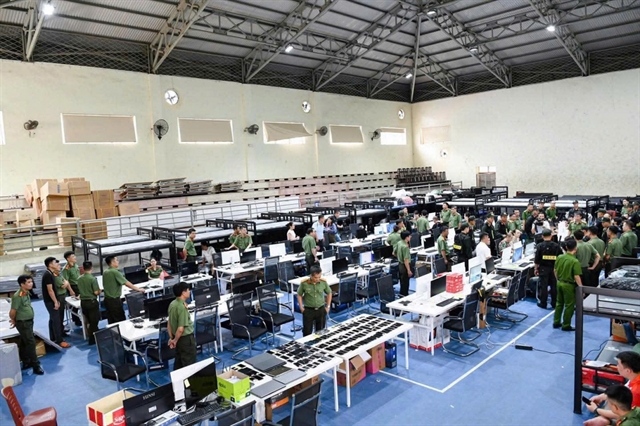
| Police raided the hideout of a group allegedly involved in a transnational fraud scheme in the northern province of Phú Thọ. — Photo courtesy of the Phú Thọ Province Police Department |
PHÚ THỌ — Police in the northern province of Phú Thọ have issued emergency arrest warrants for four suspects, including Chinese national Zhao Wei Zhong and Vietnamese nationals Nguyễn Thành Long, Trần Thị Thu Hường and Phạm Đình Nam in connection with an alleged plan to establish a large-scale online scam centre in Việt Nam.
Police said they first uncovered a number of suspicious activities involving the rental of multiple resorts, farmstays and villas in Hà Nội, and Lào Cai and Phú Thọ provinces to accommodate large groups of foreign nationals for extended periods.
Preliminary investigations found that the group was linked to online fraud syndicates previously operating in Cambodia, according to police.
Many of the suspects had reportedly worked for scam operations organised under a closed management structure, with specialised teams responsible for identifying potential targets, approaching victims, providing investment advice, instructing victims on money transfers and managing illicit proceeds.
Amid a recent intensified crackdown by Cambodian authorities on online scam compounds, the suspects allegedly sought to relocate their operations to another country.
Việt Nam was selected as a new base because of its abundance of secluded resorts, farmstays and villas located away from residential areas, making them suitable for housing large numbers of foreign nationals and installing equipment used for online criminal activities.
Police also said Zhao Wei Zhong had been tasked with entering Việt Nam to survey potential locations, coordinate operations and arrange accommodation for individuals moving from Cambodia.
He also allegedly worked with local accomplices to prepare facilities, technical equipment and other logistical requirements for the group's activities.
Last month, the suspects allegedly organised the relocation of dozens of Chinese nationals to various locations in Hà Nội, Lào Cai and Phú Thọ.
Authorities discovered 16 individuals who did not possess valid immigration documents.
To conceal their activities, the group frequently changed locations, rented large properties on long-term leases and minimised contact with local residents, according to police.
Further investigations allegedly revealed that the suspects were not just securing accommodation, but were actively preparing infrastructure to establish a large online scam centre in Việt Nam.
At the rented premises, the group had purchased and installed computer systems, mobile phones, internet broadcasting equipment, office furniture, bunk beds and other items intended to support large-scale operations, police said.
Searches carried out by police resulted in the seizure of 73 desktop computers, 134 mobile phones, 34 USB storage devices, 20 Wi-Fi transmission units, three SIM cards, five laptops and two tablet computers, as well as hundreds of desks, chairs, bunk beds, mattresses and other equipment intended for large-scale operations.
Authorities noted that all of the equipment had only recently been transported and installed and was on the verge of being put into use.
Thanks to the early detection of the scheme, local police were able to dismantle and neutralise the entire operation before the suspects could launch it.
Evidence gathered by police indicated that the group intended to deploy a range of online fraud schemes previously used in Cambodia and several other countries in the region.
The police department said the timely detection and disruption of the operation was particularly significant because the personnel, infrastructure and technical equipment required for the fraud network had only just been assembled and installed before being completely disabled.
The move helped prevent the emergence of a large transnational high-tech scam centre in Việt Nam, contributing to the protection of national security, public order and social safety, while safeguarding the assets of citizens. — VNS
Society
 Society
 Society
 Society
 Society
 Society
 Society
 Society
 Society
 Society
 Society
 Society
 Society
 Society
 Society