 Environment

Doctor brings hope to infertile couples in Lào Cai
1.
|
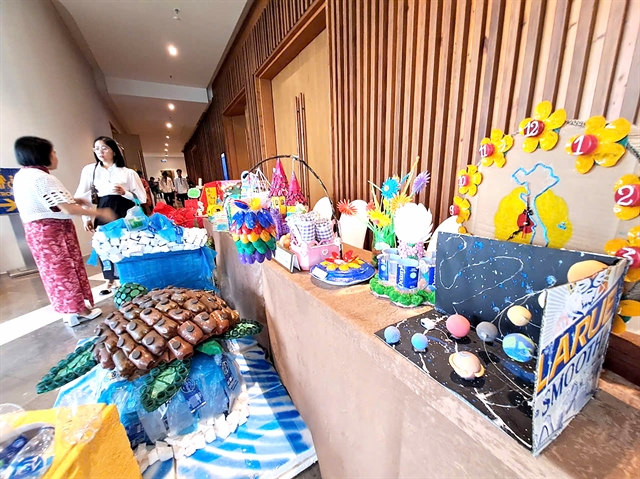
| Plastic and paper waste are recycled at an exhibition on waste sorting and recycling in Đà Nẵng. Many schools in the city began waste reduction and recycling programmes years ago. VNS Photo Công Thành |
ĐÀ NẴNG – Đà Nẵng has been accelerating the adoption of effective technological solutions and calling for investment in waste management infrastructure, as the tourism hub plans to handle 3,600 tonnes of garbage each day by 2030.
Deputy head of the city's environmental protection sub-department Nguyễn Viết Thuận announced the goal at an international event on integrated and sustainable waste management, warning that the city’s current waste management processes require technological updates, and all of its more than 2,000 tonnes of waste generated daily are buried in landfills.
He said the first waste-to-energy project at the Khánh Sơn dump, with a daily capacity of 650 tonnes, would be put into operation in the fourth quarter of 2026, while another 1,000-tonne project has been planned at the site.
“A series of projects on waste treatment have been designed for future increases accumulated from the former Quảng Nam and Đà Nẵng. Previously, 29 solid waste treatment sites were planned in Quảng Nam, but only 18 were put into operation,” Thuận said.
“The city has been struggling with daily waste collection capacity and infrastructure facilities for safe treatment of a variety of waste, including industrial rubbish and hazardous waste, in rural and mountainous communes,” he added.
Environment expert Cao Trường Sơn from the Agriculture Institute said that at least six tonnes of plastic waste, 91 per cent of which is plastic bags, are released directly into the environment in Đà Nẵng.
|
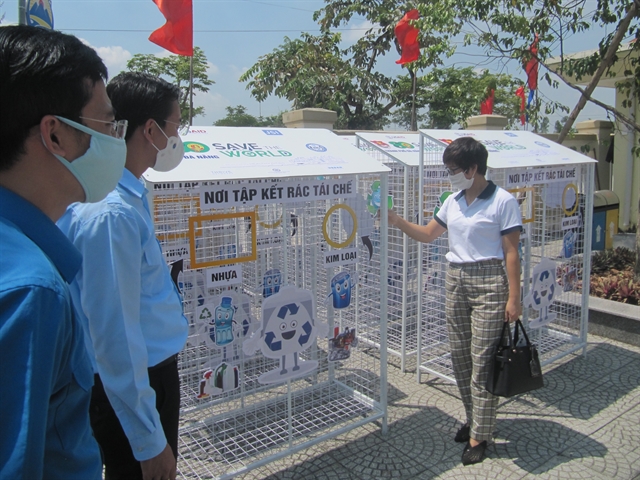
| Waste sorting containers set up at a local authority in Đà Nẵng. Waste classification at source for recycling is an option for local residents to reduce the amount of trash going into landfills. VNS Photo Công Thành |
He said tourism, which is one of the central city's major sources of revenue, discharges more than 20 tonnes of plastic – about 17 per cent of the city's total waste – each day.
Sơn said plastic waste accounts for 60 per cent (about 1.2kg) of the rubbish accumulated from each visitor each day. But a plastic recycling plant has not yet been built in Đà Nẵng, or even in central Việt Nam.
“The city has been facing plastic pollution, as waste classification at source and investment in collection facilities have not yet been completed. Meanwhile, six tonnes of plastic waste are either going into the rivers and seas, or being burnt in open-air sites,” Sơn said.
He suggested that Đà Nẵng accelerate a comprehensive solution on effective management and treatment of waste that involves participation from businesses and the community.
“Ony 17 out of 117 businesses implemented waste audits, according to a recent survey. Last year, nine businesses signed memoranda of understanding (MoUs) on waste audits, and five others began collecting and sorting out of waste,” he reported.
Maria Paola Lia, executive director of the Global Alliance on Health and Pollution, warned that pollution is responsible for approximately nine million deaths per year, or one in six deaths worldwide.
She said the number of deaths attributed to pollution remains much more significant than those from war and terrorism, diseases like malaria, HIV or tuberculosis, and drugs and alcohol. It is comparable to the global mortality burden attributable to smoking.
Paola also mentioned environmental programmes in Việt Nam since 2022 that focus on air pollution, agrochemicals and solid waste management.
She said these programmes also include interventions in the expansion of integrated pest management for farmers, nationwide adoption of microbial straw decomposition and bio-pellet production along with the launch of solid waste management models in Đà Nẵng.
According to a report from the city’s Department of Agriculture and Environment, the inner city generates more than 1,100 tonnes of garbage each day, of which 74 per cent are food, garden and park waste, and more than 11 per cent is plastic waste. Only 10 per cent of the total waste is recycled, while an incineration system only processes 200kg of solid medical waste per hour.
Đà Nẵng, in cooperation with international NGOs, has conducted awareness programmes on waste sorting and plastic waste reduction at source for 4,400 students.
More than 2,200 primary school students have received a basic ‘green’ education, while 1,500 junior secondary school students have learned practical actions to help sort waste at home and at school.
Đà Nẵng has been working to develop into the first smart and green urban centre in Việt Nam.
VNS
Environment
 Environment
 Environment
 Environment
 Environment
 Environment
 Environment
 Environment
 Environment
 Environment
 Environment
 Environment
 Environment
 Environment
 Environment