 Society
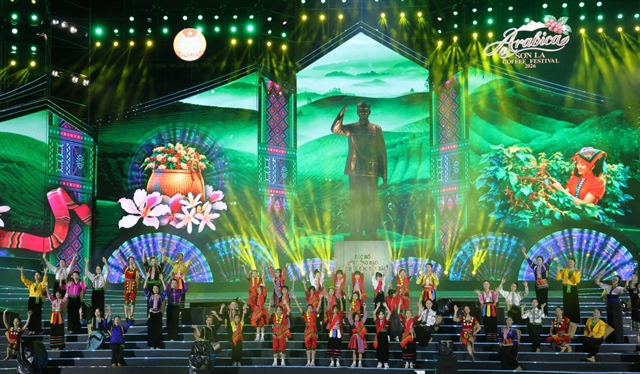
Sơn La holds second coffee festival, targeting stronger businesses in future
1.
|
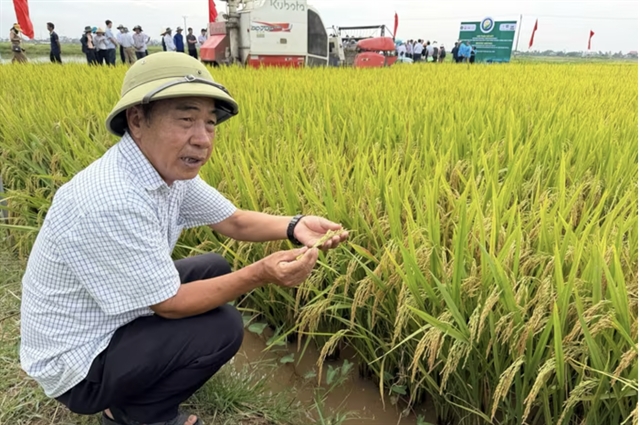
| Director of Hữu Chung Cooperative Trần Thanh Hương at a rice field cultivated according to new practices for fertiliser use to increase efficiency and reduce emissions. VNA/VNS Photo |
HẢI PHÒNG – Low-emissions rice farming models currently being implemented in Hải Phòng City as well as in Hưng Yên and Ninh Bình provinces are showing positive results.
They not only reduce production costs and increase farmers’ profits, but also help cut greenhouse gas emissions and promote more sustainable agricultural development, according to experts.
On Wednesday at the Hữu Chung Cooperative in Hải Phòng City's Tân An Commune, the Department of Crop Production and Plant Protection held a conference in coordination with the International Rice Research Institute (IRRI) reviewing pilot rice cultivation models in the Red River Delta.
Models under review focused on using fertilisers correctly and efficiently while achieving low emissions.
Participants at the conference assessed the results of the first production season using the pilot models implemented in Hải Phòng, Hưng Yên and Ninh Bình under the Fertilize Right Project, with technical support from the US Department of Agriculture.
The models applied a range of advanced technical measures aimed at reducing emissions, including mechanised dry direct seeding in rows with fertiliser incorporation (mDSR), site-specific nutrient management using improved fertilisers, alternate wetting and drying water management, integrated pest management and rice straw management.
According to IRRI senior scientist Nguyễn Văn Hùng, initial results show that the model improves production efficiency and lays the foundation for transitioning to low-emissions rice production.
In Hưng Yên, the model used at Liên Hiệp Cooperative achieved a yield of 6.49 tonnes per hectare, about 30 per cent higher than traditional broadcast seeding methods.
Profits reached VNĐ19.2 million (US$730) per hectare, while the previous cultivation method generated almost no profit.
In Ninh Bình, Nam Cường Cooperative achieved a yield of 5.65 tonnes per hectare, up 28 per cent. Profit reached VNĐ13.2 million ($500) per hectare, whereas the control model recorded a loss of about VNĐ3.1 million ($118) per hectare.
At Hữu Chung Cooperative, yield reached 7.62 tonnes per hectare, 25 per cent higher than machine-transplanted rice of the same variety.
Profit reached VNĐ24.4 million ($927) per hectare, more than six times higher than under traditional production methods.
Results from all three localities show that mDSR technology reduced seed use by more than 30 per cent, nitrogen fertiliser use by 34-44 per cent, phosphorus fertiliser use by 34-66 per cent and potassium fertiliser use by 33-39 per cent.
Production costs fell by more than 25 per cent, while average profit reached about VNĐ21 million per hectare.
According to experts, these results are particularly significant at a time when rice production faces increasing pressure from rising input costs, shortages of rural labour and increasingly stringent requirements to reduce greenhouse gas emissions.
In addition to economic efficiency, the model also delivers substantial environmental benefits by reducing agricultural inputs, conserving water and limiting emissions.
From a business perspective, Phạm Quốc Trung, general director of Hữu Thành MTK Fertiliser Joint Stock Company, said the model shows that fertiliser only delivers its true value when applied at the right time and in the right place.
“When efficiency from nutrient use increases and fertiliser use declines, environmental pressure also decreases. This is not simply about reducing fertiliser use, but about ensuring that every kilogramme of fertiliser is used in the most efficient way,” Trung said.
Lương Thị Kiệm, deputy director of the Hải Phòng Department of Agriculture and Environment, said that the results achieved after three crop seasons clearly demonstrate the effectiveness of advanced technical solutions in helping the agricultural sector achieve its goals of green development, sustainable growth and adaptation to climate change.
“The model not only delivers economic benefits, but also creates a new production mindset aimed at reducing greenhouse gas emissions and changing traditional farming practices,” Kiệm said.
According to the expert, moving from traditional fertiliser application methods to the correct use of fertilisers based on the '4R' principles – right fertiliser type, right rate, right time and right place – is a key step. — VNS
Society
 Society
 Society
 Society
 Society
 Society
 Society
 Society
 Society
 Society
 Society
 Society
 Society
 Society
 Society