 Society

Sơn La holds second coffee festival, targeting stronger businesses in future
1.
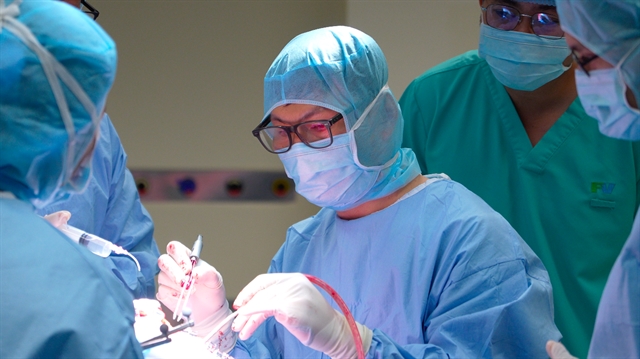 |
| Dr. Trần Lương Anh, head of the Neurosurgery and Spine Surgery Department at FV Hospital, performs surgery to remove the epidural hematoma compressing the patient's brain. — Photo courtesy of the hospital |
HCM CITY — Hong Zana, a 19-year-old Cambodian man, has made a full recovery after undergoing emergency surgery at FV Hospital in HCM City following a serious traffic accident that left him with a life-threatening brain injury.
The accident occurred at around 9pm while Zana was returning home from a part-time job. The headlights of an oncoming vehicle suddenly shone directly into his eyes, causing him to lose control and fall into a roadside ditch.
The impact resulted in severe head and facial injuries. After receiving initial treatment at a local healthcare facility, his family arranged for him to be transferred to Việt Nam overnight.
Zana, born deaf and mute, arrived at FV Hospital at 4am with severe headaches, facial injuries, nausea, neck pain and an inability to open his mouth. A CT scan revealed a large epidural hematoma accompanied by progressive brain swelling.
Dr. Trình Văn Hải, head of the Accident and Emergency Department at FV Hospital, said the case was particularly critical because the patient had sustained both a traumatic brain injury and multiple maxillofacial fractures.
"The immediate priority was to treat the brain injury to preserve the patient's life," he said.
Following an initial assessment, the hospital activated its multidisciplinary emergency response protocol. Dr. Trần Lương Anh, head of the Neurosurgery and Spine Surgery Department at the hospital, quickly determined that the epidural hematoma exceeded 100 grams, causing significant brain compression and midline shift.
"If not treated promptly, the patient could have died or suffered severe neurological complications," Anh said.
Rather than performing multiple separate operations, specialists from different departments agreed to address all injuries in a single procedure to make the most of the emergency "golden hour". Within 15 minutes of the patient's arrival, a coordinated treatment plan had been finalised.
In the operating room, the neurosurgical team performed a decompressive craniotomy to remove the hematoma and control the bleeding. Once the brain injury had been stabilised, the maxillofacial surgery team proceeded to repair the facial fractures.
Dr. Nguyễn Thanh Tùng, head of the Department of Maxillofacial Surgery and Dental at FV Hospital, said the patient had sustained fractures of the right zygomaticomaxillary complex and the right mandibular angle. As the cheekbone fracture showed minimal displacement, the team opted for conservative management of that injury while focusing on repairing the lower jaw fracture and restoring the patient's chewing function.
Tùng realigned the fractured jaw and secured it with titanium plates through an entirely intraoral approach, avoiding external incisions. The technique preserved facial aesthetics, accelerated functional recovery and significantly reduced the patient's hospital stay.
The surgery was completed in approximately 45 minutes.
After five days of treatment, Zana made a remarkable recovery. He regained full consciousness, showed no neurological deficits and was able to eat normally before being discharged from the hospital. — VNS
Society
 Society
 Society
 Society
 Society
 Society
 Society
 Society
 Society
 Society
 Society
 Society
 Society
 Society
 Society