 Society

Data centre market faces energy challenges
1.
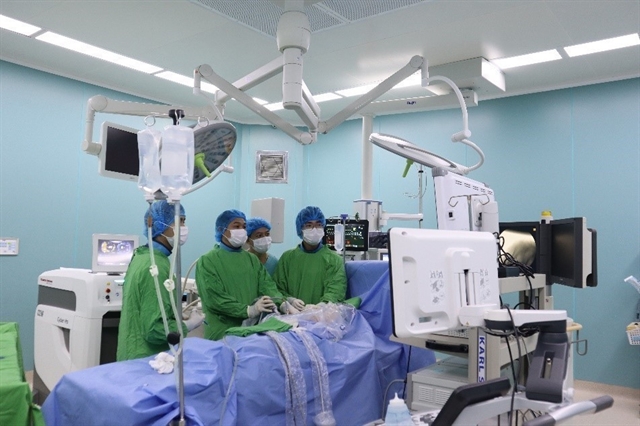 |
| Doctors perform biliary lithotripsy through a transhepatic tunnel with a laser. VNA/VNS Photo |
ĐẮK LẮK Driven by concerns arising during the process of medical examination and treatment, many practical initiatives have been researched and successfully applied by the medical staff of Buôn Ma Thuột University of Medicine and Pharmacy Hospital in Đắk Lắk Province.
The solutions not only contribute to improving treatment effectiveness but also open more opportunities for patients to approach advanced techniques in the locality that help reduce treatment cost and gradually improve grassroots-level health care service.
Needs of patients
Admitted to the hospital with fatigue, chest pains and difficulty eating, Trần Thanh H, 54, residing in Lâm Đồng Province, was diagnosed by doctors at Buôn Ma Thuột University of Medicine and Pharmacy Hospital with bile duct stones in the liver.
The disease has a high risk of recurrence and usually causes difficulties in treatment.
After being consulted about endoscopic percutaneous laser cholelithotripsy, the patient decided to be treated at the hospital with the hope of avoiding major surgery like before.
"I heard the doctor explain that this is a minimally invasive and highly effective method, so I felt reassured," he said.
"My biggest wish is to have complete treatment to soon stabilise my health and normal activities."
According to Dr Lê Đình Linh, Vice Head of Surgery, gallstone disease is quite common in Việt Nam, affecting between 2 and 6 per cent of the population, of which about 60 per cent of cases in the liver.
This is a group of diseases that easily recur, Linh said, adding that many patients have to undergo multiple surgeries but are still not treated thoroughly.
Stemming from that reality, from October 2023, the hospital implemented the technique of cutting bile duct stones through the transhepatic tunnel with a laser.
“This is a minimally invasive intervention method," the doctor said.
"The outstanding advantage of the technique is that it only creates a very small line on the skin but can still reach deep locations in the liver to thoroughly treat complex stone cases such as stones in the liver, stones in blocks or stones that recur many times.
“To date, the hospital has performed about 100 cases of percutaneous bile duct stone dissolution with a stone removal rate of over 95 per cent.
“The patient does not have to undergo major surgery, the hospital stay is only about two to three days. In cases of multiple surgeries, intervention with this method helps significantly limit the risks of repeat surgery.”
Dr Võ Minh Thành, hospital director, said that since its establishment, the hospital’s leaders have identified the target of not only improving treatment quality but also gradually performing intensive and advanced techniques that help patients not be transferred to central-level hospitals in HCM City and Hà Nội.
“The technique of percutaneous laser biliary lithotripsy is one of the clear demonstrations of innovation in medicine," Thành said.
“This is a difficult technique, currently not implemented successfully by many medical facilities in the country, but it has helped solve long-standing problems in the treatment of intrahepatic bile duct stones.”
Mastering advanced techniques
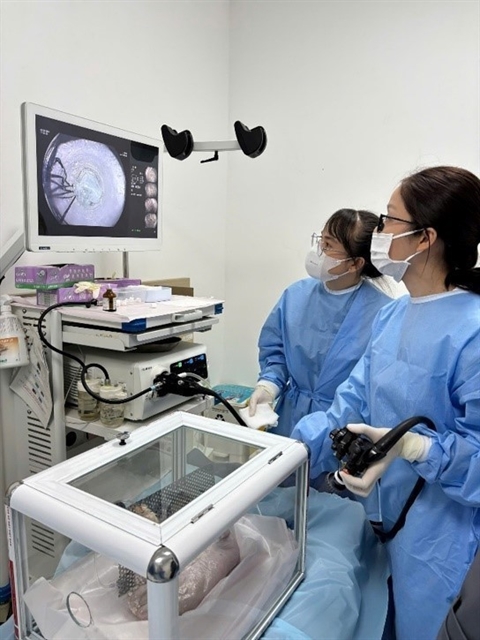 |
| Medical students practice on models in the submucosal dissection technique training course. VNA/VNS Photo |
Together with treatment service, the hospital also focuses on training high-qualified human resources to master advanced techniques.
According to Dr Nguyễn Đức Vượng, Head of the Department of Endoscopy and Functional Exploration, the number of cases of gastrointestinal cancer, especially stomach cancer, is on the rise.
If detected and treated at an early stage, the patient's survival rate is very high, Vượng said.
“Since 2023, the hospital has implemented the submucosal dissection (ESD) technique in the treatment of early gastrointestinal cancer,” Vượng added.
“However, this is a difficult technique, requiring doctors to have specialised training and a lot of practice before performing it on patients.
“Based on that practical need, the hospital's team of doctors has researched and built a gastric endoscopy simulation model to serve ESD technical training.
“Practising on the model helps doctors become more confident, limit errors and reduce the risk of complications when deployed on patients. This is also the basis for the hospital to organise training courses and transfer technology to medical units in the area.”
Many initiatives of the hospital have been recognised in the provincial Contest of Technical Innovation in 2024-2025, of which the solution of applying the technique of laser transhepatic tunnel lithotripsy in the treatment of bile duct stones at BUH won the first prize, the solution of stomach endoscopy simulation model for submucosal dissection (ESD) technique training won third prize, the solutions of application of embryo biopsy technique in treating infertility in patients with genetic abnormalities and application of VoIP system in implementing hospital internal emergency warning system also won consolation prizes.
Phan Xuân Lĩnh, chairman of the Union of Science and Technology Associations of Đắk Lắk Province, assessed that the solutions participating in the contest all demonstrate the spirit of innovation and strong development, contributing to rapid and sustainable development in the locality.
This is a vivid testament to the spirit of innovation, which is increasingly spreading across industries and fields and will continue to be perfected and widely applied in practice in the new period, he said.
In the context of increasing demand for health care, continuous research and application of science and technology is considered an inevitable direction for medical facilities. Thereby, providing effective treatment opportunities for patients, aiming to bring people access to modern medical services locally. VNS
Society
 Society
 Society
 Society
 Society
 Society
 Society
 Society
 Society
 Society
 Society
 Society
 Society
 Society
 Society