 Society
Việt Nam, Switzerland to turn education, sci-tech, innovation into cooperation focus
1.
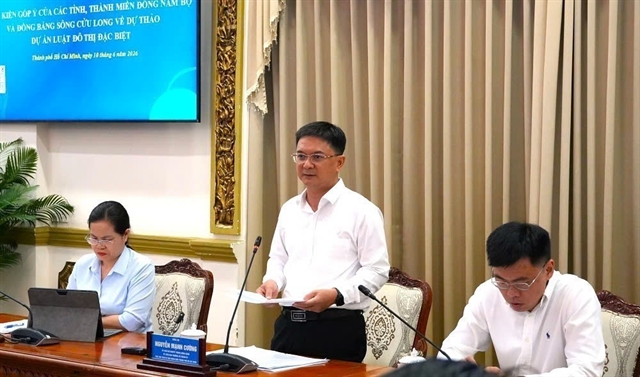 |
| Nguyễn Mạnh Cường, vice chairman of the HCM City People's Committee, addresses the summit on the draft Special Urban Area Law on June 10. — VNA/VNS Photos Liên Sơn |
HCM CITY — The proposed Law on Special Urban Areas must extend across the entire southeastern region and the Southern Key Economic Zone, positioning HCM City as the vital anchor for cohesive regional growth, policymakers and planners urged at a recent high-level summit.
The conference, convened by the city People’s Committee on June 10, gathered key representatives from across the Southeast, Cửu Long (Mekong) Delta, the South Central Coast, and Tây Nguyên (Central Highlands).
Delegates reviewed the groundbreaking draft legislation, which seeks to establish a radical new framework for regional governance, inter-provincial connectivity, and streamlined public administration.
Comprised of nine chapters and 46 articles, the draft law officially delineates the "HCM City Special Urban Area" for the first time.
The designated zone forms a sprawling socio-economic network where the southern metropolis will assume the central, guiding role to propel development across the country's southern regions.
Addressing the summit, the city People’s Committee vice chairman Nguyễn Mạnh Cường said critical infrastructure projects – ranging from ring roads, expressways, and urban metro systems to deep-water ports, logistics networks, waste processing, and river basin water management – have long suffered from fragmented implementation.
The lack of a powerful, legally mandated coordinating body has historically delayed major projects, he said.
“The new draft law remedies this by introducing an institutional framework grounded in mutual consensus, transparency, and shared regional incentives, unlocking fresh growth opportunities across provincial lines,” Cường said.
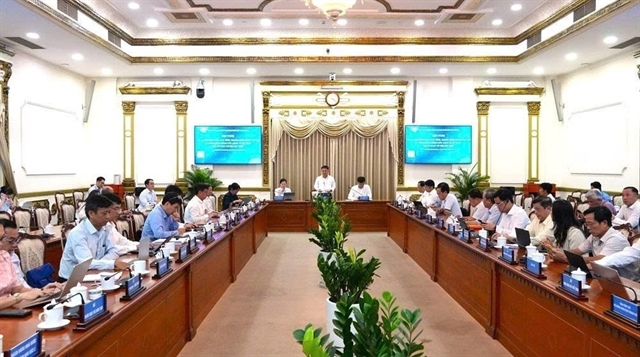 |
| Overview of the high-level summit discussing regional connectivity and the draft Special Urban Area Law in HCM City on June 10. |
Urban planning experts argued at the forum that standardising technical specifications for transport networks must be a top priority.
They highlighted that a unified legal landscape is essential; it is logistically unfeasible for a single ring road or metro line to operate under preferential regulatory mechanisms while inside the city, only to face standard bureaucratic hurdles upon crossing into neighbouring provinces.
In light of these developments, adjacent localities are already positioning themselves to align with the upcoming legislation.
A representative from Đồng Nai City – newly established in April – revealed that the local party committee is petitioning the Politburo for a dedicated resolution mapping out its growth to 2035.
The municipality aims to adopt identical breakthrough mechanisms alongside HCM City as soon as the National Assembly passes the Special Urban Area Law.
Concurrently, Tây Ninh Province, following its recent consolidation, highlighted its strategic potential for cross-border trade with the Kingdom of Cambodia.
Local authorities expressed a keen interest in accessing the same institutional autonomy to attract large-scale foreign direct investment (FDI), collectively transforming the southeast into the country’s most dynamic economic powerhouse and its primary engine of growth. — VNS
Society
 Society
 Society
 Society
 Society
 Society
 Society
 Society
 Society
 Society
 Society
 Society
 Society
 Society
 Society