 Society
Vietnamese Prime Minister meets Cambodian National Assembly President
1.
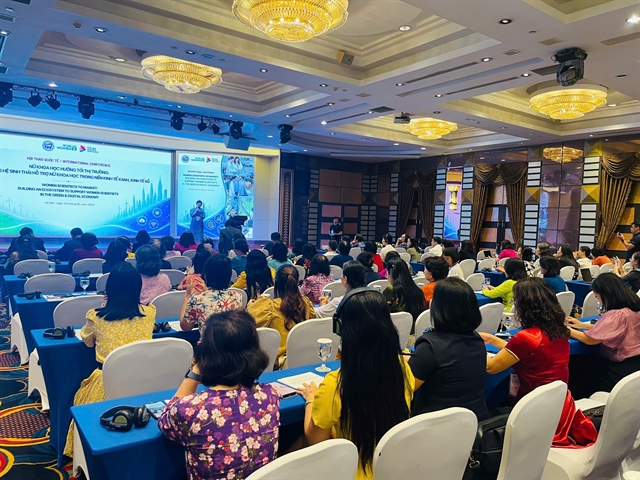 |
| As many as 180 representatives attended the international conference. — VNS Photo Thu Trang |
HÀ NỘI — Although women make up 46 per cent of Việt Nam’s research and development workforce, many research outputs led by women still face difficulties in commercialisation.
Experts from a variety of scientific fields attended an international conference titled 'Women scientists towards the market: building an ecosystem to support women scientists in the green and digital economy', which was held on Wednesday in Hà Nội.
Organised by the Việt Nam Association for Intellectual Women (VAFIW) in cooperation with UN Women, the conference attracted more than 180 delegates from State management agencies, universities, research institutes and networks, as well as the business community, investment funds, development partners and international organisations.
The event aimed to promote solutions to help female scientists translate research results into practice and contribute to Việt Nam’s innovation, green transition and digital transformation.
Information revealed at the conference shows that the share of women serving as principal investigators on science and technology projects is only 25.5 per cent, while the proportions of women granted patents, utility solutions, industrial designs and plant varieties range from just 13 per cent to 20 per cent.
VAFIW chairwoman Lê Thị Hợp said: “The green and digital economies are creating major development opportunities and placing new demands on research, innovation and technology transfer. In that process, women scientists play a particularly important role.
"Making up nearly half of the country’s research and development workforce, women in science not only help generate new knowledge, but also make active contributions to addressing environmental, social and sustainable development challenges.”
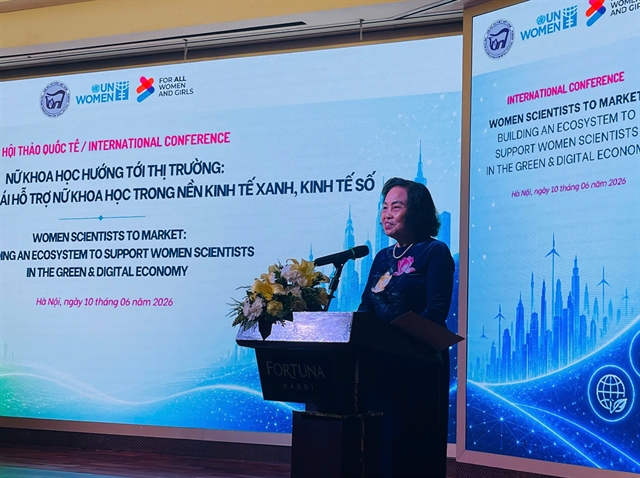 |
| Lê Thị Hợp, chairwoman of the Việt Nam Association for Intellectual Women, speaks at the event. — VNS Photo Thu Trang |
However, the journey from laboratory to market still encounters many barriers. Numerous valuable research outputs have not been commercialised effectively because of a lack of financial resources, networking opportunities, business support services, intellectual property protection and market access.
“Building a comprehensive, gender‑responsive ecosystem to support female scientists and intellectuals, and closely linking research, innovation, enterprises and markets, is an urgent necessity. This is not only a means of unlocking the potential of women researchers, but also a vital driver of green growth, innovation and the country’s sustainable development,” Hợp said.
Such an ecosystem should be designed as a seamless chain connecting scientific research, innovation, businesses, investors and markets, enabling research outputs to move beyond academic publication and be transformed into products, technologies, services and business models that generate social value.
“Female Vietnamese intellectuals and scientists possess valuable qualities: dedication, perseverance and a strong sense of responsibility, creativity and sensitivity to social and sustainable development issues. These are particular strengths that position them to contribute effectively to the development of a people‑centred green economy, digital economy and innovation agenda,” she added.
Hợp said a support ecosystem for female scientists must thus be more than a collection of isolated policies or administrative measures.
“It should be a dynamic, open and connected environment where female researchers can access resources, find inspiration and receive guidance from experts, businesses and investors, and where they have the opportunity to realise creative ideas and bring research outcomes to market and everyday life,” she said.
At the conference, participants said that the greatest challenge is not just generating new knowledge, but also enabling female scientists to access the resources needed to bring that knowledge to life.
Many female researchers continue to struggle to access investment capital, start‑up acceleration programmes, commercialisation advisory services and opportunities to collaborate with businesses and innovation networks.
Attendees confirmed that supporting female scientists in market access is both a matter of gender equality and an urgent requirement to drive innovation and economic growth.
As Việt Nam pursues its goal of becoming a high‑income country by 2045 and advances the digital transformation, green transition and innovation‑led development, this is not just a challenge for women scientists, but also an issue directly affecting the country’s competitiveness and development prospects.
International experiences shared at the conference from Canada, Finland, South Korea, the UK, Australia and Colombia show that successful innovation ecosystems have effective mechanisms to connect scientists, universities, businesses, investors and policymakers. These are also key factors in shortening the distance from research to market.
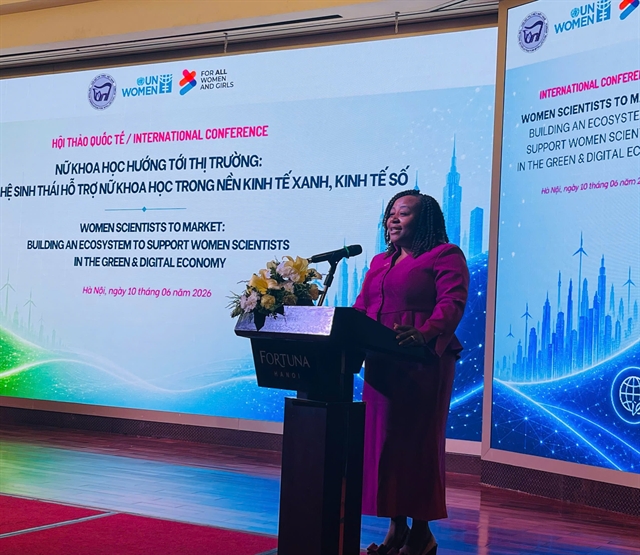 |
| Caroline Nyamayemombe, UN Women Country Representative in Việt Nam, said that gender equality is a requirement for economic development. — VNS Photo Thu Trang |
Caroline Nyamayemombe, UN Women Country Representative in Việt Nam, said: “Gender equality is not only a requirement of social justice, but also a requirement for economic development.”
“Let us work together to build an ecosystem where no talent is wasted, no initiative is left behind and every woman scientist has the opportunity to contribute fully to Việt Nam’s green and digital future,” she said.
Delegates called for increased investment in programmes supporting the commercialisation of research led by women, as well as expanded access to finance, mentoring and market connections and the construction of a more comprehensive and inclusive innovation ecosystem in which female scientists can develop research ideas into solutions that create economic and social value for Việt Nam. — VNS
Society
 Society
 Society
 Society
 Society
 Society
 Society
 Society
 Society
 Society
 Society
 Society
 Society
 Society
 Society