 Society

Việt Nam, China seek stronger substantive parliamentary cooperation
1.
|
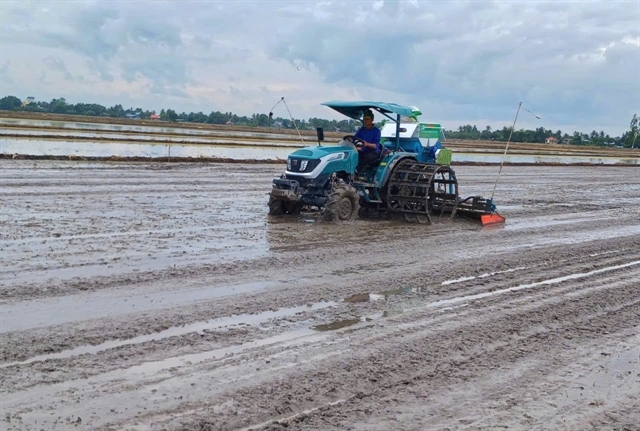
| A cluster seeding machine is used for rice sowing in Cà Mau Province, helping farmers plant rice quickly and evenly while reducing seed use and labour costs. — VNA/VNS Photo |
CÀ MAU — Science, technology, and digital transformation are reshaping agricultural production in Cà Mau Province, helping farmers improve their incomes and move towards sustainable farming.
Since the implementation of Politburo Resolution No. 57 passed in December 2024 on breakthroughs in science, technology, innovation, and national digital transformation, the southernmost province has seen clear changes in agricultural production, with digital applications gradually transforming farming methods and increasing the value of agricultural products.
Traditional rice fields are being turned into “smart fields” through the use of drones, digital monitoring systems, traceability software, and e-commerce platforms.
At the Ba Đình Agricultural General Co-operative in Vĩnh Lộc Commune, digital technology has been applied across nearly 750ha of rice-shrimp farming and integrated production models.
Nông Văn Thạch, its chairman, said the co-operative had invested in advanced cultivation technologies, including drones and cluster seeding machines, and they ensure faster and more even sowing, save seeds, reduce labour costs, and improve production efficiency.
In addition, all of the co-operative’s rice cultivation area uses combine harvesters.
The co-operative uses FaceFarm software to digitally manage production and trace product origins.
It has adopted e-invoices, digital signatures, and online payments to improve efficiency, while e-commerce platforms have enabled it to expand markets, connect with more customers, and create stable outlets for farm produce.
Technology is also changing the way farmers in the province manage their fields.
In the past, farmers had to inspect rice paddies manually to detect pests, but now, much of the information can be monitored on smartphones connected to the internet.
At the Thanh Sơn Agricultural Service Co-operative in Vĩnh Mỹ Commune, a “smart pest monitoring network” has delivered positive results.
Trần Văn Ngỗ, its chairman, said the system helps farmers reduce pesticide use and spray the right areas with the correct products and dosages.
“Production costs have therefore fallen significantly.”
|
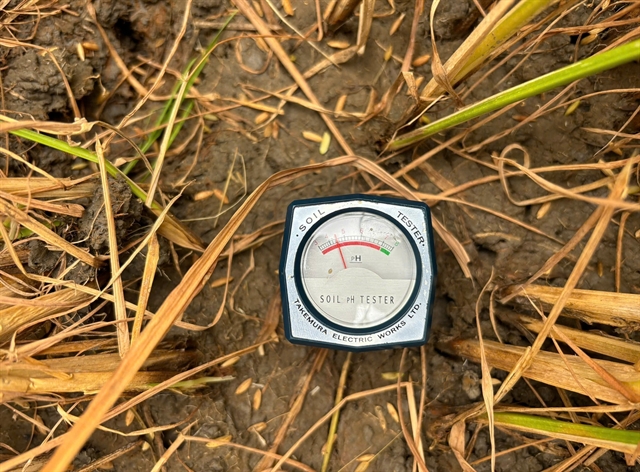
| A monitoring device tracks key indicators in water-saving rice farming in Cà Mau Province. — VNA/VNS Photo |
Many farmers said technology had made farming more systematic and less dependent on traditional experience, while improving economic efficiency.
Trịnh Văn Ngang, a member of the Đồng Tâm Agricultural Service Co-operative in Châu Thới Commune, said since joining the co-operative, local farmers had focused more on product quality and increasingly used technology.
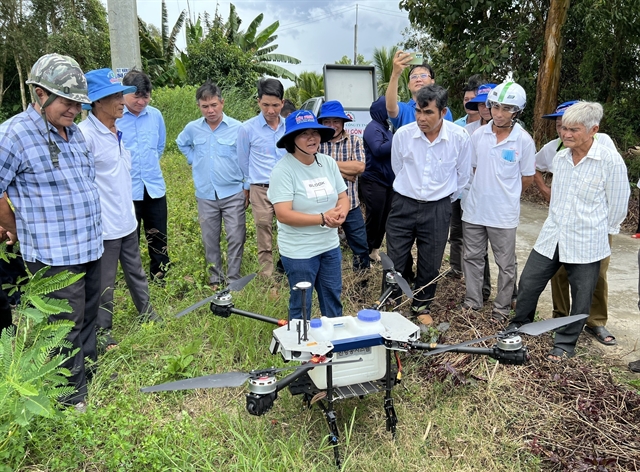
“The co-operative uses drones to spray pesticides, spread fertilisers, and sow rice. Previously, spraying pesticides on one hectare of rice took farmers seven to eight hours of manual labour. Now it takes only five to 10 minutes.
“Estimates show digital transformation can generate VNĐ10–15 million (US$380–570) higher profits per hectare than traditional farming methods.”
The province has more than 600 co-operatives, 480 in agriculture, with 35,000 members.
Many co-operatives are actively using e-commerce, information technology, and traceability systems to expand markets.
At the Ba Khía Đầm Dơi Co-operative, which produces fermented ba khía (three-striped crab) in Quách Phẩm Commune, members initially had no experience in livestream sales or online marketing.
However, they gradually built fanpages, opened stores on Shopee and TikTok Shop, and learned how to produce promotional videos.
Each product is attached to a QR code for traceability.
Orders have increased rapidly, with customers from Hà Nội, Đà Nẵng, and even Australia and Thailand becoming familiar with “Ba Khía Đầm Dơi”.
The co-operative’s revenues have risen by more than 30 per cent in the two years since its digital transformation.
Trần Thị Xa, its chairwoman, said: “Digital transformation is not simply about bringing co-operatives online. It is about connecting them more closely with consumers and bringing the intelligence, culture, and labour values of farmers into the digital environment.
“For us, every online order is a joy because it means one more person has learned about Đầm Dơi’s traditional craft and local products.”
|
| Drones are used to spray pesticides in Cà Mau Province, helping reduce costs and limit farmers’ exposure to chemicals. — VNA/VNS Photo |
Phạm Văn Mười, deputy director of the province Department of Agriculture and Environment, said digital transformation had already become part of farmers’ daily work.
It is now used in pest monitoring, irrigation, and fertiliser application in the fields, he said.
The province is also accelerating digital applications in agricultural extension work.
Under the province’s plan for this year, the agriculture sector is expected to organise 140 vocational training courses, 60 technical consultancy classes, and 26 online consultancy sessions for farmers.
Digital technical materials, instructional videos, agricultural extension websites, and applications will continue to be developed to help farmers access information and farming techniques. — VNS
Society
 Society
 Society
 Society
 Society
 Society
 Society
 Society
 Society
 Society
 Society
 Society
 Society
 Society
 Society