 Society
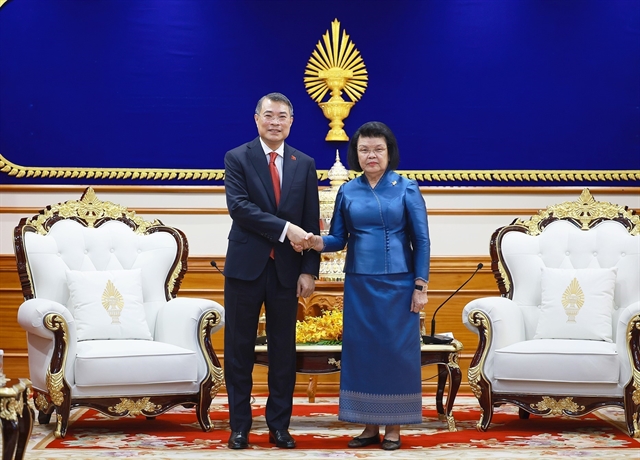
Vietnamese Prime Minister meets Cambodian National Assembly President
1.

|
| Military personnel are collecting DNA samples from the remains of a fallen soldier in the northern province of Phú Thọ. — VNA/VNS Photo Thanh Hải |
HÀ NỘI — Authorities have recovered the remains of 1,109 war martyrs after nearly three months launching a nationwide 500-day campaign to intensify the search, recovery and identification of fallen soldiers’ remains.
The remains consist of 242 in Việt Nam, 173 in Laos and 694 in Cambodia, as well as two collective war graves in the northern mountainous province of Tuyên Quang.
The data was revealed by the Office of the National Steering Committee for the search, recovery and identification of martyrs’ remains.
At the same time, relevant agencies are accelerating DNA sampling and analysis while preparing for a nationwide drive to collect approximately 250,000 DNA samples from relatives of unidentified martyrs.
Two scientific conferences were held on May 29 and June 8 to verify and assess information relating to collective martyrs’ graves in Kon Tum Ward, in the cental province of Quảng Ngãi, and Lê Thị Riêng Park area in HCM City.
Following the conferences, Deputy Prime Minister and head of the National Steering Committee Phạm Thị Thanh Trà ordered authorities to urgently complete the necessary documentation, mobilise all available resources and employ modern technologies, including ground-penetrating radar, to expedite surveys, excavation work and the recovery of martyrs’ remains.
Excavation and recovery operations are currently under way at the Đắk Cấm Ward Martyrs’ Cemetery and along Trường Chinh Street in Kon Tum Ward.
Military regions nationwide have established 360 mine and unexploded ordnance clearance teams comprising nearly 5,000 personnel and equipped with 1,311 mine-detection devices.
The northern mountainous province of Tuyên Quang alone has formed 159 clearance teams with nearly 3,000 personnel and 461 detectors. Clearance operations have covered 3,500 ha out of a planned 22,725 ha so far, equivalent to 15.4 per cent of the target area.
Regarding the collection of samples from unidentified martyrs’ remains in cemeteries, the Ministry of National Defence has issued technical guidelines covering sampling, transportation, handover, preservation and storage procedures.
The ministry has also organised a nationwide training conference on sampling, sample handover and digitalisation of information relating to martyrs’ remains.
Pilot sampling and handover activities have been conducted at Nghi Lộc Martyrs’ Cemetery in Đồng Lộc Commune in the central province of Nghệ An.
All military regions and provincial and municipal authorities have now developed implementation plans.
A total of 297 sampling teams, comprising 3,615 personnel, have been established.
Pilot sampling has been carried out at 3,651 martyrs’ graves, of which 2,510 graves met the conditions for sampling, representing 68.75 per cent, while 1,145 graves were deemed unsuitable for sampling.
Viettel Group has completed and deployed software for managing information on martyrs’ remains samples.
The group has also largely completed the development of software to monitor the progress and results of the 500-day campaign, which is scheduled to be operational before June 15, 2026, to support the national steering committee’s leadership and management activities.
In terms of identifying martyrs’ remains, the Ministry of Home Affairs has advised the Government on the issuance of Resolution No. 26/2026/NQ-CP, which introduces special mechanisms and policies to address obstacles in DNA sampling, testing and identification of martyrs whose identities remain unknown.
The ministry also helped formulate Decision No. 51/QD-BCDQG, issued by the head of the national steering committee, which sets out coordination procedures and regional responsibilities for receiving and analysing DNA samples to identify unidentified martyrs.
The National Steering Committee has called on Party committees and local authorities at all levels to strengthen leadership and direction of search and recovery efforts, particularly within Việt Nam and in areas where information on martyrs’ graves remains abundant, especially reports relating to collective burial sites.
Authorities have also been urged to prioritise additional manpower, equipment and logistical support for recovery operations, while maximising the effectiveness of local and specialised forces.
The committee called for the consolidation, reinforcement and establishment of temporary teams where necessary to ensure campaign targets are met.
The committee has directed relevant agencies to accelerate the collection, analysis and verification of DNA samples from martyrs’ relatives for integration into the national genetic database used to identify unidentified remains.
According to the Ministry of Public Security, preparations are under way for a nationwide campaign to collect DNA samples from relatives of martyrs whose identities have not yet been established.
The campaign is expected to run from June 20, 2026, to July 20, 2027, with approximately 250,000 DNA samples set to be collected. — VNS
Society
 Society
 Society
 Society
 Society
 Society
 Society
 Society
 Society
 Society
 Society
 Society
 Society
 Society
 Society