 Society

Vietnamese Prime Minister meets Cambodian National Assembly President
1.
|
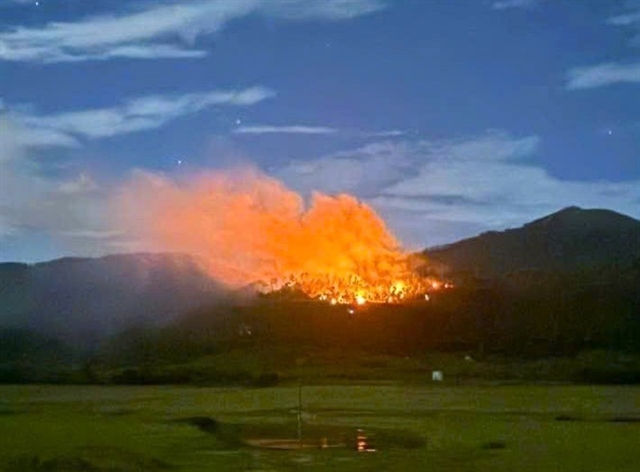
| A forest fire occurs in Rú Xuân mountain area, Phúc Lộc Commune, in the central province of Nghệ An on Sunday. — VNA/VNS Photo |
HÀ NỘI — More than 900 communes across Việt Nam are facing an extreme risk of forest fires on Wednesday as prolonged dry weather and a lack of rainfall continue to heighten fire danger nationwide.
The Forestry and Forest Protection Department under the Ministry of Agriculture and Environment reported that approximately 1,118 commune-level areas are at risk of forest fires on Wednesday.
Under its forest fire warning system, 55 areas are classified at the high risk level, 158 at the dangerous level, and 905 at the highest warning level, indicating an extremely dangerous fire risk.
The northern province of Thanh Hóa recorded the highest number of high-risk areas, with 133 locations under fire warnings across the three alert levels.
It was followed by the central province of Nghệ An with 117 locations, the central province of Gia Lai with 89, the coastal central city of Đà Nẵng with 82, the northern mountainous province of Tuyên Quang with 78, the central province of Quảng Trị with 74, the northern province of Thái Nguyên with 66, the central province of Quảng Ngãi with 55, the central province of Hà Tĩnh with 52, the northern province of Bắc Ninh with 43 and the northern mountainous province of Lạng Sơn with 39.
Hà Nội has 16 areas under forest fire warnings, while HCM City has 18.
As of 8am on Wednesday, satellite imagery had detected 14 fire hotspots nationwide.
Of these, seven were located within forested areas, while the remaining seven were believed to be outside forest zones.
Earlier, on Monday, the department warned that severe heat would continue affecting large parts of the country from Monday until Sunday, particularly from Thanh Hóa Province to Đà Nẵng City, where temperatures could reach as high as 40 degrees Celsius.
However, weather conditions remain highly variable across the country, with intense heatwaves interspersed with thunderstorms and heavy rainfall in some areas.
The department said that hot, dry conditions, low humidity and dry winds have left vegetation highly flammable, while localised thunderstorms accompanied by lightning pose a significant natural cause of forest fires.
In some areas, especially those affected by exceptionally severe heat and Foehn winds, the forest fire risk is expected to remain at the extremely dangerous level.
If a fire breaks out, it is likely to spread rapidly and prove difficult to contain, the department said.
Strengthening mornitoring
Authorities have therefore urged local administrations to maintain round-the-clock monitoring, promptly detect and extinguish fires at an early stage, and prevent small outbreaks from developing into major incidents.
The department has strictly prohibited the use of fire in or near forests, including slash-and-burn farming and vegetation clearance burning during periods of extreme heat.
Forest owners and rangers have been instructed to intensify 24-hour patrols and surveillance in high-risk areas.
Local authorities are also required to continue monitoring fire hotspots through satellite data, particularly during peak heat hours between 11am and 4pm.
Forest owners and residents have been advised to closely follow official forest fire warnings issued by the department.
The agency further called on localities to maintain the “four-on-the-spot” emergency response principle, ensuring the availability of personnel, equipment, logistics and command structures, particularly in pine forests, dipterocarp forests and concentrated plantation forests where combustible material is abundant.
The department also warned that signs of the return of the El Niño phenomenon have emerged since May, raising the prospect of a harsher dry season in the coming months.
As a result, despite forecasts of cooling rainfall this week, strict preparedness measures under the “four-on-the-spot” approach must remain in place. — VNS
Society
 Society
 Society
 Society
 Society
 Society
 Society
 Society
 Society
 Society
 Society
 Society
 Society
 Society
 Society