 Society
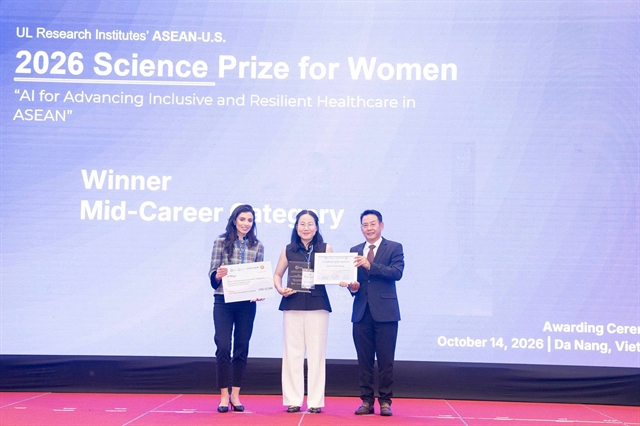
Vietnamese scientist wins ASEAN-US Science Prize for Women
1.
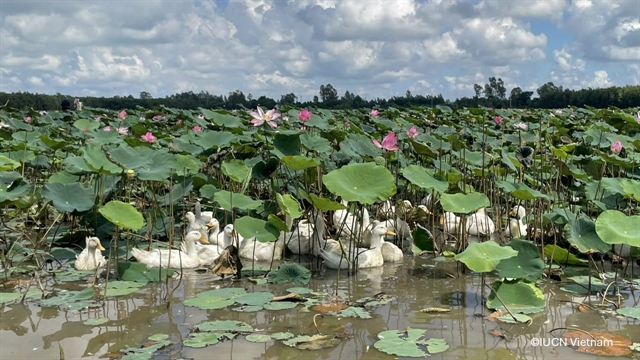 |
| The sustainable flood-based lotus-fish agricultural model in Tây Ninh Province, supported by IUCN, offers local farmers a solution to increase their income during the flood season and improve their solid quality. — Photo by IUCN |
TÂY NINH — A sustainable flood-based lotus fish agricultural model in Tây Ninh Province, supported by the International Union for Conservation of Nature (IUCN), has shown great potential for local farmers to combat climate change, declining water quality, rising input costs and market fluctuations.
In the buffer zone of Láng Sen Wetland Reserve in Tây Ninh Province, IUCN has supported the application of a flood-based lotus fish model for 80 households across 225 hectares.
This is part of the three-year project “Developing a sustainable value chain of products from lotus silk to support the flood storage strategy for the Mekong Delta, Việt Nam,” funded by The Coca-Cola Foundation.
It aims to help farmers retain water and boost flood-season livelihoods through lotus cultivation, whilst improving household incomes by combining lotus farming and freshwater fish intercropping with rice, along with building a value chain for lotus products.
The model helps farmers transition from two to three rice crops per year to a single rice crop combined with flood-season lotus cultivation and fish farming.
According to a local farmer, fields are left idle during the flood season as floodwater is let in for silt deposits, making rice cultivation impossible.
By combining lotus cultivation and freshwater fish farming during the flood season alongside their rice crops, local farmers have been able to generate additional income during this period.
The project has provided households with funding, technical training in lotus cultivation and lotus silk extraction.
Furthermore, IUCN aims to expand the model to other provinces across the region.
On June 10 to 11, the Agricultural Extension Centre under the Department of Agriculture and Environment of An Giang Province and IUCN co-organised a field trip to households implementing the project in Tân Hưng Commune, Tây Ninh Province, for 40 farmers from An Giang Province, alongside technical officers, local authorities and scientists.
Trịnh Phước Nguyên, Deputy Director of the Institute of Climate Change at An Giang University (member of Việt Nam National University - HCM City), said that a standout feature of the IUCN model is its ability to improve soil quality.
He noted that once the lotus crop concludes, all stems, leaves and roots are ploughed back into the soil, creating a natural organic source for the subsequent rice crop, which significantly reduces input costs whilst enhancing soil fertility.
They also visited other sustainable agricultural livelihood models supported by the World Wide Fund for Nature (WWF Việt Nam) in the buffer zone of Tràm Chim National Park, including a natural flood-based fish farming model in An Hoà Commune and a flood-based fish farming model combined with fingerling stocking and ecotourism in Phú Thọ Commune, Đồng Tháp Province, implemented by the Quyết Tiến Cooperative.
These models have demonstrated strong results, including reduced production costs, increased income per unit area and lower reliance on agricultural chemicals.
Through the field trips, local farmers were given the opportunity to learn about these sustainable agricultural models and their effectiveness, fostering a network of knowledge exchange between local farmers. — VNS
Society
 Society
 Society
 Society
 Society
 Society
 Society
 Society
 Society
 Society
 Society
 Society
 Society
 Society
 Society