 Economy


NA President’s visit expected to boost Việt Nam–China ties across multiple fields
1.
|
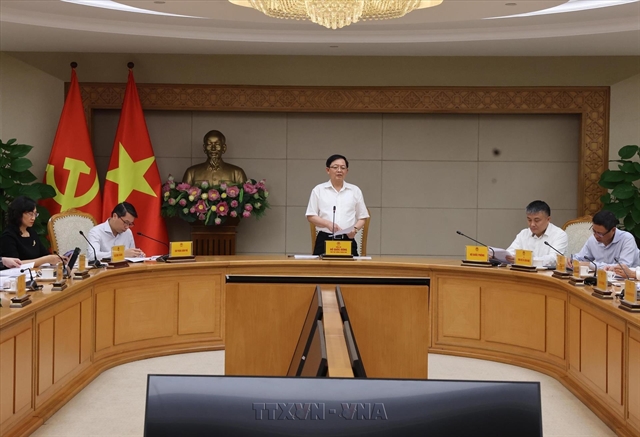
| Deputy Prime Minister Hồ Quốc Dũng chaired a meeting at Government headquarters on Tuesday on a draft scheme for restructuring national science, technology and innovation programmes for 2026-35. —VNA/VNS Photo |
HÀ NỘI — Việt Nam plans to restructure its national science, technology and innovation programmes for 2026-35 to concentrate resources on major national challenges and improve the practical impact and commercialisation of research results.
Deputy Prime Minister Hồ Quốc Dũng made the remarks while chairing a meeting at the Government headquarters on Tuesday on a draft scheme for restructuring national science, technology and innovation programmes for 2026-35.
According to Deputy Minister of Science and Technology Lê Xuân Định, the national system had around 42 science and technology programmes during 2016-25, implementing about 4,800 tasks with nearly VNĐ17 trillion (US$665 million) from the State budget.
The programmes helped maintain national research capacity, develop the scientific workforce and expand research into emerging areas such as artificial intelligence, biotechnology, digital technologies, advanced materials and foundational technologies.
However, the system also faced problems including overlapping programme scopes, fragmented resources and research tasks developed largely from individual proposals. Research results were not always effectively transferred to technology development, production and commercialisation, while businesses played a limited role.
The restructuring is therefore aimed not simply at reducing the number of programmes, but at creating an interconnected system with clear priorities and measurable outcomes, Định said.
Under the draft scheme, programmes for 2026-35 would be organised into six groups: basic research; national priority programmes; special national and strategic technology programmes; national innovation; development of national science, technology and innovation capacity; and national digital transformation.
The grouping would help clarify the objectives and expected outcomes of each programme, improve resource coordination and connect outputs across the research, development, application and commercialisation chain.
By 2030, the scheme targets 100 per cent of programmes being monitored and evaluated through a national digital management platform. It also aims to master core technologies, develop at least 20 key national and strategic technology products, and have at least 50 per cent of commissioned research tasks led or co-led by businesses, with businesses contributing at least 40 per cent of their total funding.
By 2031-35, the targets include at least 50 key national and strategic technology products reaching industrial-scale commercialisation and international competitiveness. The proportion of commissioned tasks led or co-led by businesses is expected to rise to at least 60 per cent, with business funding accounting for at least 50 per cent.
Deputy PM Dũng stressed that restructuring was a major task with broad implications for national science, technology, innovation and digital transformation, particularly in the allocation of resources.
He said the restructuring must address fragmented and spread-out investment and limited commercialisation of research, creating substantive changes rather than merely regrouping existing programmes.
The new system should cover the full chain from basic and applied research and technology development to innovation and commercialisation, he said.
He also called for a comprehensive review of programmes managed by the Government, the Ministry of Science and Technology and other ministries and sectors. Ineffective programmes that no longer meet their objectives should not continue.
The restructuring would not initially open new programmes, but would reorganise and transition existing tasks while removing those that were no longer relevant. New tasks would be considered based on the approved scheme.
Each programme must have clear objectives, particularly targets through 2035, with evaluation based on outputs and impacts rather than primarily on inputs, Dũng said.
He also called for stronger links among the State, research institutes, universities and businesses, including mechanisms for the State to commission and purchase research outputs and encourage businesses to participate in strategic technology development.
The Deputy PM urged the Ministry of Science and Technology to work with ministries and sectors to finalise the scheme and submit it to competent authorities, with the aim of making science and technology management more focused on strategic national tasks and delivering tangible contributions to economic growth and national development. — VNS
Economy
 Economy
 Economy
 Economy
 Economy
 Economy
 Economy
 Economy
 Economy
 Economy
 Economy
 Economy
 Economy
 Economy
 Economy