 Economy


Cơm Tiến Vua
1.
|
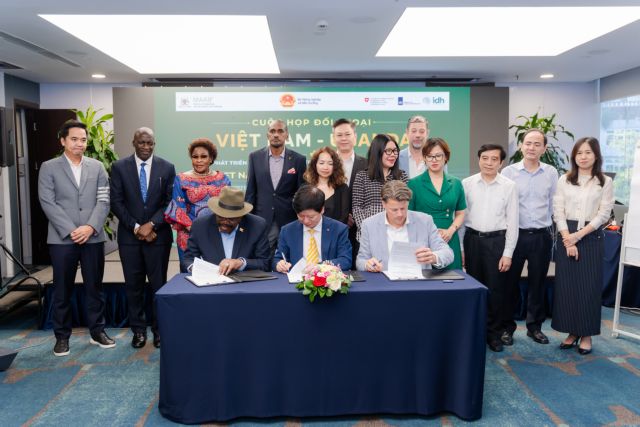
| The signing ceremony of a five-year joint action plan between the Department of International Cooperation under the Ministry of Agriculture and Environment, Uganda's Coffee Department and IDH. — Photo courtesy of the organiser |
HÀ NỘI — Việt Nam and Uganda are seeking new opportunities for cooperation in coffee production and trade, with both sides aiming to build a sustainable, climate-resilient and deforestation-free value chain that creates long-term benefits for farmers, businesses and markets.
The Ministry of Agriculture and Environment of Việt Nam, the Ministry of Agriculture, Animal Industry and Fisheries of Uganda and IDH, a Netherlands-based organisation, co-organised a dialogue in Hà Nội on Tuesday on promoting sustainable coffee development under the South-South Cooperation framework.
The event brought together representatives from diplomatic missions, international organisations, businesses and partners in the coffee value chains of the two countries.
Speaking at the dialogue, Phạm Ngọc Mậu, Deputy Director General of the Department of International Cooperation under the Ministry of Agriculture and Environment, said Việt Nam and Uganda both had important coffee sectors, with millions of people involved in production and the wider value chain.
Coffee is not only an agricultural and commercial commodity but is also closely linked to livelihoods, rural development and opportunities to increase farmers' incomes, he said.
Against the backdrop of climate change, the need for more efficient resource use, product quality and safety requirements, traceability and increasingly stringent international market standards, the coffee sector is under pressure to shift towards more sustainable production.
Mậu said the value of coffee was generated not only on farms but also through science and technology, processing, branding, market development and linkages throughout the value chain.
Việt Nam has therefore increasingly focused on quality, added value, sustainability and climate resilience rather than simply increasing productivity.
“Việt Nam has spent nearly four decades continuously building and innovating to become one of the world's leading coffee producing and exporting countries. We are always ready to share our experience with other coffee-growing countries,” Mậu said.
He said cooperation with Uganda, particularly through the Resilient Coffee Programme (RCP), would provide an opportunity for the two countries to learn from each other and combine their strengths.
“The cooperation with the Government of Uganda, especially under RCP provides a great opportunity for us to learn from one another and combine our respective strengths towards a shared goal: securing a sustainable and resilient coffee supply for the global market,” he said.
Việt Nam has experience in developing production areas, organising value chains, processing, increasing value and expanding markets, while Uganda has its own potential, strengths and development needs.
The two sides therefore do not necessarily need to pursue a single model, but can exchange experience and select solutions appropriate to the conditions of each country.
Towards deforestation-free coffee
Frank K. Tumwebaze, Minister of Agriculture, Animal Industry and Fisheries of Uganda, said coffee played an essential role in the livelihoods of millions of Ugandan farmers.
“Coffee is central to the livelihoods of millions of Ugandan farmers, and their future depends on achieving the right balance of productivity, sustainability, and resilience,” he said.
“Cooperation with Việt Nam and IDH gives us the opportunity to learn from trusted partners and strengthen our path towards a resilient, deforestation-free coffee sector.”
Major General David Kasura Kyomukama, Permanent Secretary of Uganda's Ministry of Agriculture, Animal Industry and Fisheries, said the cooperation would also help Uganda strengthen its coffee research capacity and develop climate-resilient varieties.
“Uganda hopes to strengthen her coffee research capacity for generation of high yielding climate change resilient varieties, explore ways of increasing productivity, improve coffee specific extension and models for provision of inputs and irrigation sustainably develop the Ugandan coffee value chains,” he said.
The dialogue marked the first time the Governments of Việt Nam and Uganda, with support from IDH, established a shared intention to cooperate on developing a sustainable, resilient and deforestation-free coffee sector.
A five-year joint action plan was signed between the Department of International Cooperation under the Ministry of Agriculture and Environment, Uganda's Coffee Department and IDH.
Building on the 2019 Bilateral Agriculture Memorandum of Understanding between the two countries, the plan provides a framework for policy dialogue, technical exchange, experience sharing, business linkages and resource mobilisation.
The cooperation is expected to help farmers in both countries strengthen their ability to adapt to climate change, maintain and increase productivity and meet increasingly stringent international market requirements, including the EU Deforestation Regulation (EUDR) and the Corporate Sustainability Due Diligence Directive (CS3D).
Daan Wensing, CEO of IDH, said sustainable changes in the coffee sector could not be achieved through individual efforts.
“Lasting change in coffee rarely comes from one actor working alone. IDH's role is to bring governments together with each other and with the market, so that cooperation turns into real change on the ground,” he said.
He said the partnership between Việt Nam and Uganda through RCP could demonstrate how South-South cooperation involving the market could contribute to sustainable coffee supplies over the long term.
Resilient Coffee Programme launched
Also on Tuesday, IDH officially launched the Resilient Coffee Programme in Việt Nam, with ALDI SÜD of Germany as its first front-runner investor.
Over the next four years, the programme aims to build a regenerative and verifiable Robusta coffee supply and reach around 75,000 coffee farmers.
About 70 per cent of participating households are expected to adopt regenerative agricultural practices, contributing to a reduction of 240,000 tonnes of CO₂ emissions and a 15 per cent increase in farmers' incomes.
The results will be reported through measurement, reporting and verification (MRV), traceability and co-claiming systems.
The programme aims to develop a Robusta coffee supply that is resilient to climate change while meeting increasingly stringent international market requirements.
Đỗ Ngọc Sỹ, Sustainability Manager APAC at JDE Peet's, said the company was committed to working with partners to promote sustainable and deforestation-free coffee production.
“We believe this cooperation between Việt Nam and Uganda under RCP will help farmers and companies meet market requirements and strengthen the supply of sustainable coffee for the global market,” he said.
Earlier on Tuesday, Deputy Minister of Agriculture and Environment Nguyễn Hoàng Hiệp received and held talks with Minister Tumwebaze.
Hiệp affirmed that Việt Nam was ready to accompany Uganda in moving from agricultural commodity exports towards products with higher added value, including coffee and rice.
“During its development, Việt Nam has gradually shifted from a focus on output towards quality, added value and sustainability,” he said.
“The value of agricultural products is created throughout the entire value chain, from production organisation, the application of science and technology, processing and logistics to branding and market development.”
“Moving from agricultural commodity exports to exports of higher added value is a journey Việt Nam has gone through, and we want to accompany Uganda on that journey,” he said. — VNS
Economy
 Economy
 Economy
 Economy
 Economy
 Economy
 Economy
 Economy
 Economy
 Economy
 Economy
 Economy
 Economy
 Economy
 Economy