 Society

Second language, second thoughts: what next for ESL?
1.
|
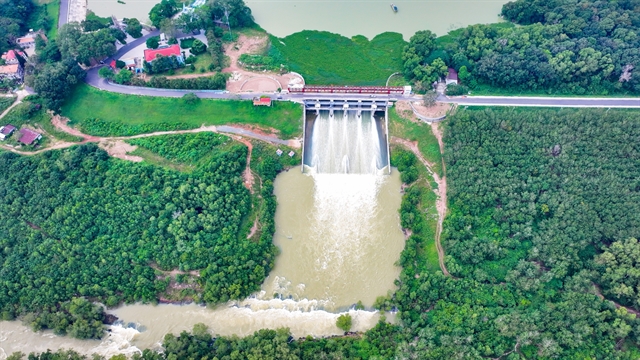
| The water-release facility at Dầu Tiếng Reservoir in Tây Ninh Province regulates water discharge to help maintain river flows and push back saltwater intrusion in downstream areas. — VNA/VNS Photo Minh Phú |
HÀ NỘI — The Department of Water Resources Management under the Ministry of Agriculture and Environment has called for water storage, regulation and allocation starting from the end of 2026 in preparation for the dry season of next year.
Speaking at the ministry’s regular press briefing on Wednesday, Ngô Mạnh Hà, the department’s deputy head, said Việt Nam has about 3,450 rivers and streams that are at least 10km long, with a total annual flow of about 844 billion cubic metres.
However, water resources are unevenly distributed among regions and throughout the year. Five out of Việt Nam’s 13 major river basins depend partly on water sources from outside the country's borders.
Việt Nam currently has about 6,733 irrigation reservoirs with a combined capacity of approximately 15.2 billion cubic metres and 705 hydropower reservoirs with a total capacity of about 55 billion cubic metres.
Of these, 137 large reservoirs are operated under inter-reservoir operating procedures across 11 river basins, with a combined capacity of about 54.6 billion cubic metres, including about 37.2 billion cubic metres of usable capacity.
These reservoirs are important water reserves for production, domestic use and other needs during the dry season, Hà said.
However, since May 2026, water levels in many rivers and streams have tended to remain below the long-term average due to the influence of El Nino. During June-August 2026, flows in most rivers and streams across 12 major river basins were 10-75 per cent below the long-term average, except for the Red River basin and the main channel of the Mã River.
Citing that rainfall in the coming period could be 10-40 per cent below average, while saltwater intrusion could occur earlier and penetrate further inland, Hà warned of El Nino’s pronounced impacts, the same as conditions in 2015 and 2019.
The water management authority also warned that reservoirs may fail to store enough water before the dry season begins.
If rainfall and river flows are low during the final months of the rainy season, irrigation and hydropower reservoirs will not have enough water reserves to regulate supplies during the dry season. This risk is particularly notable in the central region, Central Highlands and southern Việt Nam.
If the rainy season ends early and rainfall is below average, river and stream flows during the dry season will also decline.
In the central region, south-central Việt Nam, Central Highlands and southern regions, flow deficits could exceed 40 per cent, while some rivers, including the Kôn and Ba rivers, could see deficits of more than 60 per cent.
Hà said that under an El Nino scenario, if water stored in reservoirs is already below normal levels by the end of the rainy season and dry-season flows continue to decline, the risk of water shortages will increase across individual river basins and could affect water security nationwide.
About 74 per cent of hydropower reservoirs are assessed to face a 15-80 per cent shortfall in storage capacity by the end of the rainy season, while about 40 per cent of irrigation reservoirs could face a 20-87 per cent shortfall. During the dry season, flows in some areas could be 15-78 per cent below the long-term average.
Hà said Việt Nam needs to shift from responding to water shortages after they occur to proactively preparing from late 2026.
He urged relevant authorities to update hydrometeorological forecasts and strengthen warnings in areas at risk of drought and water shortages, particularly the central region, Central Highlands and Mekong Delta.
An important task is to begin storing water early in irrigation and hydropower reservoirs during the rainy season, in line with conditions in each river basin. Reservoir operations should be flexible, ensuring safety for downstream areas and flood prevention while making the most of opportunities to store water in preparation for the 2027 dry season, he said.
The water management authorities should soon announce water-resource scenarios for river basins, which will serve as a basis for localities to develop plans to prevent and respond to drought, water shortages and saltwater intrusion.
He said given current water-resource conditions, preparations for the 2027 dry season need to begin early and proactively, because once reservoirs are short of water and river flows have declined, there will be limited room for response. — VNS
Society
 Society
 Society
 Society
 Society
 Society
 Society
 Society
 Society
 Society
 Society
 Society
 Society
 Society
 Society