 Economy


HIIVE by fusion brings business and golf closer in Bình Dương
1.
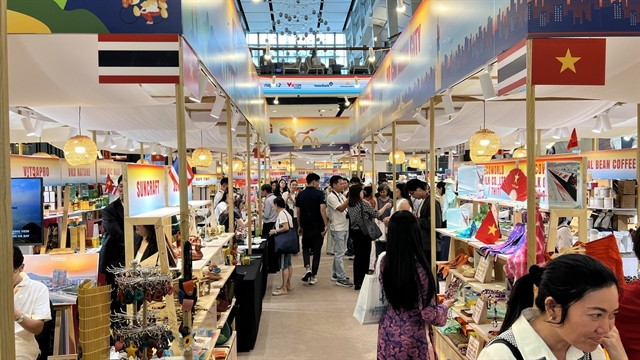 |
| Visitors explore Vietnamese products at Vietnamese Week in Thailand 2026 at centralwOrld in Bangkok. — VNS Photos Mai Hương |
By Mai Hương
BANGKOK — Vietnamese businesses are gaining more practical opportunities to test and adapt their products for the Thai market, as Vietnamese Week in Thailand 2026 puts greater emphasis on market access, buyer connections and the requirements needed to turn local products into export-ready goods.
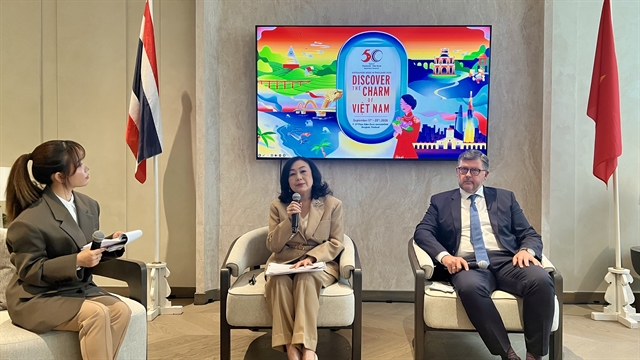
Held from September 17–20 at centralwOrld under the theme “Discover the Charm of Vietnam”, the event brings together 60 Vietnamese businesses showcasing products ranging from processed food, coffee and noodles to fish sauce, handicrafts and regional specialties. It also promotes Vietnamese cuisine, culture and tourism.
The event marks the 50th anniversary of diplomatic relations between Việt Nam and Thailand and is jointly organised by the Ministry of Industry and Trade and Central Group and Central Retail.
Speaking at the opening, Central Group chairwoman Wallaya Chirathivat said the programme had evolved since its launch in 2016 from a promotional event into a platform connecting businesses and creating commercial opportunities.
The event also includes a memorandum of understanding (MOU) between Central Retail, NAPAS and VietinBank to facilitate cross-border QR payments between Việt Nam and Thailand, linking trade with tourism and digital payment services.
Thailand is a major trading partner of Việt Nam in ASEAN. Bilateral trade reached more than US$22 billion in 2025 and continued to grow strongly this year, reaching $18.5 billion in the first eight months, up 30.6 per cent year-on-year.
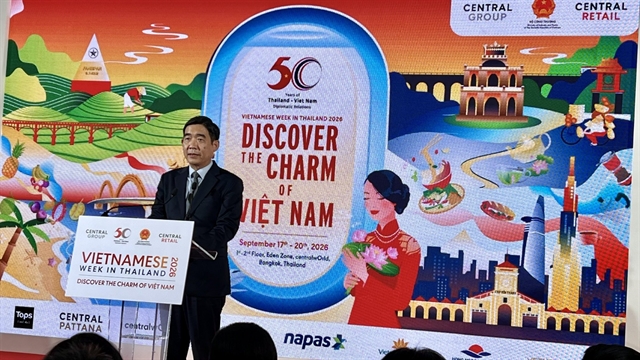 |
| Vietnamese Ambassador to Thailand Phạm Việt Hùng speaks at the event. |
Vietnamese Ambassador to Thailand Phạm Việt Hùng said the two countries should look beyond the existing trade target.
“I believe that after this year we will reach the $25 billion target and move towards trade volumes of $30 billion and $50 billion in the coming years,” he said.
He stressed that expanding trade should not be the only goal, calling for closer coordination to make bilateral trade more balanced and sustainable.
Dr. Kirida Bhaopichitr, Assistant Minister of Commerce, said the two countries should pursue closer cooperation through what she described as “Co-creation” – growing together through combined efforts across both private and public sector investments.
The expanding trade relationship is creating greater room for Vietnamese products to enter the Thai market. However, turning a business meeting into a firm order remains a significant step, requiring products to meet buyers’ requirements on quality, pricing, packaging and supply capacity.
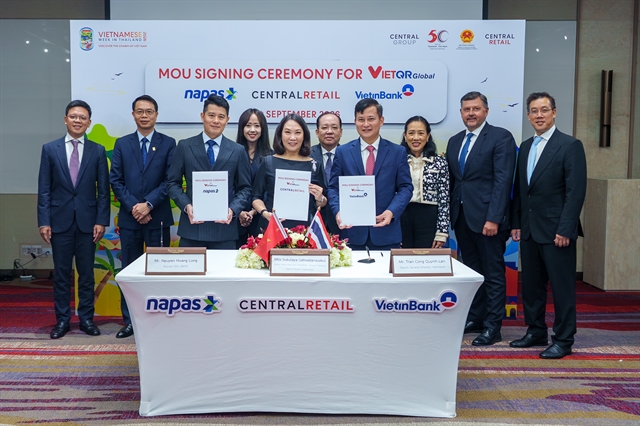 |
| Representatives of NAPAS, Central Retail and VietinBank sign an MOU on VietQRGlobal, a cross-border QR payment service between Việt Nam and Thailand, in Bangkok on September 17. — Photo courtesy of Central Retail Vietnam |
From showcasing products to securing market access
The more significant change, however, lies in the way Vietnamese businesses are approaching the Thai market.
At this year’s event, B2B meetings have been organised between 58 Vietnamese businesses and Central Group’s purchasing teams, including buyers from Tops and Central Food Hall, as well as other Thai importers, distributors and retailers.
Central Retail CEO Olivier Langlet said Vietnamese Week was designed not simply to sell products in Thailand but to expose Vietnamese businesses to an international market and give them direct feedback from consumers and buyers.
“For the past 10 years, more than 1,000 small companies joined us during this journey,” he said, adding that the programme had generated more than one million consumer interactions and more than 50 business matchings with Central Retail companies in Thailand.
The experience of Vietnamese exhibitors shows why such direct market exposure matters.
Quách Thị Vân Anh, commercial director for domestic and international markets at Sinh Dược Cooperative, a herbal and traditional handicraft producer in Ninh Bình, said the event marked the group’s first international trade fair after 10 years of developing its products.
During B2B meetings, Thai buyers showed interest in its natural soap products, particularly their technology, fragrance and pricing. One buyer even returned to the store to purchase more products after the meeting, she told Việt Nam News.
“The most valuable thing is that we can hear customer feedback directly, without going through any other platform.”
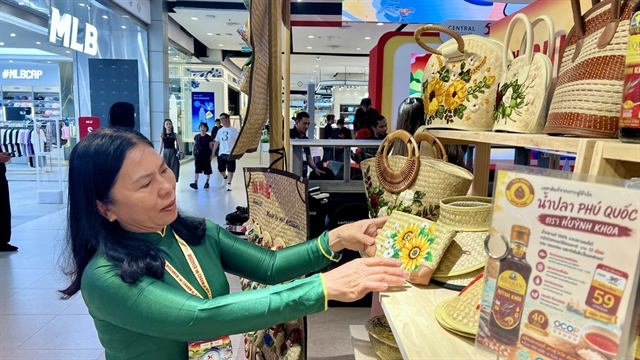 |
| Lê Thị Phương Thảo from a household business in An Giang Province at the event. |
Lê Thị Phương Thảo from a household business in An Giang Province said she did not expect orders to come immediately after initial meetings. The two potential partners she met at the B2B session were not directly looking for her products, but the meetings could still open other doors.
“Not everyone who comes to us is the person we are looking for, but it is still an opportunity. We have to know how to make use of it,” Thảo said.
This was also the first time her business had brought its products directly to the Thai market. Several sedge-grass products, including sandals, mats and handicrafts, attracted some interest from visitors. However, Thảo said it would take more time to assess their potential in the market.
For businesses seeking to export, however, market access does not end with finding a buyer. Product quality, consistency, packaging, certification and the ability to supply over the long term remain critical. — VNS
Economy
 Economy
 Economy
 Economy
 Economy
 Economy
 Economy
 Economy
 Economy
 Economy
 Economy
 Economy
 Economy
 Economy
 Economy