 Society

Drive to Great: BAIC FOTON Africa Partners Conference Set to Open
1.
|
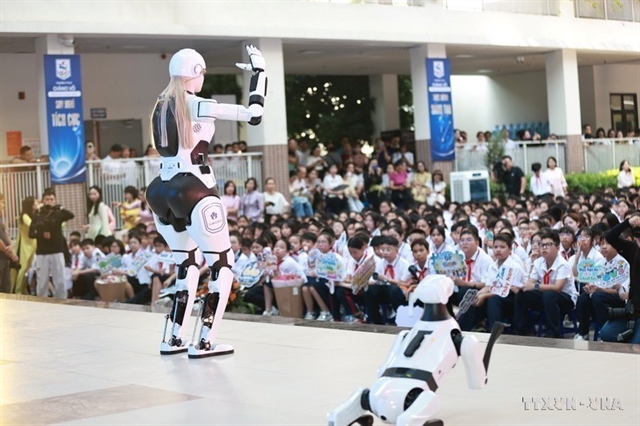
| Students at Giảng Võ Secondary School in Hà Nội take part in a special interaction with humanoid AI robots named “AIMOGA” on August, 2026. VNA/VNS Photo Thanh Tùng |
HÀ NỘI — Việt Nam wants international cooperation in education to focus on jointly developing and testing solutions tailored to the country’s needs in the digital era, rather than simply adopting foreign models and technologies, according to Nguyễn Thu Thủy, Director General of the Department of International Cooperation at the Ministry of Education and Training.
She made the remarks ahead of the International Conference on Education Cooperation in the Digital Era, to be held in Hà Nội on October 8-9. The event will bring together more than 800 delegates from 40 countries and territories to discuss digital transformation, artificial intelligence (AI) and international cooperation in education.
The conference comes as digital technologies and AI rapidly reshape education, expanding access to knowledge, supporting personalised learning and opening up new opportunities to improve teaching and management.
At the same time, the wider use of technology has raised concerns over the quality and reliability of information, ethics, copyright, data security and the digital divide.
Thủy said the conference forms part of efforts to implement the Politburo’s Resolution 57 on science and technology, innovation and digital transformation in education and training.
It is also expected to strengthen links between Vietnamese educational institutions and their international counterparts, while creating opportunities to share innovative approaches, technologies and models for teaching, learning and education management.
Building capacity to work with AI
Thủy said international experience would be particularly valuable in several areas, including the development of an integrated, secure and interoperable education data ecosystem, and the adoption of technologies and AI applications that address specific educational needs.
Equally important, she said, is equipping people with the capacity to work effectively in a rapidly changing technological environment.
|
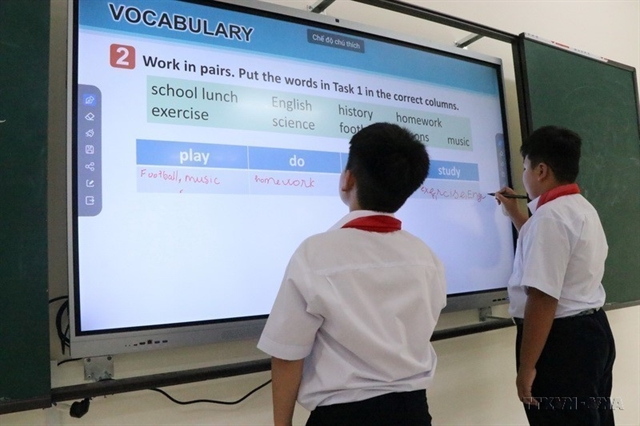
| Students at Buôn Đôn Ethnic Minority Primary and Lower Secondary Boarding School in the border commune of Buôn Đôn, Đắk Lắk Province, use smart teaching equipment during a class in September 2026. VNA/VNS Photo Nguyễn Dung |
For learners, this means strengthening independent and critical thinking, creativity, and the ability to use AI as a tool without becoming dependent on it or allowing technology to replace human thought.
“Learners need to be able to access, use and gradually master technology proactively,” she said.
For teachers, AI can support more effective teaching, deepen their understanding of learners and free up more room for creativity. However, Thủy stressed that teachers would continue to play an essential role in creating knowledge, inspiring students and guiding their learning.
For educational institutions, digital transformation should not simply mean adding technology to existing models. It should also drive changes in teaching methods, learning environments and the organisation of teaching and learning.
Thủy highlighted the potential for closer integration of face-to-face and online learning, as well as stronger links between schools, businesses, research institutions and the wider community.
At the management level, she said international experience in data-driven governance, quality standards, learning outcomes and accountability would also be valuable.
At the same time, innovation must be allowed to develop through appropriately controlled experimentation, while safeguarding quality, equity, data security, ethical standards and learners’ rights.
From sharing experience to joint solutions
The education exhibition, held alongside the conference, is expected to give Vietnamese institutions opportunities to connect with international partners and explore new knowledge, technologies and education models.
Thủy said these connections could lead to more substantive cooperation in training, research, technology development and the testing of new education solutions.
Potential areas include education data governance and use; AI applications in teaching, assessment and management; digital and AI skills for teachers; and the development of safe and responsible AI standards.
Universities, international organisations, technology companies and researchers could also collaborate on joint research, pilot projects and innovation initiatives.
|
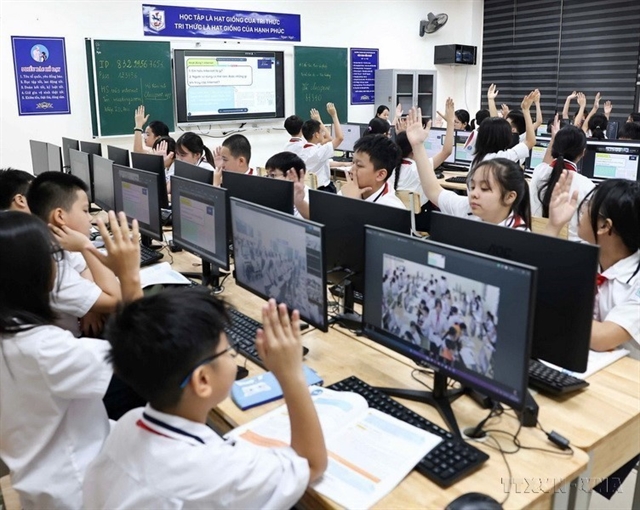
| Students at the main site of Giảng Võ Secondary School in Hà Nội enthusiastically interact with students at satellite sites at Đại Xuyên and Phú Nghĩa A lower secondary schools in Hà Nội in September, 2026. VNA/VNS Photo Thanh Tùng |
“Việt Nam wants to access the world’s knowledge, technologies and proven models, but cooperation should not stop at adopting existing solutions. Through these connections, partners can jointly research, develop and test solutions better suited to Việt Nam’s real-world conditions,” Thủy said.
She added that cooperation should ultimately respond to practical needs, helping to improve education quality, strengthen research capacity and build the digital capabilities of teachers, education managers and learners.
Global partners, local priorities
The two-day conference will bring together representatives from universities, educational organisations and technology companies from Việt Nam and abroad.
Major international companies and educational institutions, including Qualcomm, Boeing, Google, Meta, Amazon, Microsoft, Intel, Cambridge and Oxford, are among the participating organisations.
Discussions will cover digital transformation in general and higher education; digital ecosystems in vocational education; online learning; open educational resources; recognition of qualifications; and smart education management.
AI, big data and other emerging technologies will be examined in relation to personalised learning, teaching effectiveness and the development of learners’ digital capabilities.
The conference will also address quality assurance and accreditation, as well as the development of a flexible education system capable of adapting to technological and labour-market changes.
Alongside the discussions, participating agencies, educational institutions and businesses are expected to sign agreements and memoranda of understanding, creating opportunities for cooperation in training, research and technology transfer.
For Việt Nam, Thủy said, the longer-term goal is to turn international connections into practical partnerships that contribute not only to the country’s digital transformation but also to the development of education solutions that can be shared beyond its borders. — VNS
Society
 Society
.jpg) Society
Society
 Society
 Society
 Society
 Society
 Society
 Society
 Society
 Society
 Society
 Society
 Society
 Society