 Society

Drive to Great: BAIC FOTON Africa Partners Conference Set to Open
1.
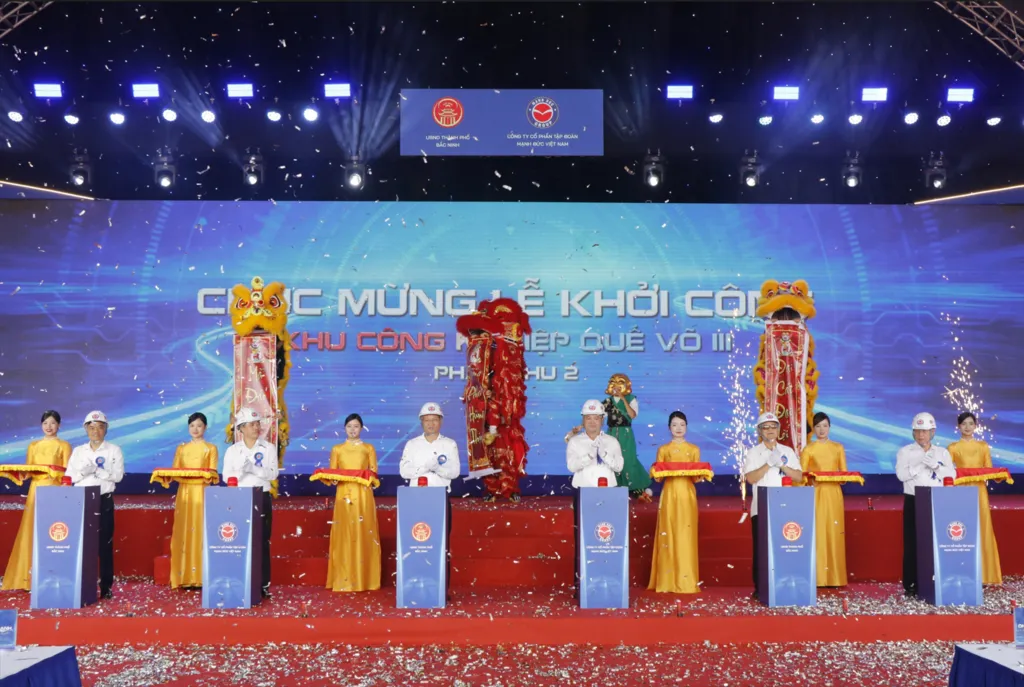 |
| The groundbreaking ceremony for the sub-zone 2 of Quế Võ III Industrial Park in Quế Võ Ward, Bắc Ninh City. — Photos courtesy of Bắc Ninh City's Department of Culture, Sports and Tourism |
BẮC NINH — The city of Bắc Ninh will focus on attracting investment resources and expanding its industrial development space in the coming period, according to Mai Sơn, vice chairman of the city’s People’s Committee.
Bắc Ninh aims to become a leading national and regional hub for the electronics industry by 2030, with a particular focus on semiconductors, microchip manufacturing and artificial intelligence (AI).
By 2040, the city envisions a balanced economy featuring high-tech industries alongside regional-standard logistics and services. By 2050, Bắc Ninh aims to become a highly liveable city meeting Asian standards, making significant contributions to the national strategic vision and serving as a model for an economy driven by digital, green and circular principles.
The master plan for Bắc Ninh through 2050 outlines a multi-polar, multi-centre urban development model that leverages the area’s distinctive natural landscape. The city will be organised into three development zones, four corridors along strategic transport axes and ring roads, and six dynamic central clusters.
Industrial zones are planned to cover about 25,000 hectares, with investment priorities shifting from processing and assembly towards semiconductors, microchips, AI, drones, aviation, and research and development (R&D). Existing zones will be transformed into eco-industrial parks and next-generation integrated industrial, urban and service complexes.
Industrial clusters will cover about 6,000-6,500 hectares and gradually transition to a green industrial-cluster model, with centralised wastewater treatment and automated monitoring systems. Investment priority will be given to supporting industries, precision engineering and the deep processing of agricultural products.
Each area in the city will have a strategic development priority. Yên Phong, Quế Võ and Việt Yên will focus on electronics, high-tech industries and large-scale industrial logistics; Gia Thuận will develop high-tech industries, aviation logistics and aviation services; Lạng Giang-Lục Nam will focus on green and supporting industries; while Hiệp Hòa and Tân Yên-Yên Thế will develop clean and supporting industries.
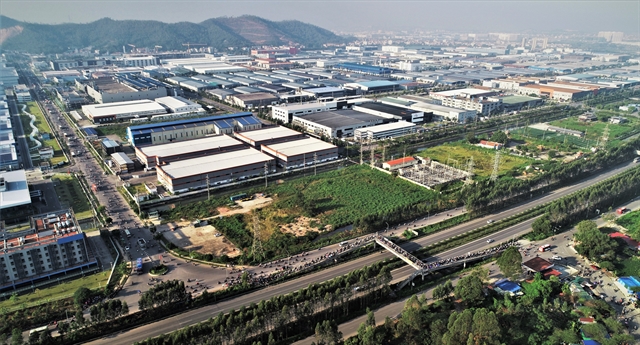 |
| Vân Trung Industrial Park in Bắc Ninh City, which focuses on electronic production, high-tech, mechanical engineering and industrial equipment manufacturing. |
The city underwent significant changes in the first nine months of the year in spatial planning, the expansion of its administrative boundaries, and the completion of requirements to operate as a centrally governed city.
It focused on planning, land banking and infrastructure development for industrial zones and clusters, aligning these efforts with a strategy of selective investment attraction.
To date, 72 industrial zones covering a total area of 21,519 hectares have been planned in the city. Of these, 39 have received approval in principle or been officially established, covering 11,903 hectares and recording an occupancy rate of about 52 per cent.
Total investment capital attracted to the city in the first nine months exceeded US$18 billion, comprising 419 newly licensed projects and 308 projects with adjusted capital. The foreign direct investment (FDI) sector continued to play a pivotal role in industrial development, exports and integration into global value chains.
The city’s industrial production value in the first nine months was estimated at VNĐ2.55 quadrillion, or about US$100 billion, representing a year-on-year increase of 20.81 per cent. Key growth drivers included electronics, component manufacturing, high-tech industries and supporting industries.
These results reflect the stability and expansion of the business sector, particularly among major corporations and FDI enterprises operating in the area, while reaffirming Bắc Ninh’s position as a vital hub for industrial and electronics manufacturing in regional and global supply chains.
Kim Sung Hun, general director of Amkor Technology Vietnam Co., Ltd., said: “We chose Bắc Ninh because it has established an electronics manufacturing ecosystem, comprehensive industrial park infrastructure, an abundant workforce and convenient connectivity to global supply chains.
“These are crucial conditions for Amkor to develop advanced semiconductor packaging and testing operations while expanding cooperation with domestic enterprises and suppliers.”
Na Ki Hong, general director of Samsung Vietnam, said: “Bắc Ninh’s transition to a centrally governed city represents not merely an administrative change but also the dawn of a new development phase for the business community.
“As investment in strategic infrastructure, including inter-regional transport, logistics, digital infrastructure, high-tech industrial ecosystems and innovation hubs, is accelerated, FDI enterprises in the technology sector, such as Samsung, will have further opportunities to improve production efficiency and strengthen research and development activities,” he added.
“We expect to attract more high-quality talent while strengthening ties with universities, research institutes and local partner enterprises that supply components and materials,” Hong said.
Hoàng Anh Tuấn, deputy director of the Bắc Ninh Department of Industry and Trade, said the department would continue to collaborate with Samsung to replicate the smart-factory improvement model.
“Together with experts, we aim to elevate factory management beyond mere automation to ensure compliance with updated criteria and standards,” he said. “Once products meet these requirements, they can enter global markets and become Tier 1 suppliers to foreign corporations.” — VNS
Society
 Society
.jpg) Society
Society
 Society
 Society
 Society
 Society
 Society
 Society
 Society
 Society
 Society
 Society
 Society
 Society